
We’ve reached the 10-percent mark of the 2026 season and the Minnesota Twins have been … surprisingly competitive. Downright decent, even.
It certainly hasn’t always been pretty, as the Twins lost their opening three series, but they’ve since pulled off a shocking four-game sweep of the preseason division favorite Detroit Tigers and won a road matchup against the reigning American League champion Toronto Blue Jays.
Despite starting 3-6, manager Derek Shelton’s club has outperformed low expectations thus far with a 9-7 record that’s tied for the Twins’ fourth-best through 10 percent of a season in the Target Field era (since 2010).
Let’s break the Twins down into a team’s five core elements — hitting, base running, fielding, starting pitching, relief pitching — and take a deeper look at where things stand.
Hitting
As a whole, the Twins’ lineup has hit .225/.328/.366 through 16 games. That may not look like much, but the .694 OPS is above the MLB average of .689 as early season weather favors pitchers. They’ve scored 4.9 runs per game, solidly above the league-wide average of 4.3 runs.
If anything, it’s remarkable the Twins’ lineup has been above average while facing an endless stream of left-handed starting pitchers and receiving very little production from Byron Buxton and Luke Keaschall, who lead the team in plate appearances while collectively hitting .198 with a .540 OPS.
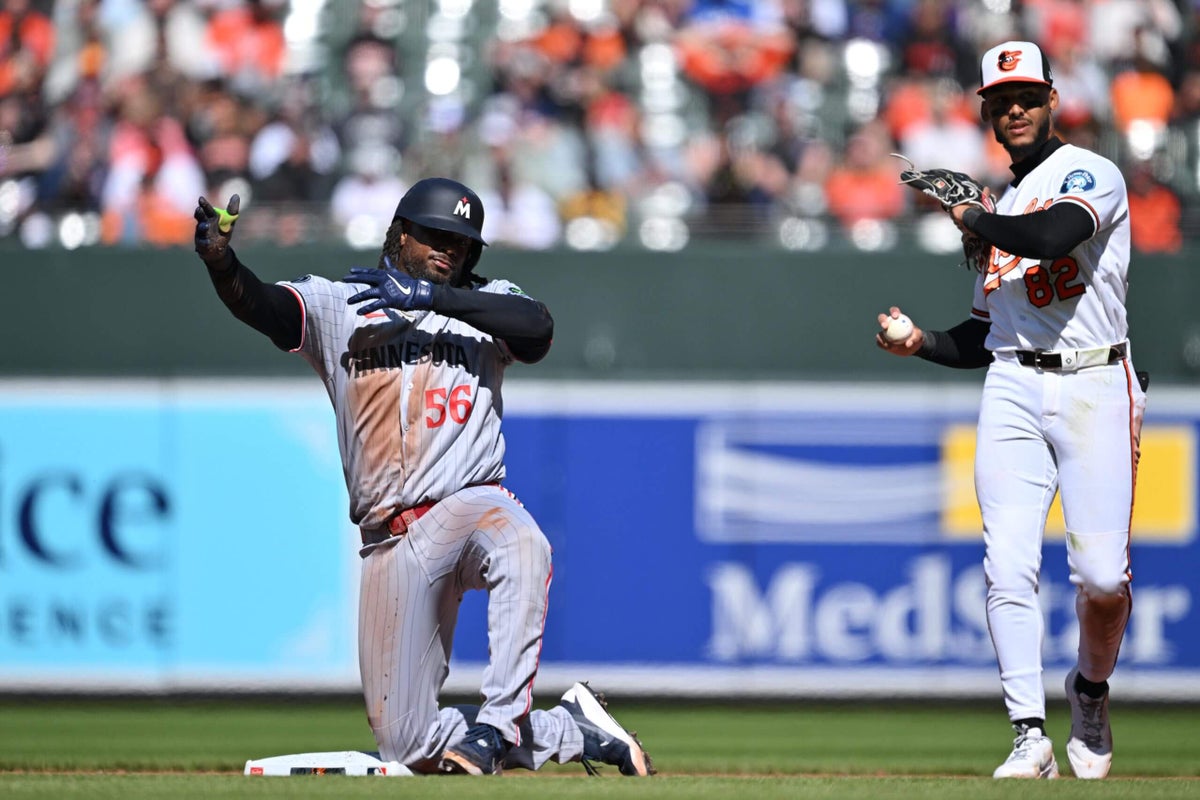
Free-agent pickup Josh Bell has been excellent, hitting .275 with a .926 OPS while leading the Twins in runs scored (14) and driven in (12). Ryan Jeffers has hit .270 with an .805 OPS while getting a larger share of catching duties with 10 of 16 starts behind the plate.
Trevor Larnach has been locked in with an .856 OPS despite logging just 34 plate appearances due to the lefty-heavy early schedule. Larnach’s platoon partner, Austin Martin, has feasted on all those lefties, batting .300 with 10 walks and a .500 on-base percentage in 42 plate appearances.
Royce Lewis got off to a nice start at the bottom of the lineup, popping two early homers and drawing a bunch of walks for an .822 OPS, but a sprained left knee has put that on hold. Lewis’ injury opens the door for Tristan Gray to get a bigger shot after quickly approaching cult hero status with 11 RBIs.
Overall, the Twins’ bats have been above average, with some boom-or-bust tendencies. They’ve been held to one run four times, but have also scored seven or more runs six times. Walk-drawing has been a team-wide strength, but they’ve also struck out often and hit a lot of weak fly balls.
Base running
Thanks to top-10 rankings in walk rate and on-base percentage, the Twins have had plenty of base runners and plenty of chances to follow through on promises of more aggressive base running. It’s been a mixed bag so far, with more chances taken and more outs made.
Continuing a trend from last August and September under former manager Rocco Baldelli, the Twins have attempted 18 stolen bases through 16 games, ninth in MLB. That’s a big change. However, they also have a poor success rate of 67 percent thanks to an AL-high six caught stealings.
There’s a lot more to base running than base stealing, but it’s been a similar story there as well. Shelton indeed has the Twins running aggressively with the 12th-most attempts to take an extra base (not counting steals), but they have also made five outs on the bases.
It’s played out largely as anticipated for a team that wants to run more aggressively, but didn’t actually make any moves to add speed to the roster during the offseason. Last season, the Twins ranked 25th in average team-wide sprint speed. This season, they rank 23rd.
There have been more highs and more lows on the bases, and it’s made for a more interesting viewing experience, but the end result is the same. Last year, the station-to-station approach led to a net total of zero runs added on the bases. This season, running more, they’ve also netted zero runs added on the bases.
Fielding
Defense projected to be a major weakness for the Twins this season, and it has been. They’re dead last in MLB with negative-11 Defensive Runs Saved and tied for last with negative-7 fielding runs above average. And in breaking those overall numbers down by position, it’s clear the infield is the problem.
Statcast’s fielding metrics assess the Twins’ outfielders as one run above average thanks to Buxton and Martin. And the Twins’ catchers check in at one run below average, a number that jumps solidly into positive territory if accounting for Jeffers’ mastery of ABS challenges.
Meanwhile, the Twins’ infield is collectively seven runs below average, and specifically the left side of Brooks Lee at shortstop and Lewis at third base is a combined six runs below average. And the Twins have an extreme fly-ball pitching staff, so the infield hasn’t even gotten that many chances.
Lee’s limited range and arm strength are well documented, but his failure to make several routine plays is surprising. At third base, the strides Lewis made last year were mostly missing prior to his injury, although he wasn’t helped by the revolving door of first basemen struggling to scoop throws.
Buxton remains a quality center fielder, and Martin is solid in left field, but none of the Twins’ other regulars are strong defenders, and several are well below average. It’s a problem magnified by the low-strikeout pitching staff, and unlikely to be solved without moving Lee and/or calling up prospects.
Starting pitching
All offseason, the Twins touted their starting rotation as a strength, only to lose Pablo López to a season-ending elbow injury on the first day of spring training. Yet despite being down López and David Festa, the Twins’ starting pitching is the biggest reason for their surprising 9-7 record.
Twins starters have thrown the 11th-most innings out of 30 teams and rank No. 9 with a 3.50 ERA. Most of that is due to Taj Bradley having a 1.25 ERA and 29-to-8 strikeout-to-walk ratio in 21 2/3 innings. Taking out Bradley, the rest of the rotation has a 4.30 ERA in 12 starts, which would rank 21st.
Shaky infielders haven’t hurt the Twins’ starters that much because they’ve induced an MLB-low 31 percent ground balls. No other rotation is below 35 percent, and the MLB average is 43 percent. In general, fly balls are turned into outs more often than grounders, and it’s especially true with the Twins.
Home runs are the main negative that comes with fly balls, and the Twins’ starters have allowed just five in 82 1/3 innings, an unsustainably low total. They’ve allowed a homer on just 4.5 percent of fly balls, the second-lowest rate out of 30 teams and less than half of the 9.5-percent MLB average.
Eventually, a lot more of those fly balls will go over fences, especially as the weather warms up. When they do, the Twins’ rotation may be in danger of regressing quite a bit. Looking past ERA, which is heavily driven by homers, Twins starters rank 22nd in strikeout rate, 20th in xERA and 25th in xFIP.
The biggest concern is Bailey Ober, whose velocity has gone missing since hip problems last spring. Ober’s fastball has averaged 88.6 mph, the lowest in MLB for a starter, and down from 90.3 mph in 2025 and 91.7 mph in 2024. He’s struck out just seven of 59 batters faced, a very fine needle to thread.
Relief pitching
So far, the projections have been right about the Twins’ bullpen being well below average, although it’s also fair to say their relievers have been closer to competency than catastrophe. They rank 24th out of 30 teams with a 5.15 ERA and have a neutral-ish Win Probability Added, ranking 18th.
Digging a little deeper, if Mick Abel’s five-run piggyback start on March 29 is removed from the bullpen’s tally, the traditional relievers would improve to 22nd in ERA and 15th in WPA. They’ve been … fine. And given the front office’s lack of investment in bullpen help, that’s better than expected.
That said, there are some red flags that suggest even maintaining this mediocre bullpen work may be tough. Twins relievers rank 27th in strikeout rate, 24th in strikeout-to-walk ratio, 25th in xERA and 28th in xFIP. They’re also 29th in average fastball velocity, which shows the real issue.
League-wide velocity has skyrocketed to the point that the average fastball thrown by a reliever is 94.5 mph. Twins relievers have averaged an AL-low 92.6 mph, and every one of the nine traditional relievers they’ve used this season has below-average velocity. In fact, no one is above 93.6 mph.
Shelton has clearly tried to pull as many strings as possible, and his mixing and matching without set bullpen roles has produced better-than-projected early results, if only slightly. But the underlying numbers and league-worst velocity suggest the bullpen simply lacks the necessary firepower. For now.