
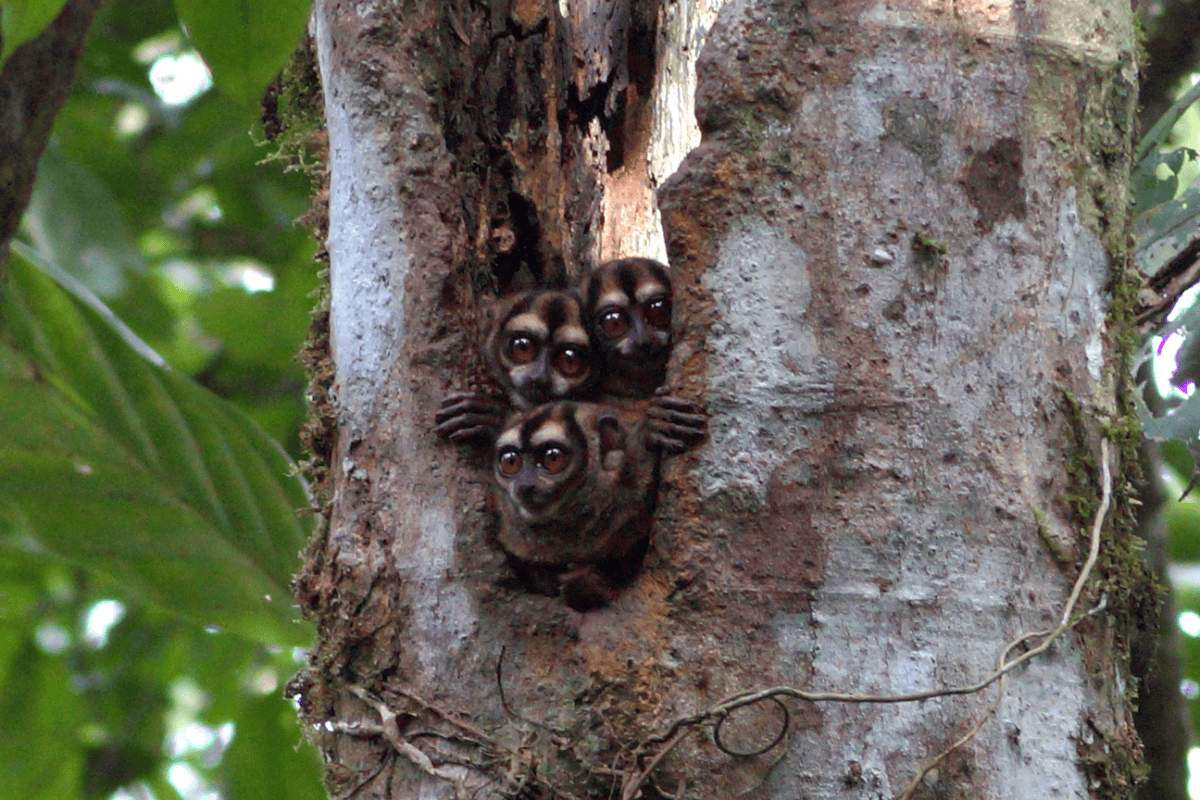
A new study looks at genetic evidence to suggest that Colombia’s Magdalena River, and not the Andean massif, may be the true boundary separating two near-identical species of nocturnal primates.Night monkeys from the genus Aotus, the only nocturnal primates in the Americas, have remained largely invisible to both the public and the scientific community, says the study’s main author.Experts in the field say this discovery could fundamentally reshape national conservation maps and protection strategies for night monkeys.
See All Key Ideas
One night, 10-year-old Sebastián Montilla heard a creature moving over a tree branch on his father’s farm in Pijao, Quindío department, one of Colombia’s renowned coffee-growing regions. As he pointed a lantern up to the canopy, he saw a wild creature with big red eyes and a long tail watching him before moving away from the light. It was a night monkey, from the genus Aotus. This brief encounter would decide Montilla’s path.
“I became very passionate about those animals, in fact, when I was in school, my favorite pastime was to go outside and lie down under their sleeping place, to watch them do nothing,” Montilla, now a doctoral student in biological sciences at the University of the Andes in Bogotá, told Mongabay in a video call.
“I’m very surprised by the fact that [night monkeys] have gone unnoticed for so long, both in the scientific community and in the public sphere,” he added. “It’s astonishing because at midnight they are moving right past our houses and we don’t even notice.”
Night monkeys, also known as owl monkeys, are the only primate group in the Americas that have adapted to be active at night. These monkeys have evolved enormous round eyes with retinas 50% bigger than those of daytime-active primates to better capture the scarce light available in their environments. Unlike other nocturnal primate species in Asia and Africa, such as lorises (family Lorisidae), tarsiers (Tarsiidae) and lemurs (Lemuroidae), which tend to be solitary, night monkeys form lifelong monogamous pairs, raising one to three offspring at the same time. Most of what we know about the reproduction and behavior of these primates comes from biomedical laboratories and zoos that held night monkeys in captivity. The difficulty of following these monkeys in the dark has made them almost impossible to study in the wild.
Montilla said he became obsessed with knowing everything about night monkeys, and to his surprise found there wasn’t that much in the existing literature. This gap led him to become a biologist and now a leading expert on night monkeys. Over almost two decades, he has followed these monkeys through the nights and discovered differences in activity patterns depending on the moonlight and the places where they prefer to live. He has assessed their diet, reported the first case of albinism in a night monkey, and helped create the first management plan for the conservation of the Andean night monkey (Aotus lemurinus) in Quindío.
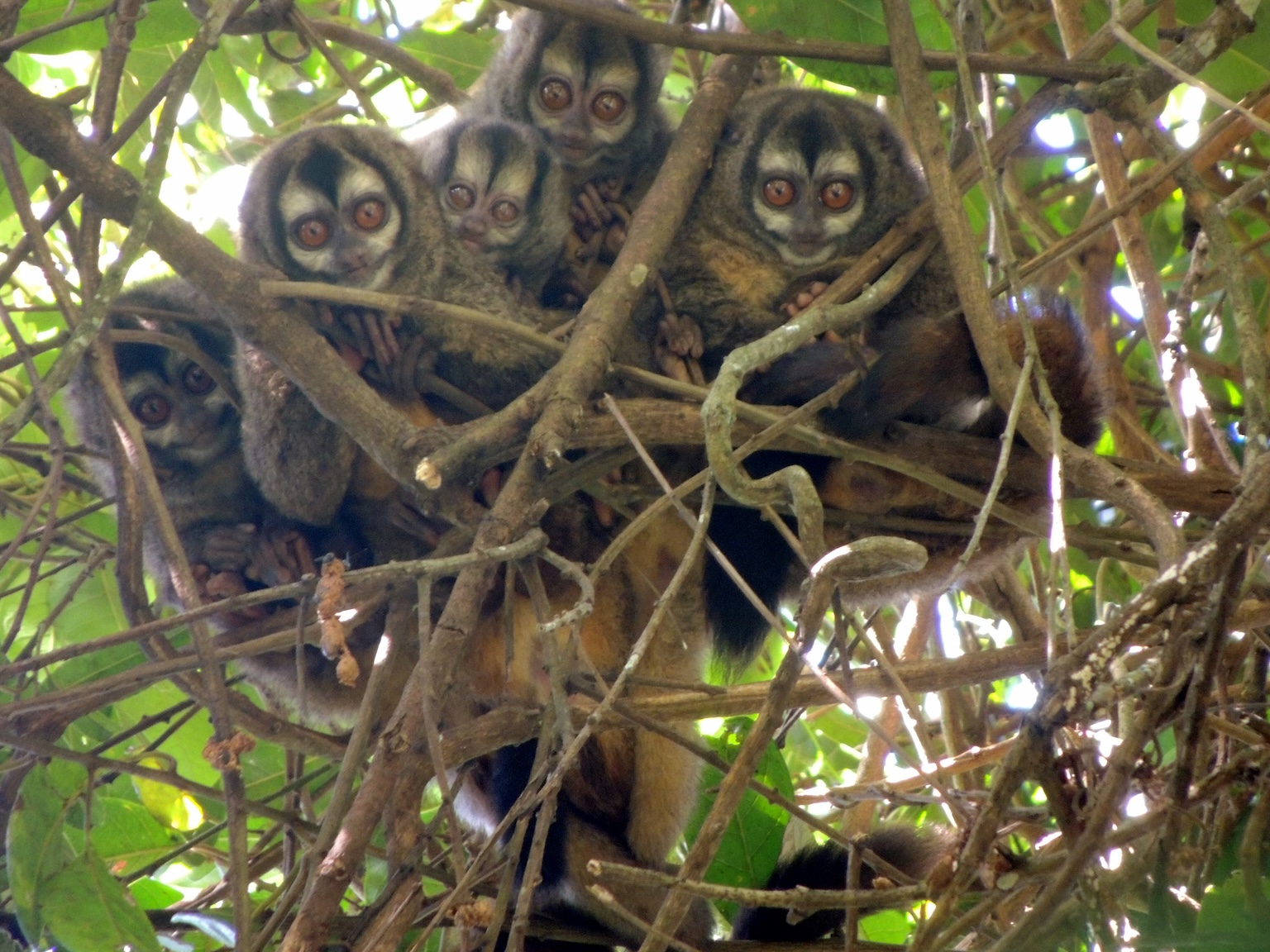 Night monkeys are an example of cryptic species, which are genetically different but almost indistinguishable physically. Image courtesy of Sebastian Montilla.
Montilla recently published a study in the International Journal of Primatology that suggests it’s the Magdalena River, and not the Andean massif, that could be the true barrier separating two identical-looking night monkey species on the border of the departments of Antioquia and Santander. That finding could shift conservation approaches for the five species of night monkeys found in Colombia, which are losing habitat to cattle ranching, oil palm plantations and mining, and are traded as pets.
Identifying night monkey species is a challenge for taxonomists. Widely distributed from Panama to northern Argentina, the monkeys are all visually almost indistinguishable.
“They are complex twin species. A night monkey in the Amazon, in the Caribbean, [and] in the Andes looks exactly the same,” Montilla told Mongabay.
Night monkeys are an example of cryptic species, which are genetically different but almost indistinguishable physically. Natural barriers such as rivers, mountains and deserts isolate the species, limiting their dispersal and giving rise to multiple taxa. This is a phenomenon that’s been seen in amphibians, bats, birds and other nocturnal primate species; the most iconic cryptic species example is Astraptes fulgerator, a skipper butterfly that turned out to be not one, but 10 different species.
In 2010, biologists trying to identify the habitat limits for each species of night monkey suggested a natural barrier at 1,000 meters (about 3,300 feet) in the central and eastern Andes. Under this hypothesis, the night monkeys found in Colombia’s north and the Magdalena Valley would fall under the species Aotus griseimembra; in the Pacific lowlands, they would be Aotus zonalis; and above 1,000 meters, Aotus lemurinus. That would mean both A. griseimembra and A. lemurinus could be found on either side of the Magdalena River, with the monkeys’ hair the only physical trait setting them apart: those in the mountains are hairier than those in the lowlands.
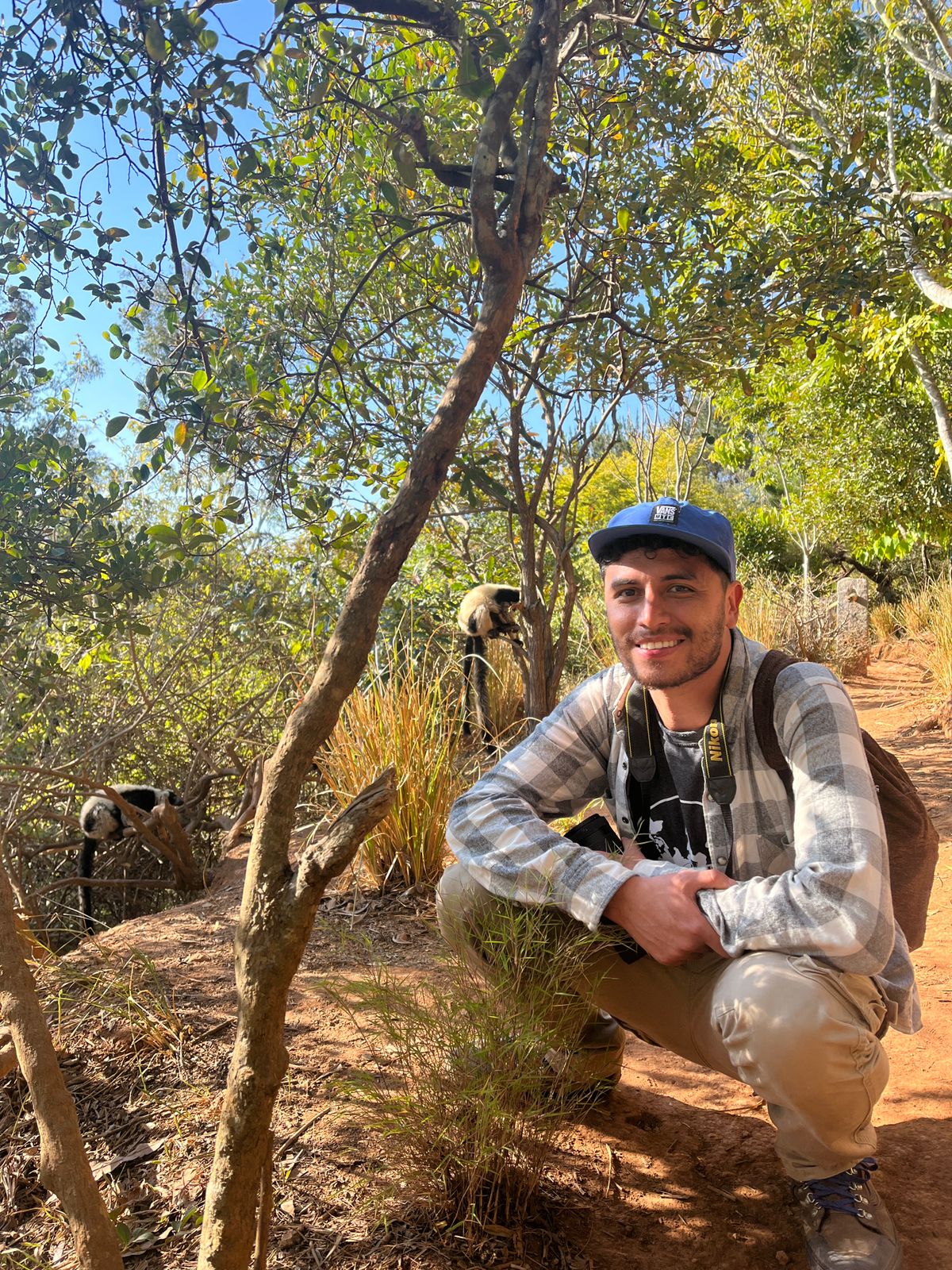 Sebastian Montilla has been passionate about studying night monkeys since early childhood. Image courtesy of Sebastian Montilla.
“It’s a bit ambiguous to think that there’s an imaginary line at 1,000 meters, and that a monkey above 1,000 meters is going to say, ‘Oh no, I’m not going to go past 999 meters,’” Montilla said. “So there was always this thought that there might be more out there.”
Not convinced by this hypothesis, Montilla has dedicated his doctoral studies to researching how night monkeys are genetically distributed throughout Colombia. Between 2022 and 2025, he followed night monkeys every night, collecting droppings and extracting DNA from 92 different locations across the country.
To his surprise, the results showed that in the middle Magdalena Valley, two groups of monkeys belonging to the same species, A. griseimembra, and living just 100 m (330 ft) apart, were genetically very different. Notably, they were separated by the Magdalena River. Montilla found that the pattern repeated itself several times in the upper and middle sections of the Magdalena Valley, indicating that the river, rather than the mountains, played the central role in limiting the dispersal and connectivity of night monkey populations.
Emerging at an elevation of almost 3,700 m (12,100 ft) in the Paramo de las Papas, in Popayán, Cauca department, the Magdalena River is perhaps Colombia’s most important waterway. It flows some 1,540 kilometers (957 miles) and carries on average more than 8,000 cubic meters (2.1 million gallons) of water per second until it reaches the Atlantic Ocean at Bocas de Ceniza.
The river is not only a historic route for human settlements, culture, economic development and transport between the Andes and the Caribbean. It’s also a richly biodiverse wildlife corridor, home to more than 120 fish, 630 bird, 120 reptile and 4,000 plant species. The region also hosts endemic and threatened mammals such as the blue-billed curassow (Crax alberti), the brown spider monkey (Ateles hybridus), jaguar (Panthera onca), Magdalena striped catfish (Pseudoplatystoma magdaleniatum), and of course night monkeys.
According to Sebastián García, president of the Colombian Primatological Association (APC), Montilla’s findings open the possibility of redefining the current distribution maps for A. griseimembra and A. lemurinus. “These kinds of research will impact where conservation efforts are located throughout the country,” García told Mongabay by phone.
For García, being able to correctly identify each species and where it lives is crucial for improving action plans to protect wildlife and for initiatives such as Colombia’s National Primate Conservation Program. A set of strategies designed by experts to address the main threats for the country’s 38 primate species, including the five night monkey species, is currently pending approval from the Ministry of Environment and Sustainable Development.
Nonetheless, studies have shown that although knowing the distribution and habitat the limits of a cryptic species is one of the first steps toward protecting it, many conservation action plans fail because cryptic species are not detected or are data-deficient.
“We need these types of studies and more government support that can be applied directly or indirectly to the conservation of primates in our country, because this is one of many primates in Colombia that requires this type of study,” García said.
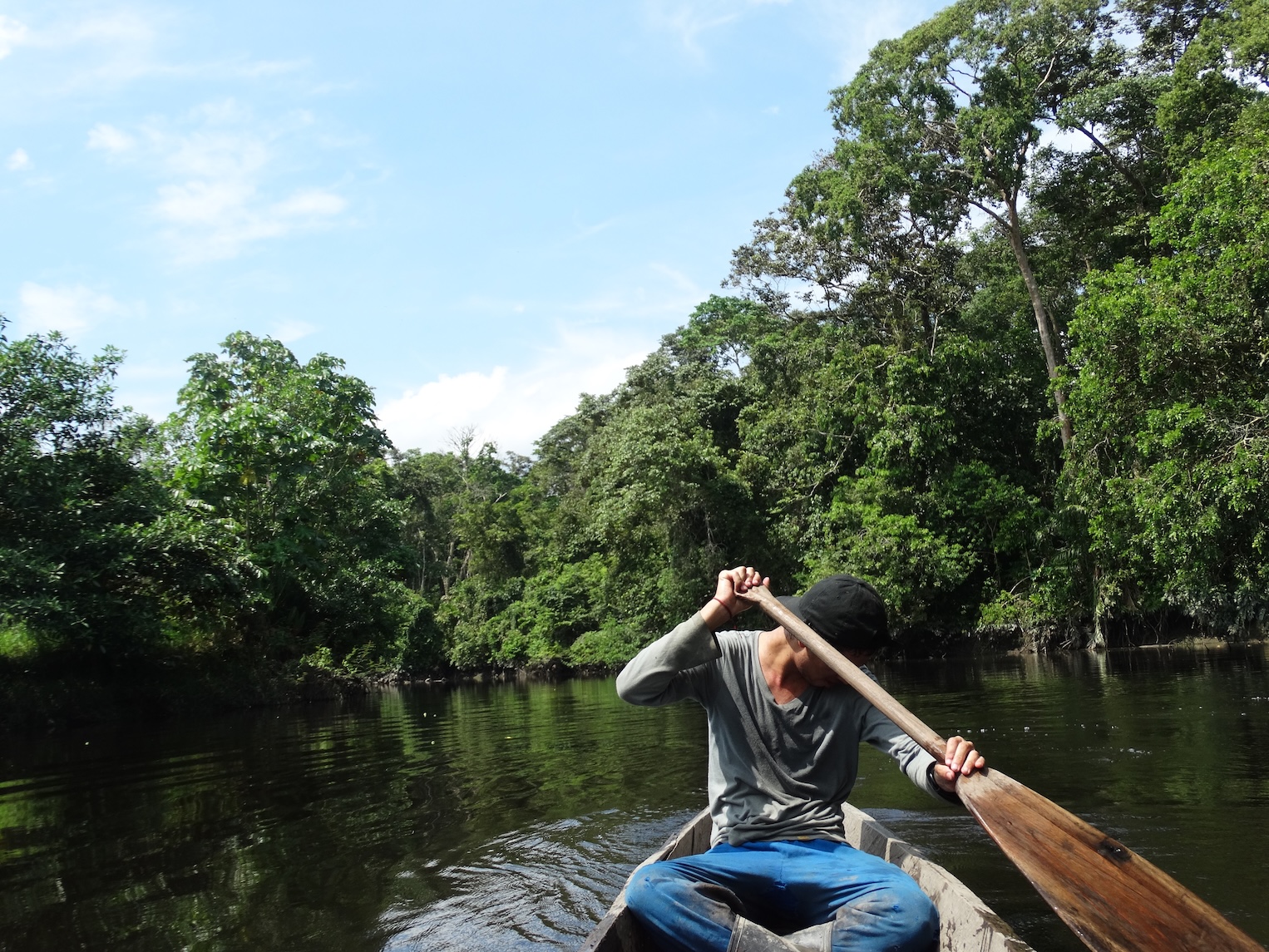 According to Montilla’s research, the Magdalena River, and not the Andean massif, could be the true barrier separating two identical-looking night monkey species on the border of the departments of Antioquia and Santander. Image courtesy of Sebastian Montilla.
“The thing is that since Aotus is strictly nocturnal, it’s very difficult to study,” Eduardo Fernandez-Duque, a professor of anthropology at Yale University in the U.S., who wasn’t involved in the study, told Mongabay by video call.
In the case of night monkeys, there are still many gaps to fill. Many of the night monkey species are data-deficient or listed as vulnerable on the IUCN Red List because there’s no basic information about their population in the wild, social dynamics, reproduction, diet, response to fragmentation, or vulnerability to climate change. For García and other experts in the field, this makes Montilla’s findings a valuable contribution toward filling these knowledge gaps and supporting efforts to protect all night monkey species.
“We conducted a year-long study of Aotus in Ecuador, and it was very difficult,” Fernandez-Duque said. “What our Latin American colleagues are doing is impressive. They’ve accomplished things that, of all the nocturnal Aotus study projects, are undoubtedly the most advanced in Colombia.”
Montilla said he aims to consolidate his findings with more evidence, by comparing the number of chromosomes between species, identifying differences in their vocalizations, and comparing morphological data to establish the genetic and physical differences between the various night monkeys.
This would not only help draw the lines of where these cryptic species are found on each side of the Magdalena River, but also along other large rivers such as the Amazon, Caqueta and Putumayo that could be having the same barrier effect on other groups of night monkeys.
“Only time will tell to what extent that idea withstands the test of time, the scrutiny of other groups, contradictory evidence, and supporting evidence,” Fernandez-Duque said. “That’s what doing science is all about.”
Banner image: Night monkeys (genus Aotus). Image courtesy of Manuel Fonseca.
Citations:
Link, A., Muñoz-Delgado, J., & Montilla, S. O. (2023). Nocturnality and activity budgets of owl monkeys in tropical ecosystems. Developments in Primatology: Progress and Prospects, 353-373. doi:10.1007/978-3-031-13555-2_12
Montilla, S. O., Mopán-Chilito, A. M., Murcia, L. N., Triana, J. D., Ruiz, O. M., Montoya-Cepeda, J., … Link, A. (2021). Activity patterns, diet and home range of night monkeys (Aotus griseimembra and Aotus lemurinus) in tropical lowland and mountain forests of central Colombia. International Journal of Primatology, 42(1), 130-153. doi:10.1007/s10764-020-00192-1
Montilla, S. O., & Link, A. (2022). Albinism in a wild Caribbean night monkey (Aotus griseimembra) in a fragmented landscape in Colombia. Therya Notes, 3, 14-17. doi:10.12933/therya_notes-22-62
Montilla, S. O., Arango-Lozano, J., Toro-Cardona, F. A., Ramírez-Chaves, H. E., Di Fiore, A., & Link, A. (2026). Phylogeography and niche modeling of night monkeys (Aotus) in northwestern South America. International Journal of Primatology. doi:10.1007/s10764-025-00532-z
Hending, D. (2025). Cryptic species conservation: A review. Biological Reviews, 100(1), 258-274. doi:10.1111/brv.13139
Hebert, P. D., Penton, E. H., Burns, J. M., Janzen, D. H., & Hallwachs, W. (2004). Ten species in one: DNA barcoding reveals cryptic species in the neotropical skipper butterfly Astraptes fulgerator. Proceedings of the National Academy of Sciences, 101(41), 14812-14817. doi:10.1073/pnas.0406166101
Wolovich, C. K., Shanee, S., Maldonado, A. M., Méndez‐Carvajal, P. G., Perea‐Rodriguez, J. P., Tabares, S., … Evans, S. (2023). A call‐to‐action to assist in efforts to protect owl monkeys (Aotus spp.). American Journal of Primatology, 86(3). doi:10.1002/ajp.23501
FEEDBACK: Use this form to send a message to the author of this post. If you want to post a public comment, you can do that at the bottom of the page.
