
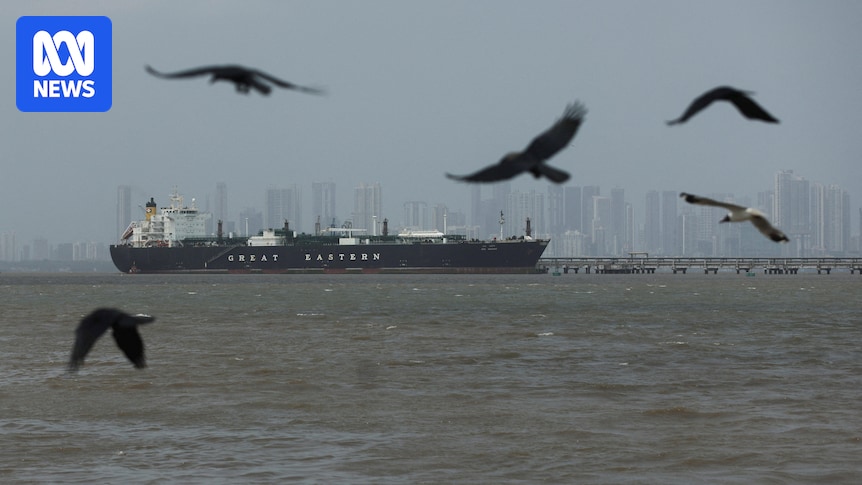
A tense exchange between the United States and Iran in the Persian Gulf shows the extremely fraught situation in the Strait of Hormuz as a fragile ceasefire hangs in the balance.
With thousands of sailors still stuck in the liminal space on either side of the critical waterway, a sailor who has been speaking with the ABC recorded a sudden crackling of the radio over the weekend.
“Engaged in transit passage in accordance with international law,” said the voice with a North American accent.
“No challenge is intended to you, and I intend to abide by rules of our government’s ceasefire. Over.”
An Iranian voice, who shipping crews had become familiar with in recent weeks, replied: “You are heading to the Persian Gulf and it is against Iranian law, so I advise you to alter course, go back to the Indian Ocean immediately.
“Go back to the Indian Ocean immediately. If you don’t obey my orders, I will open fire immediately. Out.”
Iran war live updates: For the latest news on the Middle East crisis, read our blog
The Iranian armed forces then broadcast another message.
“Attention all vessels in the Strait of Hormuz and Persian Gulf. You must clear this area as soon as possible, because we are targeting a US Navy warship in the area.”
Similar warnings have been broadcast to ships in the Strait of Hormuz since the start of the war and even prior to the conflict, according to analysts.
The reply from the US Navy ship indicated it was not backing down.
“I intend to transit through Omani territorial waters and defend my unit if interfered with,” the US naval officer said.
“No challenge is intended to you and I intend to abide by the rules of our government ceasefire.”
The response from the US warship was a “standard response”, said Jennifer Parker, a former director of operations of the Combined Maritime Forces in the US Central Command (CENTCOM).
“That is how the US and, in fact, Australian warships respond when challenged transiting through international borders,” she told the ABC.
Traffic through the Strait of Hormuz has been at an effective standstill since the Islamic Revolutionary Guard Corps (IRGC) launched attacks and made threats on vessels navigating the area.
An average of only seven ships — tankers, bulk carriers and container ships — transited the strait each day from February 28 to April 8 compared to pre-war traffic of more than 130 vessels a day, according to marine data analysed by the ABC.
Many of the vessels allowed to pass did so with the permission of Iran and followed a new route through the waterway, closer to Iran’s coast.
But the tense exchange over the weekend appeared to be further indication that the US military was seeking to transit through the strait to show that it was open to shipping and came as US President Donald Trump said he had instructed the US Navy to commence their own blockade of the waterway.
The US effort will begin at midnight on April 13 AEST.
US claims two warships transited Strait of Hormuz, but Iran denies it
The radio confrontation was over Marine VHF Channel 16, a radio frequency used for international emergencies and safety messages being monitored by ships around the Strait of Hormuz.
It was sent to the ABC at 1pm Gulf Standard Time (GST), just hours before negotiations began between the United States and Iran in Islamabad.
“The Iranian Revolutionary Guard Corps warning is a bit different,” Ms Parker said.
“I haven’t heard them claim on the waters that the Strait of Hormuz brings them under Iranian law, but it is common, and well before this conflict the Iranian Revolutionary Guard Corps Navy would warn and even harass ships, warships going through the Strait of Hormuz.”
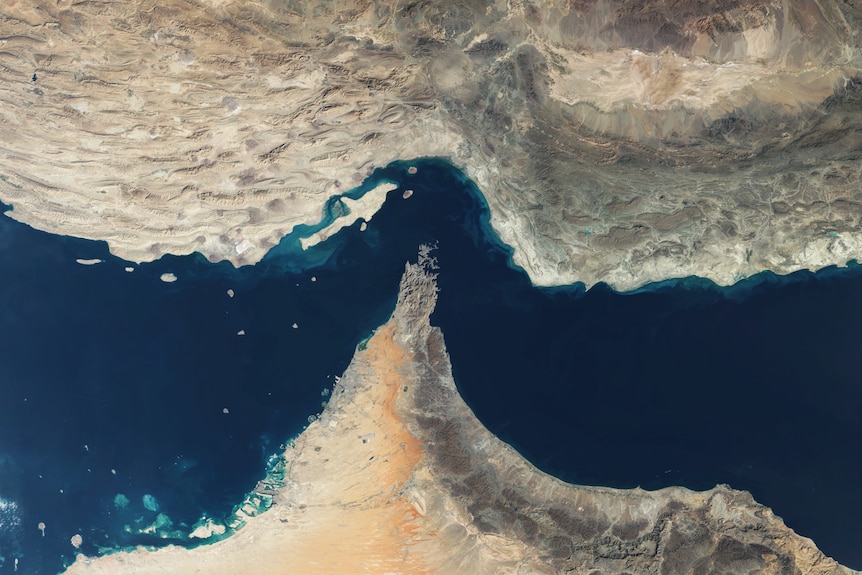
Nearly 20 per cent of all oil and 25 per cent of LNG exports pass through the Strait of Hormuz. (Getty: Gallo Images/Orbital Horizon/Copernicus Sentinel Data)
The narrowest part of the Strait of Hormuz is shared between Oman and Iran as their territorial waters, but the rules of free passage should mean ships are still allowed to transit.
Ms Parker said: “It’s clear that Iran sees it as its leverage in the negotiations with the US.”
The US and Iran are offering competing versions of whether US navy ships have been able to transit the strait.
Marine transponder data showed a “US GOV VESSEL” that was positioned to the west of the Strait of Hormuz at 12:20pm GST.
Late on Saturday night, United States Central Command released a statement on X saying that two Navy guided-missile destroyers had transited the strait to conduct operations.
“USS Frank E. Peterson (DDG 121) and USS Michael Murphy (DDG 112) transited the Strait of Hormuz and operated in the Arabian Gulf as part of a broader mission to ensure the strait is fully clear of sea mines previously laid by Iran’s Islamic Revolutionary Guards Corps.
“The Strait of Hormuz is an international sea passage and an essential trade corridor that supports regional and global economic prosperity.
“Additional US forces, including underwater drones, will join the clearance effort in the coming days.”
The New York Times cited multiple US officials in its report that two American Navy destroyers entered the Strait of Hormuz and destroyed an Iranian surveillance drone approaching one of the ships.
It reported the two Navy ships sailed from the Gulf of Oman before entering the Strait of Hormuz and then turned around.
Iran is disputing that the US Navy ships were able to transit through the strait.
Iranian semi-official news agency Tasnim also reported an “American destroyer from the Port of Fujairah” (in the UAE), “was promptly met with a military response from Iran”.
Tasnim reported that Iranian negotiators raised the issue with the United States delegation through Pakistan’s mediators.
“According to information received, the firm response by the Iranian Armed Forces, together with the warning and follow-up by the negotiating delegation, led to the order to halt the American warship,” the report said.
The battle for control of the Strait of Hormuz
Since the war began on February 28, Iran has maintained a stranglehold of the strait by attacking and threatening ships. It is now charging ships a toll to pass through.
“I think that they’re wanting to exert more dominance over the strait right now because they see this as a leverage point against the US because of some of the international backlash that has occurred [due to] the economic impacts,” Ms Parker said.
“But I think that we’re transitioning now to a phase where you’ll see the US conducting more naval operations in and around the strait to try and demonstrate that Iran does not have control of the strait.”
In an interview with ITV news last week, an Iranian official admitted that mines had been laid in the critical waterway, although some analysts were sceptical of the claims.
“Iran has claimed [the strait has] been mined [but] there’s no evidence to say it has been. The Joint Maritime Information Centre, which was a coalition centre that’s supported by the US, says there’s no confirmation,” Ms Parker said.
“But this is an issue in mining. All you need to do is say that you have mined to deter ships from going through there — whether you have or have not is kind of irrelevant to the impact.”
The New York Times has reported that US intelligence sources believe Iran is now unable to locate the mines.
“If it has been mined, the US will need to clear it, and they are preparing to clear it,” Ms Parkers said.
Sailors still stranded
On Friday, several days after the ceasefire was agreed to, a sailor in the Persian Gulf sent the ABC a radio transmission broadcast from Iran.
“The Strait of Hormuz is closed … if any vessels try to transit through the Strait of Hormuz without our permission, will be destroyed.”
20,000 stranded sailors in the Persian Gulf
The International Maritime Organization said there had been 21 attacks on commercial ships, killing 10 seafarers.
“Around 20,000 civilian seafarers remain aboard vessels in the Persian Gulf, facing dwindling supplies, fatigue and severe psychological stress,” the UN agency said in a statement.
Those sailors have waited more than a month at sea.
One sailor, who we are calling James to protect his identity, said his ship was destined for Japan, but the crews had been in limbo since February 28.
“Hopefully we can go home soon,” he said.
“They said it’s possible to pass, but we need to ask permission from the Iranian Navy … we are ready to move anytime.
“Our internet keeps disappearing and the GPS might be getting jammed.”
He said during the war he and the crew watched as drones and missiles passed through the area where his ship was.
Another sailor, who we are calling Paul, said that his ship had moved further from the strait while they waited for instructions.
“We were able to replenish our supplies … but there’s no good news from the company,” he said.
“The only advice the company gave our captain is to move the ship farther away … there is still no ceasefire.
“We are drifting at sea.”
A new phase of the war
While missiles and drones may have stopped passing over the Strait of Hormuz, Ms Parker said the developments over the weekend signalled that the US was “entering a new phase of this conflict”.
Impact of Trump’s Strait of Hormuz blockade on Iran
On Sunday night Australian time, US President Donald Trump said he had instructed the US Navy to commence its own blockade of the strait, through which about a fifth of global oil and LNG shipments passed.
“As [Iran] promised, they better begin the process of getting this INTERNATIONAL WATERWAY OPEN AND FAST,” Mr Trump wrote on Truth Social.
“Every Law in the book is being violated by them.”
The US president echoed the previous statement by US Central Command, that the US was about to begin work to destroy “the mines the Iranians laid in the Straits”.
“I think that we’re entering a phase now where you’ll see a lot more economic pressure on Iran, which is why the blockade has been announced,” Ms Parker said.
“You’ll see a lot more isolation of Iran. I think that naval blockade will also seek to have countries stop resupplying Iran with weapons or prevent them from [doing so]. And I think and I hope you’ll see more of a focus on reassuring shipping.
“So that will start with some more transits, more operations of US naval assets, mine clearance, information sharing, etc. I think this is the phase that we’re moving into.”
It is not immediately clear what a US blockade of the Strait of Hormuz would look like or what it would involve.
Ms Parker said the US had the capability to do it, but the conflict “was always going to have to end in negotiations”.
“The question is, how do you get Iran to the point where they’re going to negotiate giving away the highly-enriched uranium, limiting the ballistic missile program, etc? Clearly the military objectives that the US have hit … have not gotten them to that point.
“And so the next phase is how do you economically pressure them … to the point of negotiation? That is only how this conflict ends.”