
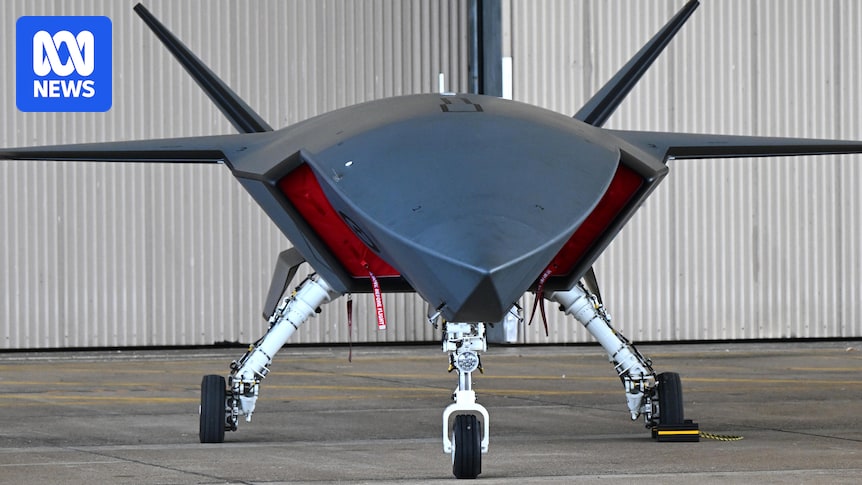
Billions of dollars will be poured into drones as Defence responds to some of the most immediate lessons from recent conflicts.
At least $2 billion in new or redirected funds will be included in Defence’s new Integrated Investment Program (IIP), to be released later this week.
That additional spending will take the total spending on drones over the next decade to at least $12 billion.
ADF confirms navy has capacity to send warship to Iran
It is not yet known what Defence projects will be “reprioritised” to free up the extra money.
Defence Minister Richard Marles will release the IIP and the 2026 National Defence Strategy on Thursday.
Funding will go towards large uncrewed systems such as the Ghost Bat and the Ghost Shark, as well as the development of smaller, cheaper drones.
There is a significant injection of new funds into smaller drones — at least $2.2 billion is to be spent developing smaller, lower-cost options.
Work already underway on counter-drone measures will also be bolstered after recent conflicts highlighted the capacity of cheap, mass-produced drones to drain stocks of expensive interceptors.
Mr Marles says the Ukraine and Iran conflicts have illustrated the need for a greater focus on drone technology.
“Over the past two years conflicts overseas have shown just how important drones and uncrewed systems are for our defence force,” he said.
“The war in Ukraine and conflicts in the Middle East underscore the rapid advancements in these technologies, and the ability for these systems to generate significant asymmetric advantage against larger, more expensive platforms.”
Lessons from abroad
Drone warfare has been a dominant feature of the war in Ukraine and the US-Iran conflict.
Iran’s use of cheap, mass-produced drones to target countries such as the United Arab Emirates and Qatar has been particularly noted.
Thousands of long-range Shahed drones have been fired from Iran, forcing the US and UAE to intercept them with missiles often worth millions of dollars.
Defence analysts have argued there needs to be significant efforts poured into working out how to defend sensitive military sites in Australia from drone attacks.
$30K drone reshapes how Australia views future wars
The government has also been focusing efforts on developing local expertise in larger drones such as the Ghost Shark and Ghost Bat, with an eye to potential export opportunities.
The Ghost Bat, developed by Boeing Australia, is designed to fly alongside crewed aircraft such as F-35 fighter jets and late last year successfully fired at an aerial target in testing.
The German government has expressed a strong interest in acquiring the Ghost Bat for its armed forces.
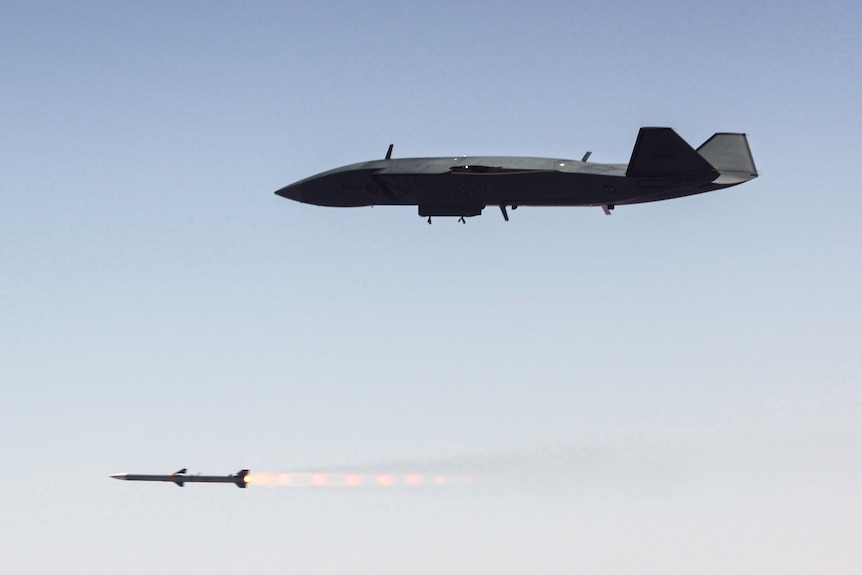
The Ghost Bat is designed to operate alongside crewed aircraft. (Supplied: Department of Defence)
Mr Marles said drones such as the Ghost Bat and Ghost Shark had become significant features of Australia’s defence industry.
“Expanding our fleet of autonomous and uncrewed systems across all domains will not only help the ADF keep our nation safe, but will boost Australia’s sovereign defence industry, supporting local jobs and harnessing Australian innovation,” he said.
“Australia is at the forefront of technologies like Ghost Bat and Ghost Shark which are being designed and manufactured right here in Australia, by Australian workers for the ADF.
“Sovereign uncrewed capabilities will also help protect the ADF and critical infrastructure — one of the key capability effects outlined in the National Defence Strategy.”