
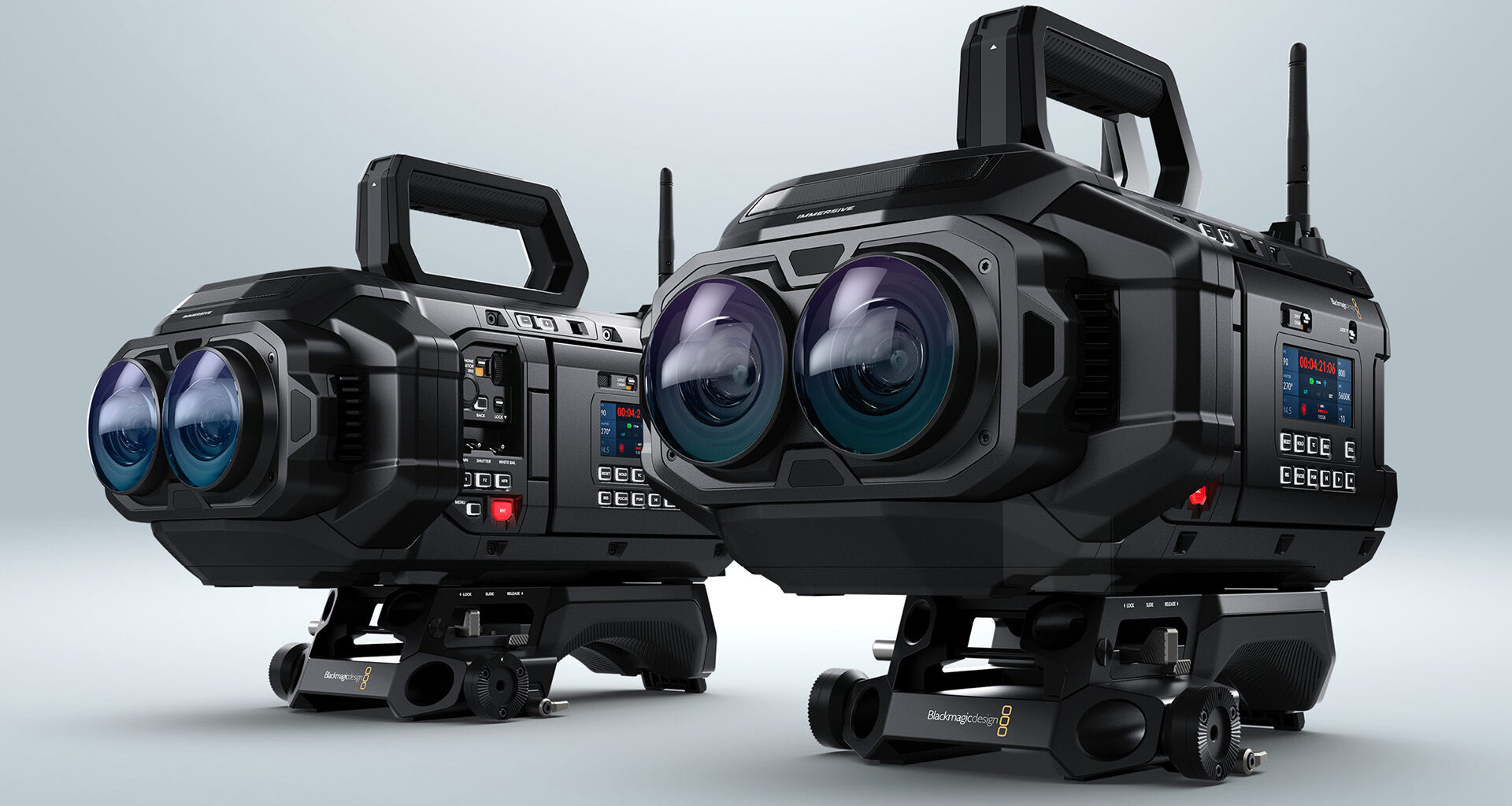
Blackmagic Design has used its pre-NAB 2026 announcement window to unveil a sweeping lineup of products built around a single thesis: 100G Ethernet and SMPTE-2110 are the backbone of live production’s future. The announcements span three hero products, including the URSA Cine 12K LF 100G with live output up to 440fps, the world’s first immersive cinema camera for live broadcast, and a free software-based audio mixer, plus nine pieces of supporting infrastructure that form a complete IP-based broadcast ecosystem.
The scope of this announcement cycle is classic Blackmagic Design. As with previous NAB shows, the company has dropped a dozen-plus products in a single wave, but this time with a tighter strategic focus than usual: rather than spreading across cameras, editing tools, and broadcast gear independently, the entire lineup is unified around a single 100G Ethernet and SMPTE-2110 architecture. From camera sensors through switching, recording, storage, conversion, and audio mixing, everything connects via the same IP backbone and nearly everything includes SMPTE-2022-7 redundancy with dual network connections. Blackmagic Design also announced DaVinci Resolve 21 as part of the same pre-NAB push, which we have covered in a separate article.
The URSA Cine 12K LF goes live
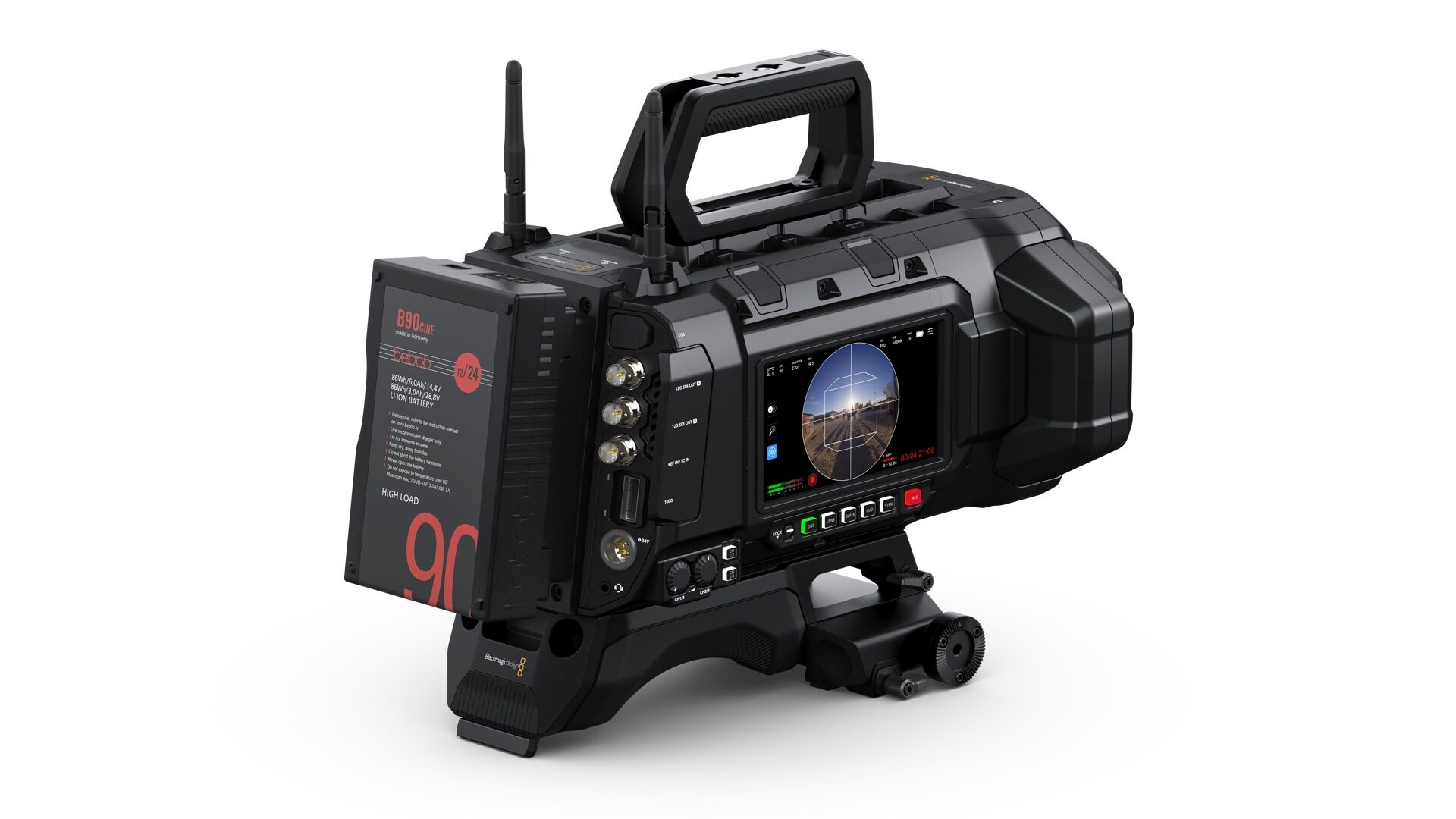
The URSA Cine 12K LF, Blackmagic Design’s flagship digital film camera with its large format 36x24mm RGBW sensor and 16 stops of dynamic range (we tested the camera in our lab and can confirm its excellent performance), now gains a 100G Ethernet port and a dedicated live production mode. Set the camera to “SMPTE-2110 Live” in the menu, and it becomes a studio camera, outputting real-time IP video at up to 2160p60. The 100G model takes this further with live output up to 440fps for slow-motion sports replays, a specification that no traditional broadcast camera can currently match.
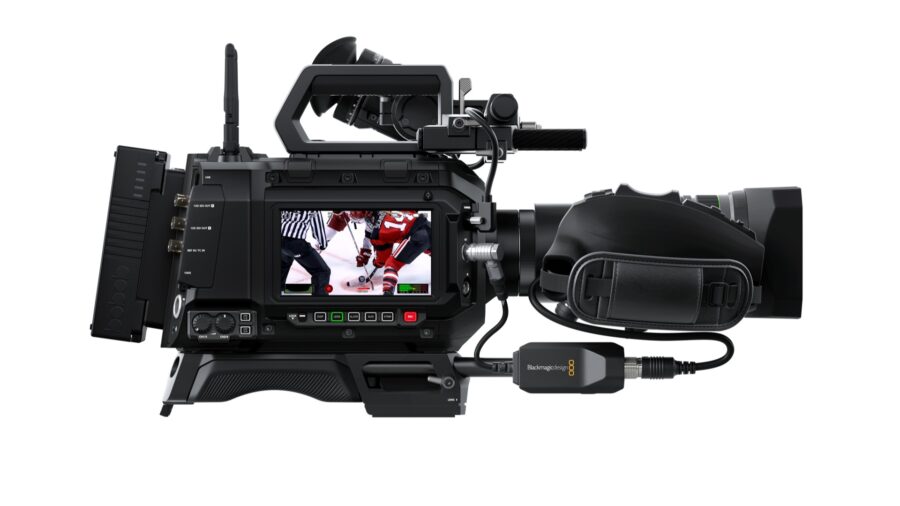 Blackmagic URSA Cine 12K LF 100G. Image credit: Blackmagic Design
This is a significant move for Blackmagic Design. It means a single camera body can serve double duty on film sets and in live broadcast environments, which is particularly attractive for rental houses and owner-operators looking to keep expensive bodies busy. The RGBW sensor technology that makes the URSA Cine 12K LF special in the cinema world, with its equal distribution of red, green, blue, and white pixels across a 6×6 grid, now brings those same advantages to live production: higher dynamic range, better low-light sensitivity, and richer color at high frame rates.
To complete the broadcast package, Blackmagic Design is introducing an optional B4 lens mount that lets users attach electronically controlled broadcast lenses, along with a new 7-inch Studio Viewfinder with a touchscreen that connects and powers via USB-C. A center-crop mode when using B4 lenses allows Ultra HD output at high frame rates. The built-in DaVinci Resolve-based primary color corrector now includes a dedicated 3D LUT processor for the SMPTE-2110 output, separate from the LUTs applied to other outputs, so live grading can be tailored specifically for the broadcast feed.
Generation 6 Color Science carries over from the existing URSA Cine 12K LF, with its redesigned processing pipeline using 3D LUTs for film, extended video, and video gamuts. Users can load custom LUTs and output different color spaces including Rec. 709, 2020, and PQ. The URSA Cine 12K LF 100G will be available in Q3 2026 for $8,995.
Live immersive production arrives
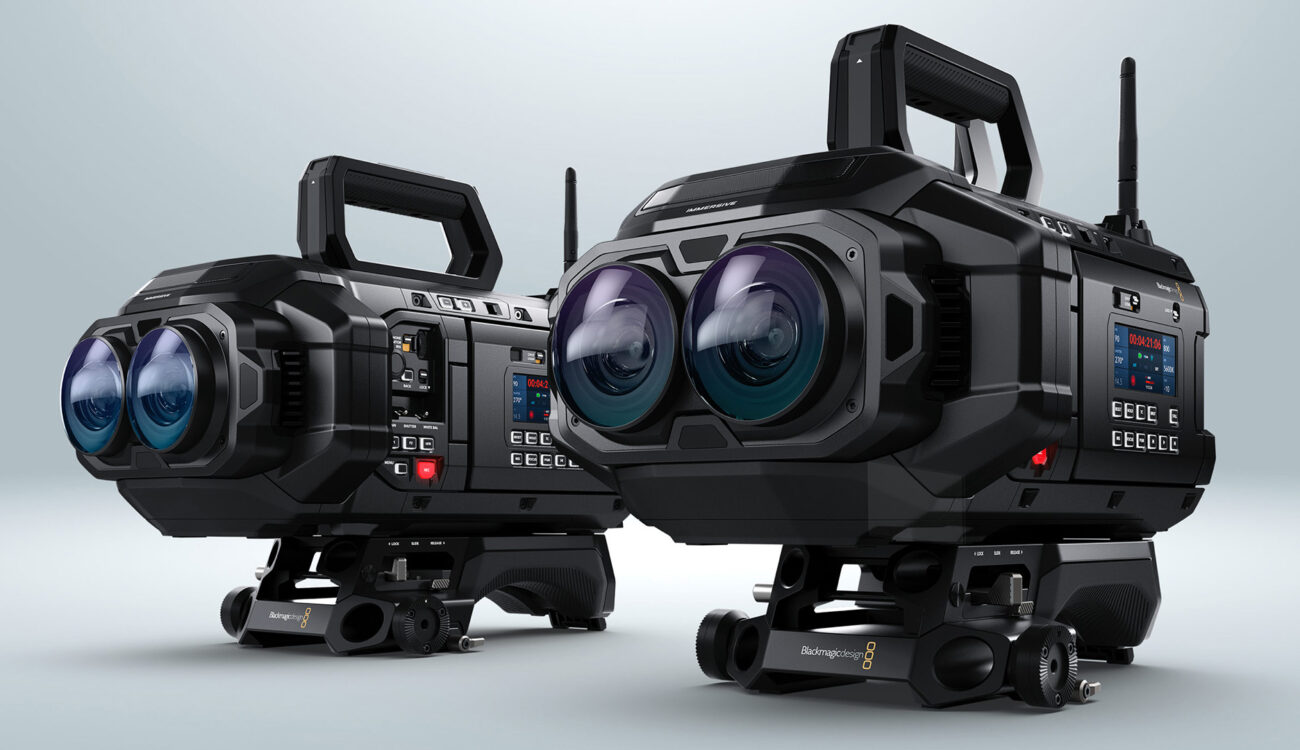
Perhaps the most forward-looking announcement is the Blackmagic URSA Cine Immersive 100G, priced at $26,495 and also expected in Q3 2026. Building on the original URSA Cine Immersive (now $24,995, down from $29,995), which we have covered extensively as the first professional camera designed for Apple Immersive Video, the 100G variant adds real-time live output capabilities. The dual 8Kx8K RGBW sensors and 16 stops of dynamic range remain, but a new companion module, the Blackmagic URSA Live Encoder, compresses live immersive video into Apple ProRes for output as SMPTE-2110-22 IP video via 100G Ethernet.
 Blackmagic URSA Cine Immersive 100G. Image credit: Blackmagic Design
The practical implication is that live events, from concerts to sports, can now be captured and delivered in Apple Immersive Video format in real time. Blackmagic Design confirmed that the camera data rate is under 50 Gb/s, meaning two cameras can share a single 100G Ethernet connection. The camera has already been deployed for Spectrum Front Row, a series of live Lakers games in Apple Immersive during the 2025/2026 season, now available on demand through the Spectrum SportsNet and NBA apps for Apple Vision Pro.
This is where Apple’s immersive strategy and Blackmagic Design’s broadcast ambitions converge most directly. We have followed immersive production closely, from the original camera announcement at WWDC 2024 through productions like the Bastille Day film and Apple’s immersive video workshops. Until now, these were all post-produced experiences. The 100G model fundamentally changes that equation by making immersive a live medium, not just an on-demand one.
Blackmagic Design also announced an ATEM Solaris switcher family on its roadmap (no pricing or timeline given) that will handle full 3D and immersive switching downstream, suggesting the company sees live immersive as more than a one-camera experiment.
Fairlight Live: a free software-based broadcast audio mixer
On the audio side, Blackmagic Design has announced Fairlight Live, a software-based live broadcast audio mixer that is available immediately as a free public beta download from the Blackmagic Design website. This is not a stripped-down version of the Fairlight audio engine inside DaVinci Resolve; it is a purpose-built live mixing application that supports everything from stereo to 5.1 surround to full immersive and ASAF spatial audio formats.
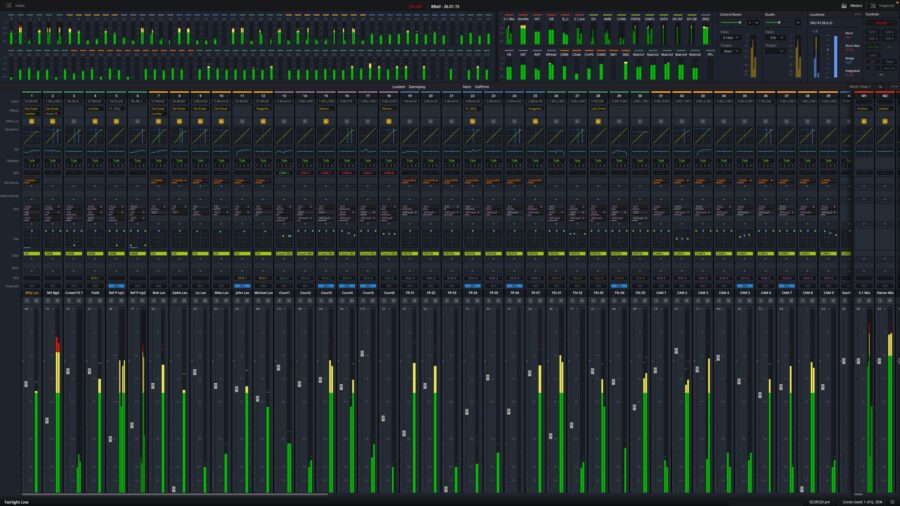 Screenshot of Fairlight Live. Image credit: Blackmagic Design
The feature set reads like a checklist of what broadcast audio engineers have been requesting from software-based solutions for years. Fairlight Live scales from a handful of channels to hundreds or even thousands, depending on host hardware. Each channel gets built-in six-band EQ, expander/gate, compressor, limiter, and panner, with four effects slots that can expand to 24 plug-ins per channel via the ChainFX hosting system. Third-party VST and AU plug-ins are fully supported. There is a built-in cue player with 16 audio and 16 MIDI cues, snapshots for recalling entire mixer states between show segments, virtual soundcheck recording and playback, and up to 128 VCA groups with nesting support.
For broadcast workflows, Fairlight Live connects directly to ATEM switchers via USB-C for audio follows video (AFV) camera selection supporting up to 100 cameras. It also supports native SMPTE-2110 audio integration with PTP clock synchronization and sample-level delay compensation. Four talkback groups, mix-minus for clean feeds to remote guests, on-air mode that locks critical functions, and remote gain control round out the broadcast feature set.
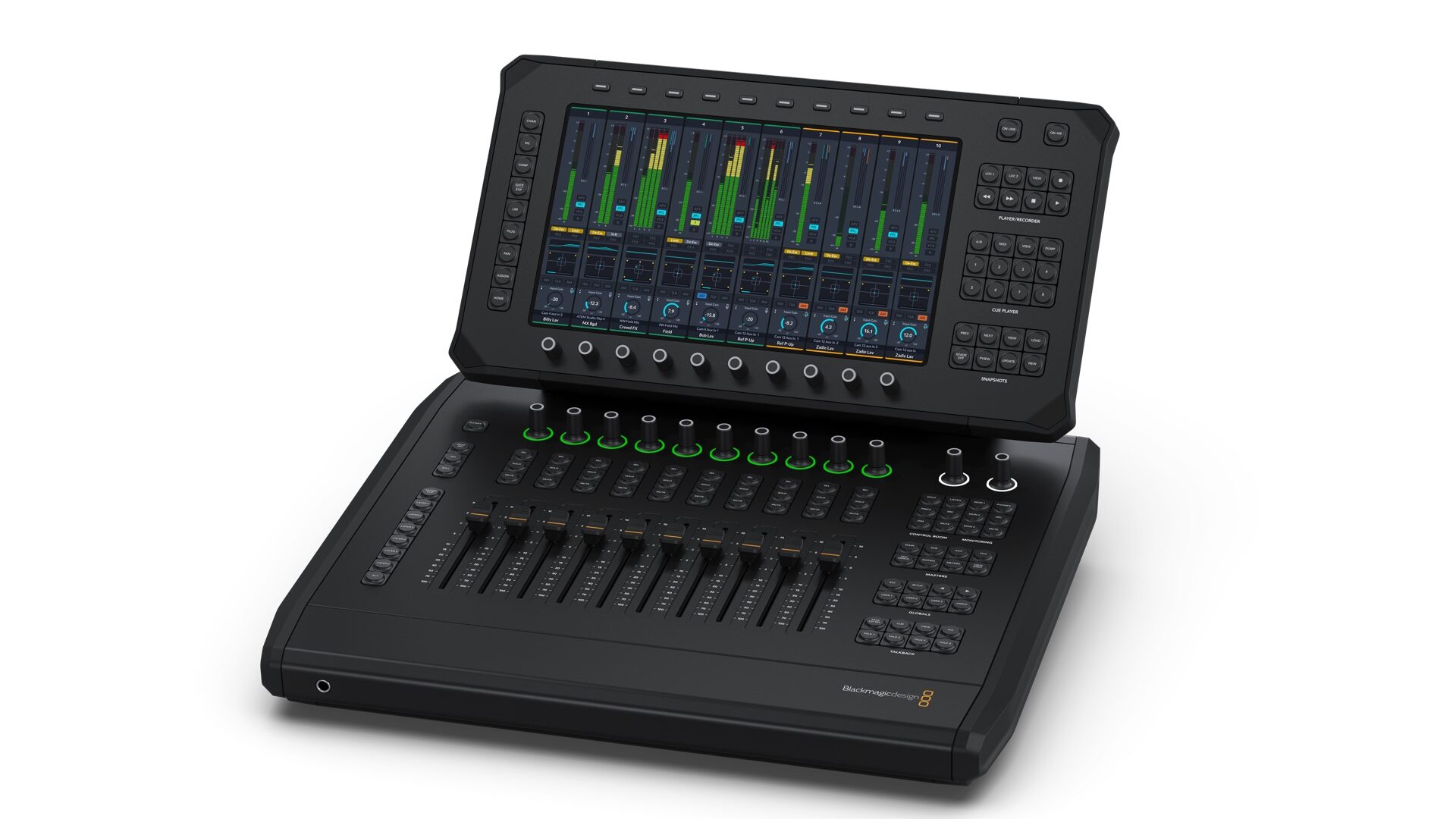 Fairlight Live Audio Panel 10. Image credit: Blackmagic Design
Blackmagic Design is simultaneously launching Fairlight Live Audio Panels in 10, 20, and 40 fader configurations, designed as physical control surfaces for the software. The pricing of the software itself, free, is the aggressive part: this positions Fairlight Live as a direct challenge to established hardware-based broadcast audio mixers, some of which cost tens of thousands of dollars.
The 100G infrastructure ecosystem
Behind the hero products, Blackmagic Design has announced nine infrastructure products that together form a complete SMPTE-2110 broadcast system. All are priced in a range that undercuts traditional broadcast infrastructure significantly, and all are expected in June 2026.
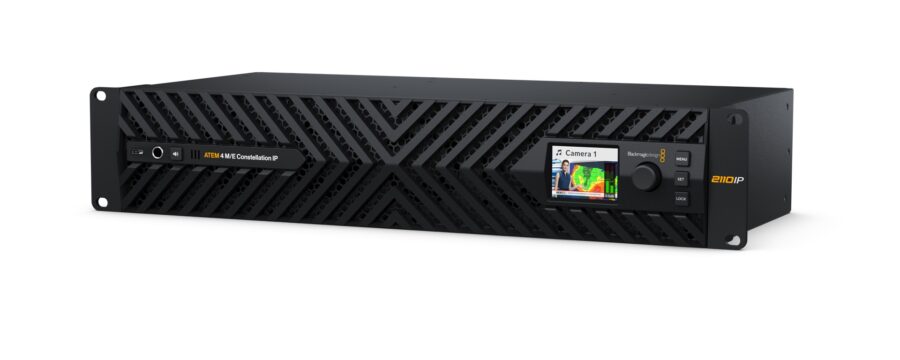 ATEM 4 M/E Constellation IP. Image credit: Blackmagic Design
The ATEM 4 M/E Constellation IP (from $7,995) is a native SMPTE-2110 live production switcher with up to 64 inputs and 52 outputs via 100G Ethernet, full standards conversion on every input, 16 Advanced Keyers, 4 multi-views, and 2 SuperSource processors. It retains the familiar ATEM Constellation feature set from the SDI models but in a redesigned front-to-back cooled chassis with SMPTE-2022-7 redundancy on all video ports, plus redundant PTP clock connections.
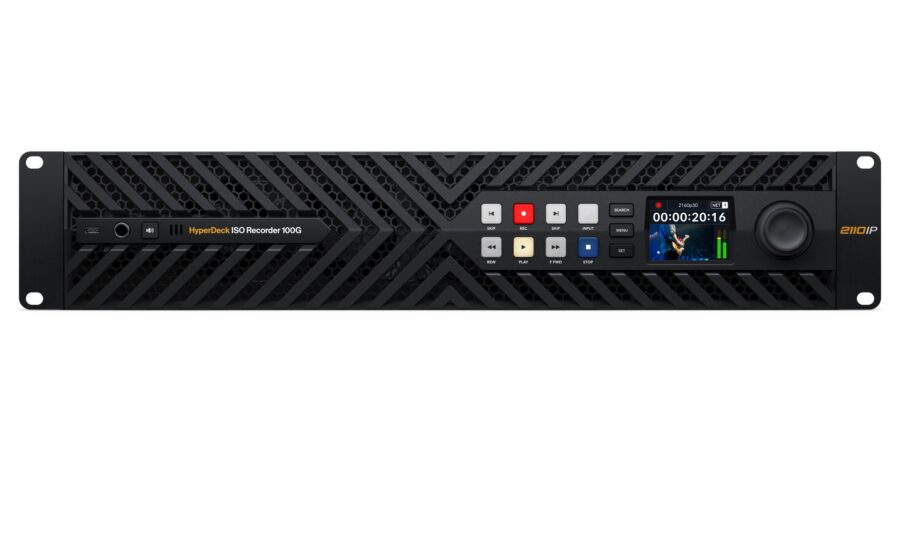 HyperDeck ISO Recorder 100G. Image credit: Blackmagic Design
The HyperDeck ISO Recorder 100G ($4,995) records up to 8 channels of Ultra HD Apple ProRes video simultaneously from a single 100G Ethernet connection to network storage. DaVinci Resolve can access files mid-recording for live action replay workflows. The recorder features broadcast deck controls with a machined metal search dial and active clutch, dual redundant 100G Ethernet connections for both video and data, and RS-422 serial control for legacy broadcast automation.
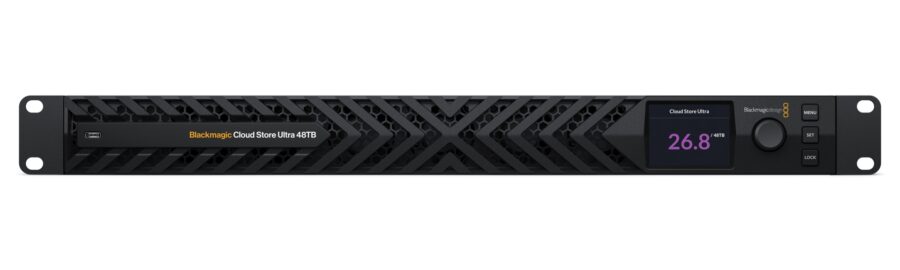 Blackmagic Cloud Store Ultra. Image credit: Blackmagic Design
For storage, the Blackmagic Cloud Store Ultra (from $8,835 for 24TB, also available in 48TB) provides dual independent 100G Ethernet ports with RAID 5 support, so one port can handle HyperDeck recording while the other serves edit workstations simultaneously. The Blackmagic Media Dock Ultra ($2,995) brings the same dual 100G Ethernet design to Blackmagic Media Modules, the removable storage used in URSA Cine cameras, with HDMI and SDI status monitoring and Blackmagic Cloud sync.
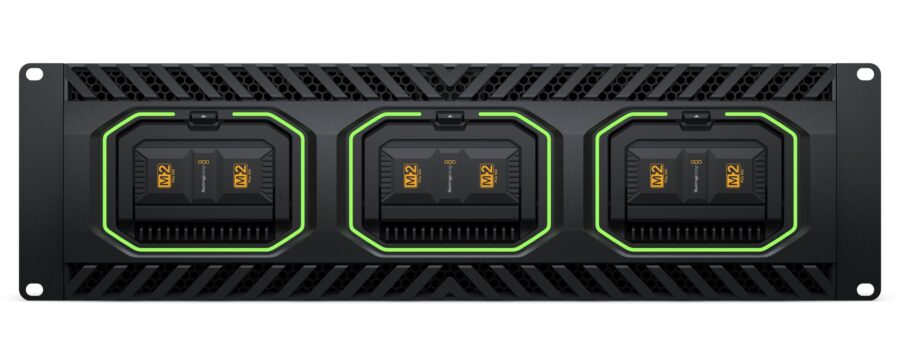 Blackmagic Media Dock Ultra. Image credit: Blackmagic Design
Bridging the 100G world to existing infrastructure is handled by three converters. The Blackmagic SDI Expander 8x12G ($2,995) provides 16 channels of bidirectional 12G-SDI to SMPTE-2110 conversion via dual redundant 100G Ethernet in a single rack unit. The Blackmagic StudioBridge 10G PWR ($2,495) aggregates 8 separate 10G Ethernet connections into redundant 100G, with 90W PoE++ on each port for powering cameras and converters directly. The Blackmagic UpDownCross 100G (from $2,435) handles 8 simultaneous channels of standards conversion between SD, HD, and Ultra HD over 100G Ethernet.
Rounding out the network layer, the Blackmagic Ethernet Switch 820 ($2,295) provides 8 x 100G and 2 x 10G Ethernet ports with redundant PTP clock distribution, dedicated NMOS control, and broadcast-oriented front-to-back cooling. The ATEM Monitoring Rack Panel (from $995) combines SMPTE-2110 IP-to-SDI/HDMI monitoring conversion with a rack-mount control panel for the ATEM Constellation IP switchers.
Pricing and availability
The Fairlight Live public beta is available now as a free download from Blackmagic Design’s website. The URSA Cine 12K LF 100G ($8,995) and URSA Cine Immersive 100G ($26,495) are expected in Q3 2026, with the URSA Live Encoder arriving later in the year. All infrastructure products are targeted for June 2026 availability. All prices exclude local duties and taxes.
The breadth of this announcement is hard to overstate: Blackmagic Design is not just adding 100G Ethernet to a camera or two, they are building an entire live production chain from acquisition through delivery, all speaking the same IP-based language. What part of this lineup are you most interested in, and do you see SMPTE-2110 becoming the standard at your facility anytime soon? Don’t hesitate to let us know in the comments below!