
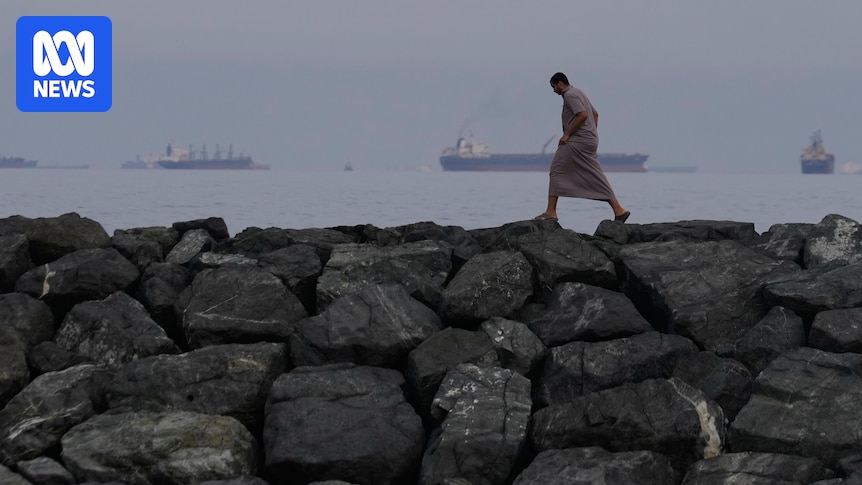
The International Monetary Fund has released a sobering assessment of the global economic and financial stability outlook as conflict in the Middle East spikes energy prices and cuts the economic growth outlook.
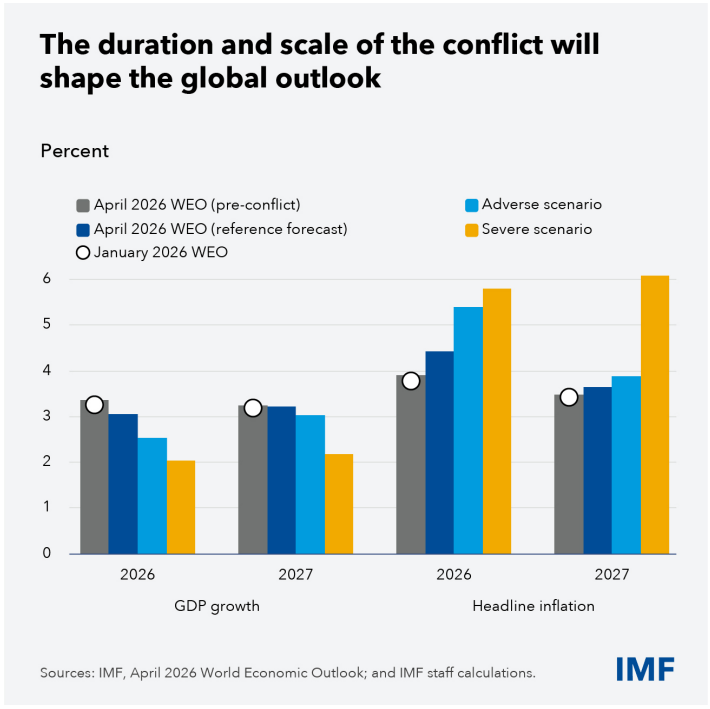
In its latest World Economic Outlook report, the IMF has painted three scenarios that each get progressively worse depending on how long Middle East energy supplies are disrupted.
Iran war live updates: For the latest news on the Middle East crisis, read our blog
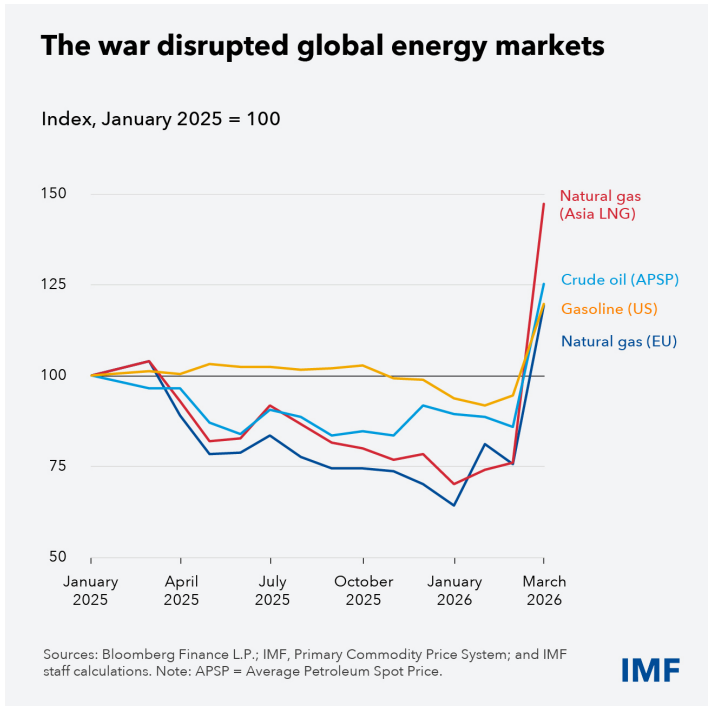
In the first scenario, in which energy supply disruptions related to the closure of the Strait of Hormuz are short-lived and average energy prices this year only rise 19 per cent on last year’s levels, the IMF expects global GDP growth of 3.1 per cent and inflation of 4.4 per cent.
While that would be “a sharp deviation from the global disinflation trend in recent years”, the fund warns that a longer shutdown of the Strait of Hormuz and further damage to drilling and refining facilities would disrupt the global economy “more deeply and for longer”.
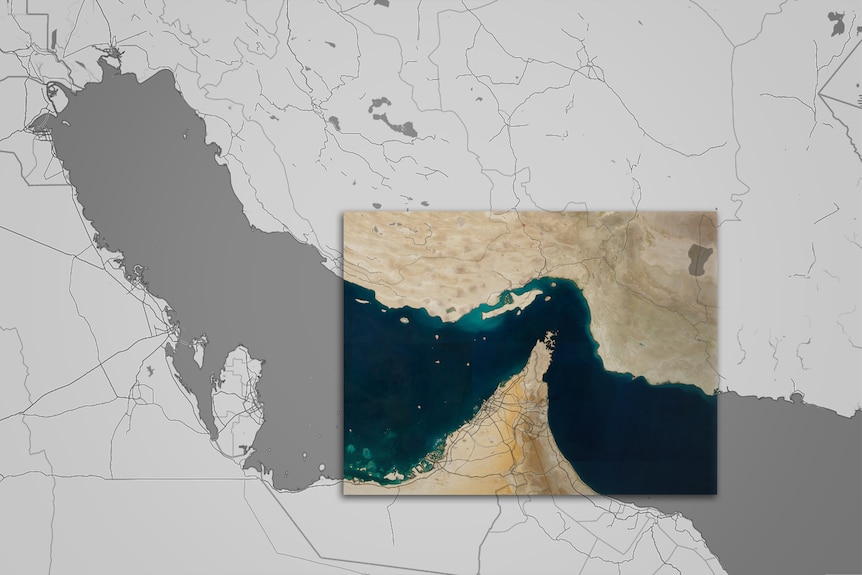
The full impact of the closure of the Strait of Hormuz is yet to be felt. (Supplied: Sentinel Hub)
In that “adverse scenario”, growth is expected to fall to 2.5 per cent globally over 2026, while inflation would rise to 5.4 per cent.
In the third “severe scenario”, in which energy supply disruptions extend into next year, the IMF warns growth could slow to 2 per cent in 2026 and 2027, while inflation “would exceed 6 per cent”.
(Pierre-Olivier Gourinchas, IMF Blog, International Monetary Fund World Economic Outlook, April 2026)
A rapidly changing environment
In mid-February, two weeks before the Middle East war erupted, IMF staff published their latest update on the health of Australia’s economy.
At the time, they said Australia’s economy was expected to grow at an average rate of 2.1 per cent in 2026 and inflation was expected to gradually converge towards 2.5 per cent by the second half of 2027.
But the IMF’s new World Economic Outlook has been published in a thoroughly different environment.
Stagflation is a ‘central banker’s nightmare’, says RBA deputy governor
On Tuesday in New York, Reserve Bank deputy governor Andrew Hauser warned that Australia was going to experience a “big income shock” soon because to the war and said inflation would increase.
He said consumer confidence in Australia had recently declined significantly and that could potentially impact economic activity this year. Business confidence has also plummeted.
Mr Hauser said the “big question” for the RBA was how the global energy shock and the coming wave of inflation would impact economic activity in Australia and how it would feed into inflation over the next two to three years.
“It is a central banker’s nightmare,” he said of recent weeks.
“The stagflationary shock — inflation up, activity down. Judging the balance between those two is, I guess, how we earn our money.”
(Pierre-Olivier Gourinchas, IMF Blog, International Monetary Fund World Economic Outlook, April 2026)
‘Price stability must take precedence’
Despite the projected global economic slowdown this year, the IMF’s Pierre-Olivier Gourinchas has warned that central banks must prioritise raising interest rates to tame inflation over protecting economic growth.
“If medium- or long-term inflation expectations drift up as prices and wages pick up, restoring price stability must take precedence over near-term growth, with a swift tightening,” he wrote in an IMF blog tied to the release of the report.
Fuel excise cut may work against, not for us, analysts warn
Mr Gourinchas also warned governments against subsidies to soften the blow of surging fuel prices.
“Preserving price signals is important: high prices signal scarcity, encouraging demand restraint and supply expansion,” he argued.
“If needed, direct, targeted transfers to vulnerable households and firms typically provide greater relief at lower fiscal cost than broad subsidies.”
Australia’s government, like many others, has temporarily lowered its taxes on fuel, halving the petrol and diesel excise for three months.
Treasurer Jim Chalmers will be flying out from Australia on Wednesday morning to participate in the G20 finance ministers’ and central bank governors’ meeting and the IMF-World Bank spring meetings in Washington DC.
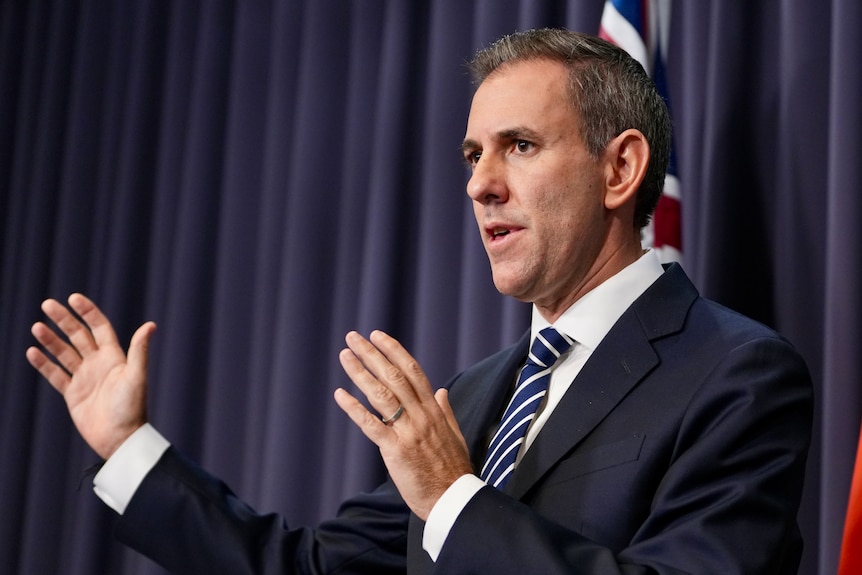
Jim Chalmers is heading to Washington DC. (ABC News: Callum Flinn)
Aside from the formal engagements, Mr Chalmers said he would also meet bilaterally with finance ministers from South Korea, Japan, China, the UK, Indonesia and Singapore.
“These engagements come at a dangerous time for the global economy,” he said in a statement.
“There couldn’t be a more important time to engage with countries and counterparts which are so crucial to our supply chains and our prospects more broadly.”
‘Resilience should not be taken for granted’
The IMF also published its latest Global Financial Stability Report, which focused on the emerging risks from the Middle East conflict and energy price shock.
It noted that so far the cycle of escalation and de-escalation, had “not yet triggered the kind of sustained market drawdowns that give rise to acute liquidity stress, margin calls, and forced deleveraging”.
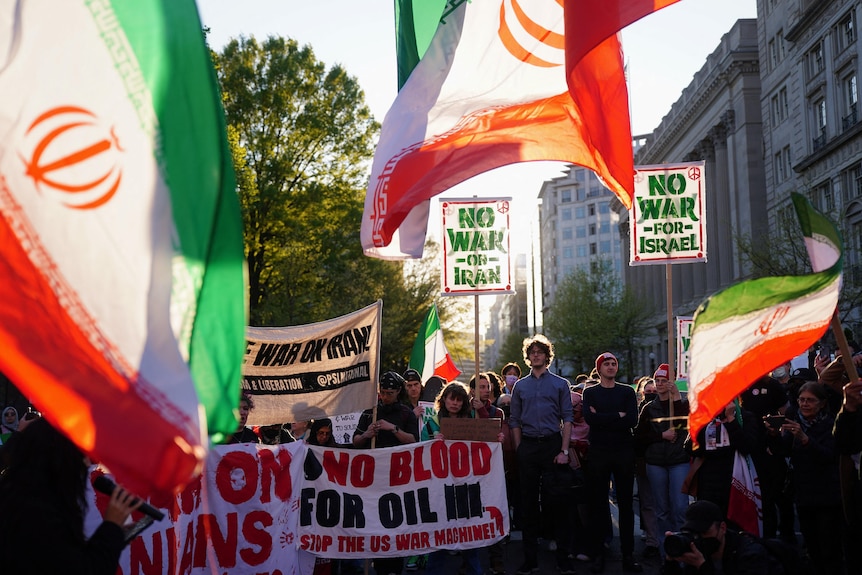
Demonstrators took to the streets of Washington DC earlier this month to protest against military action in Iran. (Reuters: Nathan Howard)
However, the report added, “this resilience should not be taken for granted” and noted that “it may indicate that markets have not fully priced more adverse scenarios”.
As with the economic risks, the risks to share markets, bond markets, private credit and the banking and financial systems as a whole depended largely on the course of the war.
“The likelihood of downside scenarios materialising depends critically on the duration, intensity and scope of the conflict,” the IMF said.
The IMF warned that increased global debt levels posed a risk to sections of the financial sector.
“The longer the conflict continues, the greater the risk that global financial conditions — which had been very accommodative before the war — could tighten further and more abruptly,” it said.
“An abrupt tightening of financial conditions can lead to forced selling by hedge funds, option sellers, leveraged exchange-traded funds, and other non-bank financial intermediaries (NBFIs) that have expanded through leverage.”
Loading…