
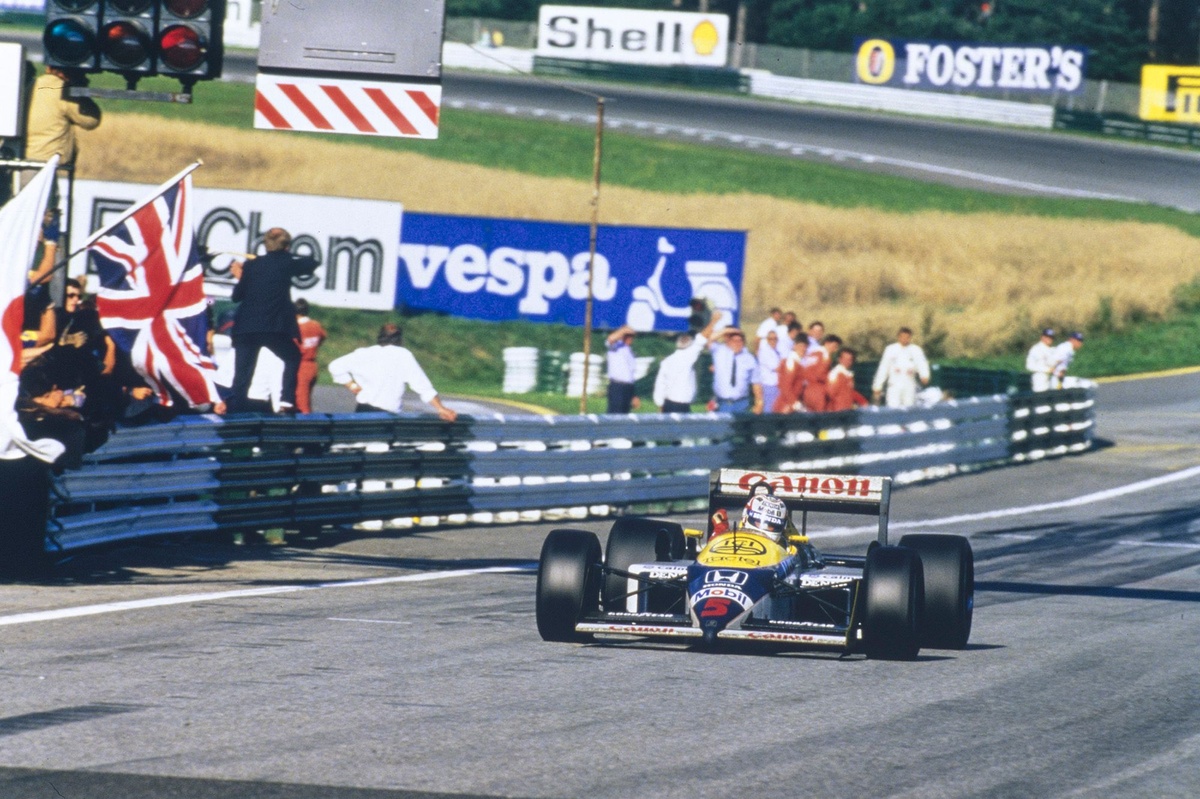
Lando Norris’ revelation that he essentially overtook Lewis Hamilton by accident during the 2026 Japanese Grand Prix, as a result of inadvertently triggering a different engine mode, was among the hottest topics of post-race debate. The role of the driver in pushing a car to its limit cuts to the essence of what motor racing is all about.
‘Boost-gate’ also highlighted how much less linear the process of boosting an F1 car is than it was during earlier eras of turbocharging, given the rapid cycles of charging and depletion that now occur from lap to lap.
Read Also:
One facet of turbocharging that proved exceedingly challenging in the 1970s and ‘80s, but which was largely smoothed away by the action of the MGU-H in the post-2014 hybrid era, is the phenomenon of turbo lag. This is the delay between the driver’s request for power and its actual arrival, owing to the mechanical inertia of the compressor as it spins up.
Lag is now a factor again in F1 owing to the removal of the MGU-H in the cause of simplification. Very difficult to engineer reliably given that it had to rotate at up to 100,000 rpm, the MGU-H reclaimed heat energy and could deploy it to pre-spin the turbo.
As power outputs rose well north of 1000bhp at the peak of F1’s first turbo era in the mid-1980s, it was up to the driver’s right foot to mediate the crudity of its delivery. Those horses tended to arrive at the gallop, given how funky fuel blends had enabled engine designers to squeeze compression ratios as well as fitting larger turbos.
“Being totally brainless,” says Nigel Mansell when asked to explain the technique of driving a twin-turbo F1 car.
“I think Martin Brundle summed it up beautifully when he said, this era of cars, every corner the car wanted to try and kill you.
“And I agree with him wholeheartedly. Every corner we came to, we never knew quite what it was going to do because of the lag…”
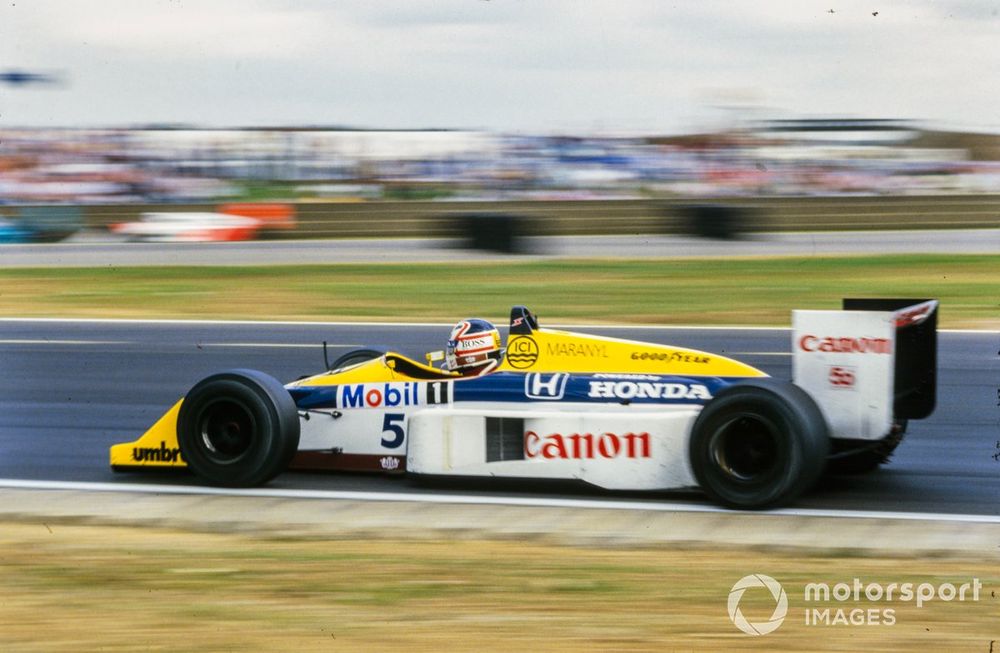
Nigel Mansell, Williams FW11B Honda.
Photo by: LAT Photographic
At the British Grand Prix this year, Mansell will be a special guest at the Pop-Up Hotel hospitality village, which overlooks the scene of one of his most remarkable achievements: ignoring the fuel read-out, setting the boost to maximum, and hunting down and passing Williams team-mate Nelson Piquet into Stowe corner to win the 1987 iteration of the race. On the slowing-down lap, his FW11B coasted to a halt having run out of fuel and, according to folklore, melted at least one piston.
There are parallels between Honda’s current travails in F1 and its early turbo experiments with Spirit and Williams. The first RA163E 1.5-litre V6 of 1983 was fundamentally a short-stroke version of its successful 2-litre naturally aspirated F2 engine, with a turbo plumbed in. Massively oversquare, with a 90mm bore and a stroke of 39mm, it suffered frequent piston failures because their huge surface areas were subjected to more heat than they could evenly dissipate.
Lag was also worse, as Mansell pointed out when he joined Williams in the winter of 1984 from Lotus, where he had used Renault’s powerful but rather less brutal V6 turbo. Over the next three seasons, Honda narrowed the bore through 82mm and 79mm iterations, and longer strokes of 47.2mm and 50.8mm, to give a more usable rev range and smooth the gap between fully off and fully on.
But even with these improvements, and the fitting of variable-geometry turbochargers, timing the arrival of the power depended on the driver’s judgement.
“There isn’t the lag today you had back then,” says Mansell. “Certainly in ‘85, ‘86 and even part of ‘87, depending what turbo you had on the car.
“In ‘85, Keke Rosberg and I had some horrendous accidents because we’d call for the power and put the foot down. One, two, three seconds, still no power.
“And then the corner’s coming up and so you back off and then nothing’s happening. And then the power comes halfway through the corner, and you don’t want it. And it makes you go off and have an accident.
“It makes you look stupid. And so the early versions of the turbo engine, because we had A, B, C, D. We had so many versions of the turbo engine with Honda in the beginning.
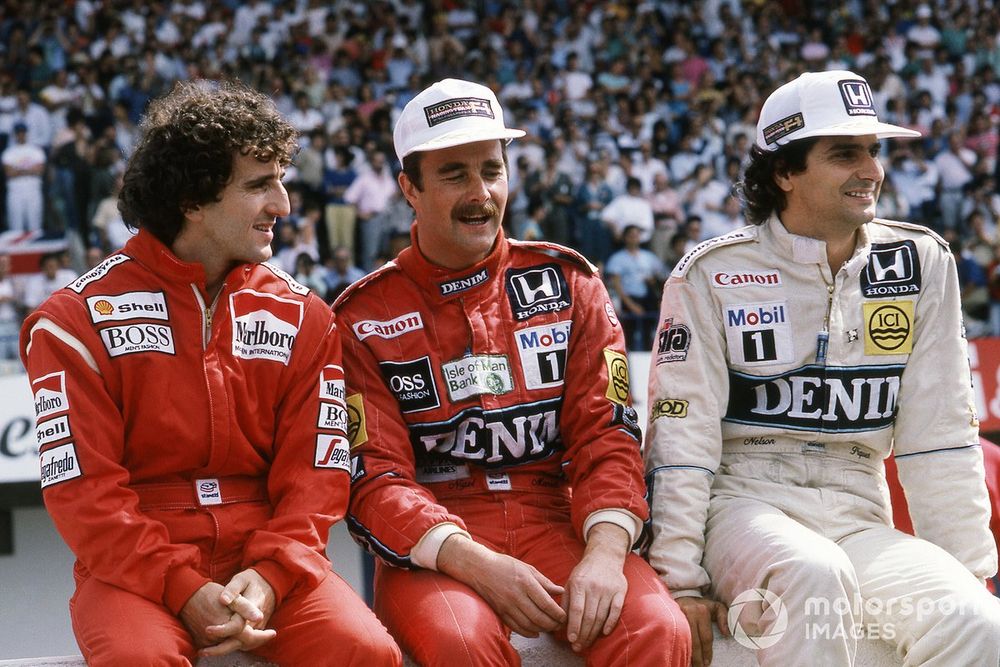
Alain Prost, McLaren, Nigel Mansell, Williams and Nelson Piquet, Williams
Photo by: Sutton Images
“And we had a terrible time at Monaco the one time. I think we blew six engines up in one weekend. The fuel was bad and we detonated the pistons.
“So, it was the most amazing, thrilling, unbelievable time driving these cars because you had to hang on to them on every corner. If you can imagine going into a corner, braking like crazy, but anticipating trying to put the power on two seconds before you need it… to get to the apex so it can pull you out the apex.
“You time it right, that’s great. But if you’re in the middle of the corner and you don’t time it right and it comes in early or it comes in late, it can stick you in the barrier.
“And so, yeah, it was one of the epic times in Formula 1 where the drivers, I believe, earned every single penny they were paid. It was just so dangerous.”
This was an era, of course, before limits were placed on how many engines drivers could use per season. You could blow up and replace as many as you needed, provided you were a works team with an ambitious and deep-pocketed supplier.
Nowadays, only single turbo compressors are permitted, and variable-geometry compressors are among the many nuances banned on grounds of cost. In the combustion chamber, the regime is entirely different: where in the 1980s, tight compression ratios, aggressive ignition timing and high induction pressures were facilitated by carcinogenic anti-‘knock’ ingredients such as toluene, now the compression ratio is capped at a more relaxed rate and the fuel is a specialist 100% sustainable blend.
Read Also:
The cars themselves, despite being heavier and less powerful at their peak than 1980s turbos, are actually faster in terms of laptime thanks to advances in aerodynamic understanding. In the decade of decadence, a draggy ‘barn door’ wing was a compromise acceptable in service of transmitting all that power to the asphalt.
“The power we had back then was astonishing,” recalls Mansell.
“I mean, these engines could deliver up to 1,500 horsepower. On some circuits you’d be getting wheelspin in 6th gear at 170, 180 miles an hour…”
We want to hear from you!
Let us know what you would like to see from us in the future.
– The Autosport.com Team