

Australia’s richest person Gina Rinehart has been dealt a blow, with a court finding the family of former mining pioneer Peter Wright has the right to potentially hundreds of millions of dollars worth of past and future royalties from lucrative Pilbara mining assets.
Justice Jennifer Smith dismissed all claims, including by Mrs Rinehart’s children and Mr Wright’s descendants, to an ownership share in the Hope Downs iron ore mines and tenements, currently operated as a joint venture between Mrs Rinehart’s Hancock Prospecting and Rio Tinto.
Justice Smith found both Hancock Prospecting and Rio Tinto were jointly liable for the royalties payments to Mr Wright’s family’s company, Wright Prospecting.
But she found Hancock Prospecting remained the 50 per cent owner of Hope Downs, in Western Australia’s north.

Wright Prospecting successfully argued it was owed half of royalties from the Hope Downs mines. (AAP Image: Christian Sprogoe)
Mrs Rinehart’s company welcomed the decision in a statement, saying the court had rejected the “baseless ownership claims of (two of her children) John (Hancock), Bianca (Rinehart) and Wright Prospecting Pty Ltd (WPPL) in their entirety”.
Meanwhile, John Hancock expressed hope the judgement would lead to family reunification.
“I hope we can finally put these events from decades ago behind us, and as a united family, celebrate and continue the contribution we have made to Australia,” he said in a statement.
As well as upholding Wright Prospecting’s claim to a royalty share in Hope Downs, Justice Smith in part also upheld the claims to a separate royalty share by DFD Rhodes, representing the family of the late prospector Don Rhodes.
Lengthy trial
Justice Smith’s ruling in the monumental legal showdown comes more than two years since the 51 days of hearings concluded in December 2023.
She scrutinised more than 4,000 documents tendered in evidence to determine the meaning and importance of agreements, documents and memos detailing events principally from 1967 to 2005.
The case revolved around the formal agreements made between Mrs Rinehart’s father and iron ore pioneers Lang Hancock, his friend and business partner Peter Wright and Mr Rhodes on how to divide up their assets.
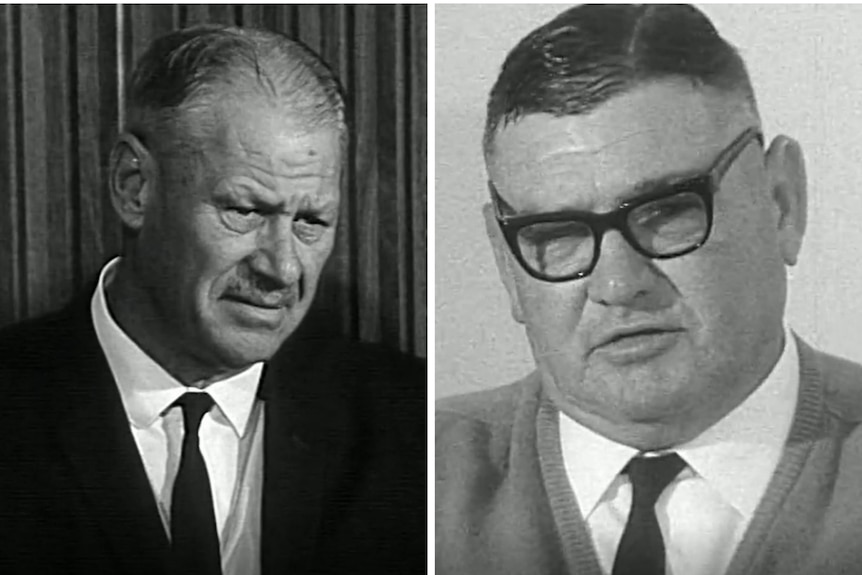
Peter Wright and Lang Hancock in the 1960s. (ABC News)
“At the heart of the issues raised by the parties to the proceedings were a number of formal agreements made decades ago between men who were friends or colleagues,” Justice Smith said in a summary of the judgment.
In a statement, Wright Prospecting welcomed the judgment.
“Wright Prospecting commenced this action to recover our share of royalties from the Hope Downs 1 -3 mines,” it said.
“That claim has been upheld.
“WPPL also sought either a proprietary interest or a royalty in the Hope Downs 4-6 mines and has been successful in its royalty claim.”
At the heart of the dispute were the lucrative Hope Downs mines and tenements in the Pilbara region’s Hamersley Range.
Wright Prospecting claimed they were “improperly denied” royalties and equity in Hope Downs by Hancock Prospecting.
Their case rested on the basis they were part of a partnership agreement between Mr Hancock and Mr Wright dating back to 1978.
1987 agreement key
Wright Prospecting asserted it was entitled to its half of the 2.5 per cent in royalties that Mr Wright and Mr Hancock’s partnership Hanwright secured in an agreement with Rio Tinto’s subsidiary, Hamersley Iron, in the early 1960s.
Wright Prospecting acknowledged Hancock Prospecting removed those Hope Downs tenements from their partnership, as they were allowed to do under a 1987 agreement, but that the same agreement stated they should still receive royalties from the asset.
As for the rest of the Hope Downs tenements, previously known as East Angelas, Wright Prospecting claims it has always remained an asset of the partnership and it should then receive an equity share in those tenements, potentially worth several billion dollars.
Hancock Prospecting sought to dismiss that claim outright, saying a later 1987 agreement was “fatal” to Wright’s case.

The Hope Downs iron ore operation is in WA’s Pilbara region. (AAP Image: Christian Sprogoe)
Hancock’s barrister, Noel Hutley SC, told the court Hancock Prospecting exploited Hope Downs after Wright Prospecting “relinquished any right it had to those areas” under the 1987 agreement.
He said under that agreement, it was decided Hancock Prospecting could take up the East Angelas areas “for its own benefit”.
DFD Rhodes had claimed a 1969 agreement meant it was entitled to a 1.25 per cent royalty share in Hope Downs.
Here’s what you need to know about today’s Gina Rinehart court ruling
Justice Smith in her summary “dismissed Rhodes’ claims in contract for royalties, and upheld in part Rhodes’ claim in equity to past and future royalties”.
Speaking outside court, DFD Rhodes chief executive Matt Keady told reporters the decision was “a win” for the company, and although the windfall could be “substantial” there were likely to be further arguments.
“We are very, very pleased that the judgement has recognised the contribution of Don Rhodes to the iron ore industry,” he said.
Asked how he reflected on the way Hancock Prospecting and Ms Rinehart handled the case, he said: “They are a formidable opponent.”
Children’s defences ‘fail at first hurdle’
Mrs Rinehart’s children, Bianca Rinehart and John Hancock, had claimed their grandfather Lang Hancock had put mining assets, including Hope Downs, in a family trust, partly for them to inherit.
But they claimed their mother had removed the assets to enrich herself in a “calculated and deliberate fraud”.
In a separate legal action, they are claiming a share of Hope Downs from their mother.

John Hancock and Bianca Rinehart are Gina Rinehart’s oldest two children. (AAP/ABC)
They and their siblings Hope and Ginia were joined to the case by Wright Prospecting to bind them to any decision.
Justice Smith found “it is not necessary to consider any of Bianca Rinehart and John Hancock’s defences in these proceedings as they fail at the first hurdle”.
A hearing has been set for next week to determine costs.
Justice Smith said both Hancock Prospecting and Wright Prospecting had won part of their case and lost part of their case, and one option could be they cancel out each other’s costs.
The case could still be appealed, potentially all the way to the High Court, which would mean this high-profile battle between billionaires could continue for years to come.