
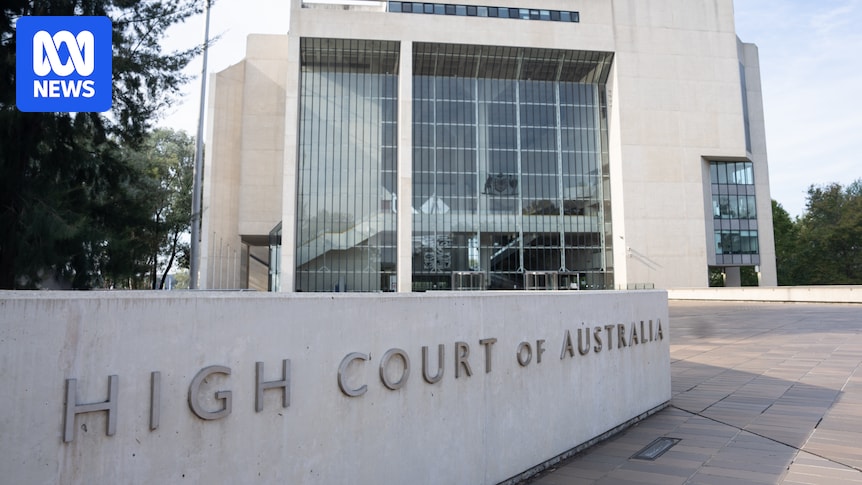
The High Court has scrapped Victoria’s political donation and disclosure laws just seven months out from the state’s upcoming election.
The extraordinary decision was welcomed by integrity watchdogs that have criticised what they called a “loophole” in Victorian election law, but the state government and opposition expressed concern over the state being left without a system for regulating political donations ahead of polls in November.
Lawyers for independents Paul Hopper and Melissa Lowe had argued Victoria’s $4,970 cap on campaign donations from individuals was unfair.
That was because a separate system existed allowing three major parties — Labor, the Liberals and Nationals — to receive sizeable donations from “nominated entities”.
The independents argued this risked allowing wealthy voices to drown out others, and placed an impermissible burden on the implied freedom of political communication under the constitution.
The High Court found the nominated entity system benefited major parties.

Independent candidate Melissa Lowe ran in the seat of Hawthorn at the 2022 Victorian election. (ABC News: Danielle Bonica)
But the court went further than what was asked by the challengers.
Instead of scrapping sections pertaining specifically to the cap and nominated entity system, it struck out an 89-page section of Victoria’s electoral legislation that also deals with a ban on foreign donations, reporting obligations around political donations and campaign expenditure.
A spokesperson for the Victorian government said it was disappointed by the decision.
“This is a win for billionaires and a loss for transparency. We are considering our options,” they said.
Law was wholly invalid, court says
The problem arose when the state introduced the $4,970 cap but excepted what was known as “nominated entities”, which were an avenue for fundraising.
Nominated entities registered before 2020 were eligible to avoid the cap.
The state agreed the law did place a burden on the implied constitutional right to freedom of political communication but said the cap was justified to curb corruption and prevent undue influence.
In other arguments, the state told the High Court the major parties were the ones which form government and for that reason different treatment was warranted.
But it was the time limitation that sank its defence. The state eventually conceded the 2020 cut-off could not be justified and was invalid.
The High Court said the law was wholly invalid.

Independent candidate Paul Hopper welcomed the High Court ruling. (ABC News: Danielle Bonica)
Both independents involved in the case welcomed the ruling.
“Thanks to this verdict, the days of major parties rigging elections to serve themselves are over,” Mr Hopper said.
Ms Lowe noted the wider implications for Australian democracy.
“It’s a great day for democracy and goes a long way to enshrining a level playing field in our elections and a chink in the armour of the two major parties’ duopoly,” she said.
“It has implications for the fairness of electoral laws around the country.”
The Australia Institute, a progressive think tank, agreed.
“Victoria’s donation cap, with its many loopholes, is undemocratic,” said director of the institute’s democracy and accountability program, Bill Browne.
“The whole political finance system was implemented in an unfair and undemocratic way, so that major party spending was barely affected but minor parties and independents face an uphill battle.”
Mr Browne said the High Court decision gave the Victorian parliament a chance to “go back to the drawing board, consult with voters and design a fair political finance system”.
Decision likely to have national consequences
Victoria’s Shadow Attorney-General James Newbury said the verdict presented “a very big problem for the integrity of our electoral system”.
“We now have, effectively, no donation system, no cap system, and no limits on foreign donations,” he said.

James Newbury says the High Court decision will have “a flow-on effect to the federal system”. (AAP: James Ross)
Mr Newbury said the opposition would work with the government in good faith to fix the issue.
“We cannot, for even one day, have a system whereby we have no donation limits, no caps, no transparency, no reporting, no limits on foreign donations,” he said.
“This is going to have a flow-on effect to the federal system, because the federal laws are modelled off Victoria, as are South Australia and WA.”
Former federal independents Zoe Daniel and Rex Patrick had been waiting on today’s result as they gear up to mount a similar challenge to Commonwealth laws.
Victorian Greens leader Ellen Sandell called for the government to immediately introduce laws capping political donations after the court threw out its “botched” donation laws over a “dodgy loophole”.
“In Labor’s desperate attempt to cling onto their political slush funds, Labor have completely botched these donation laws,” she said.

Ellen Sandell says the Victorian government should urgently introduce laws capping political donations. (AAP: James Ross)
“As a result, the Victorian state election this November could be influenced by multi-million-dollar donations from big corporations, Gina Rinehart and other billionaires who want to buy our democracy for their own gain,” Ms Sandell said.
“We cannot afford to have a system like the United States where billionaires and big corporations can buy politicians and elections.”