
Fuel prices and inflation aren’t the only metrics climbing as the Strait of Hormuz remains shut.
The Albanese government’s level of frustration is rising just as fast.
Whether it’s Donald Trump threatening to wipe out an entire civilisation, posting a Jesus-like image of himself or taking pot-shots at the pope, there’s daily disbelief at what’s coming out of the White House.
Iran war live updates: For the latest news on the Middle East crisis, read our blog
This general sense of dismay wasn’t helped by Trump’s Treasury Secretary Scott Bessent’s tone-deaf response yesterday to the International Monetary Fund’s warnings of economic doom.
“A small bit of economic pain” is worth it, Bessent insisted, to deprive Iran of a nuclear weapon.
Nearly seven weeks since the war began, the extent of Iran’s nuclear threat and whether indeed it will be completely removed, is just one of the known unknowns.
As is the prospect of a return to free passage through the Strait of Hormuz any time soon.
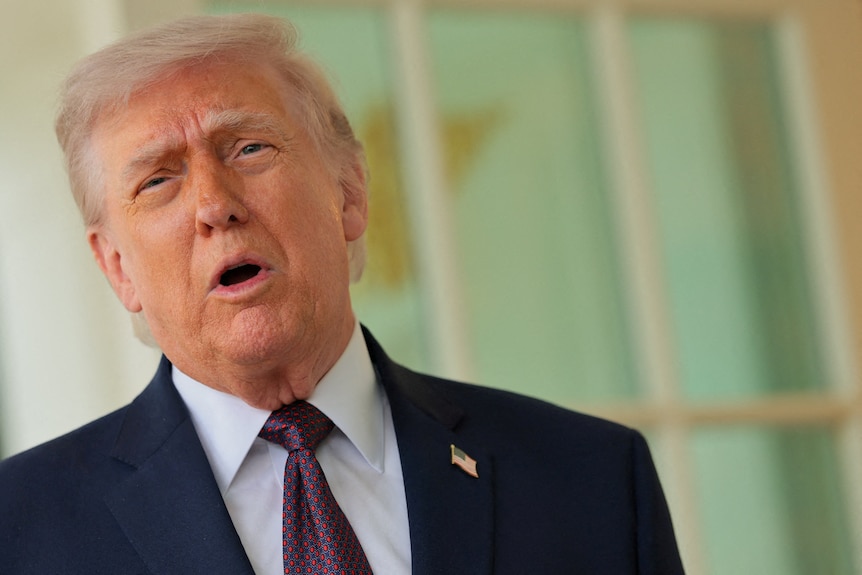
Whether it’s Donald Trump threatening to wipe out an entire civilisation, posting a Jesus-like image of himself or taking pot-shots at the pope, there’s daily disbelief at what’s coming out of the White House. (Reuters: Jonathan Ernst)
Australians paying price for war
After initially supporting the US and Israeli strikes against Iran in the hopes this would be a short, sharp operation, the prime minister and foreign minister have spent the past few weeks calling for “de-escalation”.
In a coordinated move, Treasurer Jim Chalmers has gone even further this week. He’s bluntly calling on Trump to end this war.
“Australians didn’t choose the circumstances of the war,” Chalmers pointed out before boarding a plane to the United States yesterday, “but they are paying a very hefty price for it”.
He certainly doesn’t see this as a “small bit” of pain as he faces the difficulty of putting together next month’s budget with competing demands for serious reform, spending cuts, and enough support for an unknown but potentially disastrous economic future.
The treasurer is not alone in trying to dial up the diplomatic pressure for peace.
Chalmers, who joins his counterparts and central bank governors for a lightning round of G20, IMF and World Bank meetings in Washington later today, made his top priority for the visit clear: “The purpose of this trip is to join with other countries continuing to call for an end to this war in the Middle East.”
This collective call from stressed finance ministers flying into Washington may be unlikely to sway Trump, but it underscores the mounting strain this war continues to place on US alliances.
Loading…A blockade no-one wants to join
The naval blockade of Iran is the latest flash point of disagreement.
The president initially said “other countries” would join his blockade, but NATO allies were quick to say no thanks.
The Australian government also appeared to rule out any involvement before any request had even been received.
Defence Industry Minister Pat Conroy told Afternoon Briefing on Monday, “we’re not considering joining the blockade”.
In the days since then, he and other ministers have been less emphatic, leaving some room for consideration, depending on where this unpredictable situation goes.
Strategic analysts are somewhat divided on Trump’s latest move. Even critics of the president’s war strategy (or lack thereof), such as Joe Biden’s former national security advisor John Kirby, argue that the blockade “might be helpful” as a diplomatic tactic.
The signals from the opposition are also somewhat mixed.
Loading
Shadow defence minister James Paterson, a whole-hearted supporter of the US alliance, described joining this blockade as “a very grave decision to make”.
“I am very cautious and frankly sceptical about whether … it is in our national interest or whether it’s within our capability, to join a blockade on Iran,” he told 7:30.
“That would be crossing a very significant threshold to effectively be participating in offensive operations against Iran.”
His leader, Angus Taylor, by contrast, expressed fewer concerns, arguing: “Australia should be providing whatever support we reasonably can to make sure we get the Strait of Hormuz opened up”.
China, which took 90 per cent of Iran’s oil exports before the war began, has branded the US blockade as “dangerous and irresponsible”, sharpening fears about where this conflict heads next.
A boost for defence
Defence Minister Richard Marles has a chance today to explain how the government is navigating the strategic bind this war has created.
He will address the National Press Club to launch the government’s latest National Defence Strategy, which includes an extra $14 billion in spending over the next 4 years and $53 billion over the decade.
If Australia were to adopt the same metrics as NATO, he would argue, this would lift defence spending to approximately 3 per cent of GDP by 2033, a minimum benchmark Trump has demanded of US allies.
Government announces billions in spending on military drones
The extra spending on drones and other automated systems will improve Australia’s readiness for what lies ahead, Marles will argue.
The harder question is whether it can keep pace with a strategic environment worsening by the month.
The defence minister will note “international norms that once constrained the use of force and military coercion continue to erode”. He doesn’t mention Trump in this context. He doesn’t have to.
Polls show support for the US alliance has slipped in Australia since the war began. This will only make the government’s task of maintaining support for AUKUS even harder.
From immediate financial concerns to longer-term strategic challenges, it’s little wonder that ministers’ frustration is increasing every week this conflict drags on, even when a ceasefire is meant to be in place.
David Speers is national political lead and host of Insiders, which airs on ABC TV at 9am on Sunday or on iview.
Loading…