

Sam BruceApr 16, 2026, 12:32 PM
CloseSam was brought up on long drives and the dusty fields of north-west New South Wales, where he developed his love of rugby from an early age. He joined ESPN after a five-year stint heading up Fox Sports Australia’s digital rugby coverage.
Multiple Authors
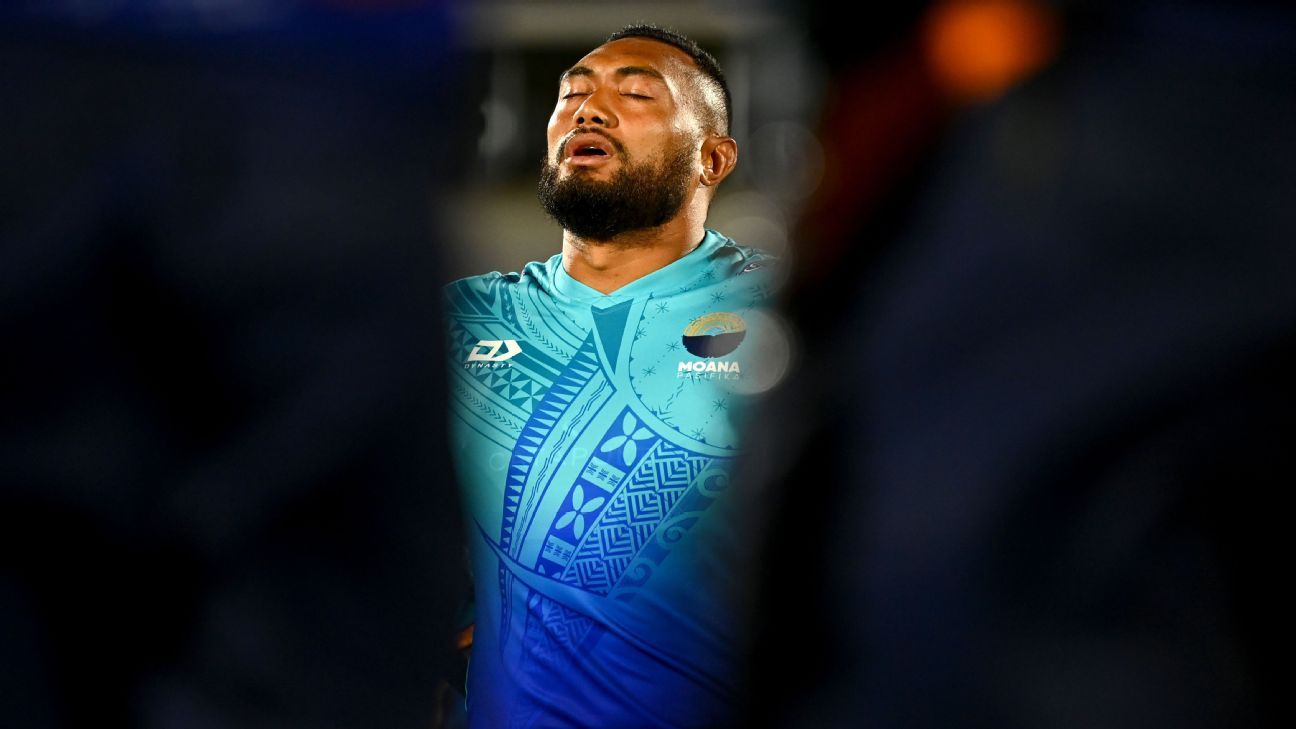
Moana Pasifika’s inaugural captain and Wallabies centurion Sekope Kepu has lamented the demise of the Super Rugby Pacific franchise, describing his time with the team as one of the highlights of his career.
Moana will cease to exist at end of the 2026 season, Wednesday’s announcement from franchise owners Pasifika Medical Association officially ringing the death knell on the team’s five-year run.
But with World Rugby having wound up their initial support, and New Zealand Rugby, who retain the team’s license, facing financial challenges of its own, Moana’s long-term viability had been the subject of speculation for some time.
Still, their demise hasn’t been, and should not be, greeted with any joy. And it has certainly stung Kepu who, after a storied career at both club and Test level, concluded his playing days in Auckland with Moana, handed a final opportunity to honour his Pasifika heritage.
“I could wholeheartedly say it was probably one of the highlights of my career, being able to come back to be a part of a team that was a true reflection of me,” a disappointed Kepu told ESPN from Japan, where he now coaches Shimizu Koto Blue Sharks.
“And I guess representing our Pacific people and being a proud Tongan man, it was nice to get back in, and being away for so long and to come back to a team that truly accepts you for who you are as a person and my values.
“Obviously, with our Pacific heritage and our people, faith is a big part of that, and our culture is massive. So to sit there and start our days off with meetings; you’d say a prayer and you’d start off with hymns and songs and chants; that was always something you looked forward to.
“And look, we had challenges setting up the team in our first few years, it was highly, it was challenging, but it was highly satisfying to be able to navigate that space and help not only the players, but also those around us in the environment in terms of coaches and staff.
“So it was definitely a highlight of my career, and I’m really grateful that I got that opportunity to kind of give back after years of being abroad and learning a lot, gaining a lot of experience. To be able to give that back to the Moana Pasifika team was pretty special.”
Sekope Kepu said his three years at Moana Pasifika were some of the proudest of his storied career Hannah Peters/Getty Images
As Kepu said, Moana faced significant challenges, particularly in its first two seasons when the team won just three games. In 2024, they registered four victories, while Ardie Savea’s arrival in 2025 saw Moana record six wins, achieving their highest ever finish of seventh.
Just exactly what the franchise was trying to achieve, however, was a constant topic of debate.
Regardless, Kepu said the environment Moana fostered for players of Pasifika heritage was something they would not have got elsewhere, and that the growth he saw in some of the franchise’s younger players was undeniable.
“We all saw a lot of good growth and it was, for a lot of them, some hard lessons,” Kepu said. “It was trying to speed up their learning and adapting of their habits and training habits and everything to what a professional rugby player looks like. And I’m grateful that we had a great leadership team, and our manager at the start that really helped nurture that.
“There [are] still guys there from the first season; William Havili and Abraham Pole and Miracle Fai’ilagi, who’s become a great leader and player now, and represents Samoa, a kid from the village. From the squad of 30-odd at the start, there was only a handful of us that played Super Rugby. And to be able to get those guys around us to learn and grow has been pretty special.”
Fai’ilagi remains Moana’s biggest success story. Having first been scouted on-island in Samoa, Fai’ilagi has since established himself as one of the best back-rowers in Super Rugby. He flourished while playing alongside Savea in 2025 and was this year named the team’s captain.
Whether such a story can unfold beyond this season is one of Kepu’s biggest concerns.
“There are more guys like Miracle, in Tonga and Samoa,” Kepu said. “And to have him play in Super Rugby, which is the primary competition that every family in Samoa and Tonga and the Pacific watch, so to have him running around in the Super Rugby competition as well as he has been, is massive.
Miracle Fai’ilagi is Moana Pasifika’s greatest success story, having been brought through from Samoa to become the team’s captain Fiona Goodall/Getty Images
“For the young boys seeing him doing that, all of a sudden that plants the seed and they think they can be the same. So I think that’s the ultimate goal, to inspire the next generation, but also give back to the communities that they come from. And a lot of the guys were guys that also grew up in New Zealand and Australia that had come over in the first generation. So, you’ve got to give back to their families and it’s sort of a little bit of a gesture of gratitude for the sacrifices they’ve made.”
While the stakeholders involved with the franchise may have had the best intentions, with the promotion of Pasifika rugby at its core, the reality is that commercial issues had plagued the team from the outset. Ultimately, Pasifika Medical Association have had to cut its losses and the fact that no saviour has jumped at the chance to obtain the license reflects the challenges in the local sporting market.
The Australian Government has however agreed to a funding package for the Pacific worth $150 million, after previously green lighting $600 million for the NRL’s expansion to Papua New Guinea, some of which it has since been revealed has been carved for a broader play in the Pacific region.
Reports have previously suggested that the Fijian Drua, and potentially teams from Tonga and Samoa could join Australia’s Super Rugby Aus, which will be contested later in the year, potentially setting up one avenue where the loss of Moana Pasifika might be somewhat offset.
“Obviously the ultimate goal would be for them to stay in the competition and just to carry on. But, I mean, if that’s an alternative, then yeah, definitely,” Kepu responded when asked about the $150 million package and a potential move to Super Rugby Aus.
“It’s been five years’ worth of work and dedication put in by so many different people and players. So, I think whatever the Australian Government can do to help and assist in that way would be greatly appreciated. To see what the government has done for the PNG team and the rugby league, and I know that they’re funding from time to time, with some of the rugby and stuff.
“Rugby union is a far greater global sport and it’s recognised all over the world. And when we were playing and representing the team, people from all walks of life, from all different industries all over the world would reach out and send their messages of how proud they are to be affiliated, or feel like they’re a part of a team that represents them.
“And I think that’s what people don’t realise, it’s not a franchise or a union or a team that is a part of a city, it’s a team, it’s a people’s team that represents Pasifika people all over the globe.”
Having seen firsthand the growth of rugby league in New Zealand, Kepu is aware of the fight rugby has on its hands to retain its place in the Pacific. And then there is Super Rugby itself, which has shrunk to the size of its amateur era tournament.
Japan presents a potential opportunity, though, and after spending a season-and-a-half as a coach with Shimizu, the former Wallabies prop believes it is a market the competition should once again revisit.
GET YOUR RUGBY FIX WITH ESPN
Stay across all the big rugby news — sign up to our weekly newsletter here!
SUBSCRIBE
And while Moana Pasifika as he knows has, for now, come to an end, the 110-Test prop will cherish the memories from his three years with the club.
“Plenty of good memories. The first couple of years, just the joy of turning up every day and trying to inspire those around me and trying to inspire the community at large,” Kepu reflected.
“Being able to represent our people and run out that first game, and during COVID in Dunedin against the Crusaders and scoring the first try in those moments. Getting your first number, your cap; getting the first victory against the Hurricanes. That was massive.
“It’s taken 20, 30 years [for teams to develop]; the competition is 30 years now. Moana came in five years ago, so people, I guess, lose sight that it’s taken those teams 25 years, or the head start to get to where they are today. And, we’re five years in.
“And hopefully people can see that and continue to develop because, I mean, the impact last year that the team had on the rugby community was massive. So I think those are the things, the uniqueness of the team and what it brings to the competition, that’s what I’ll cherish.”