
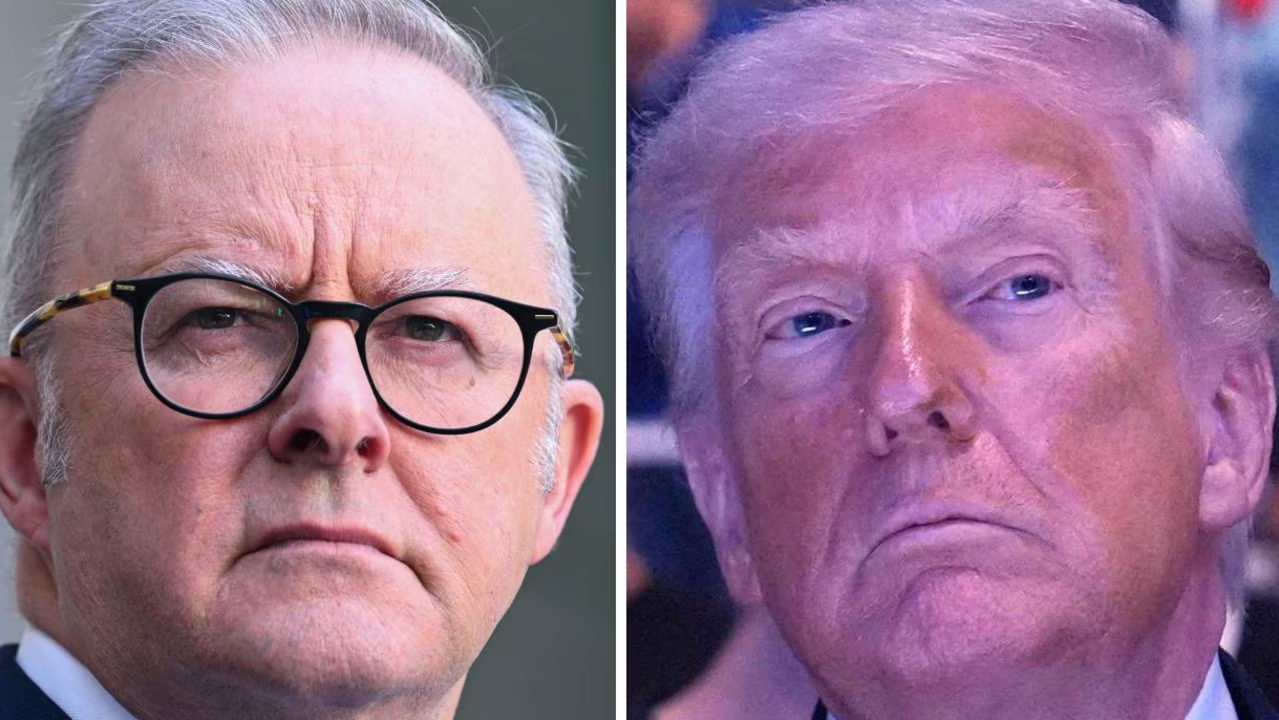
There is “no world” where the United States is not central to balance of power for Australia and the region, despite the Albanese government seeking great self-reliance, Richard Marles has warned.
The Defence Minister appeared before the National Press Club in Canberra on Thursday, where he announced the 2026 National Defence and Integrated Investment Program.
He said the government would invest an additional $14bn over the next four years and $53bn over the next 10 above the trajectory set in the 2024 NDS, which will be in the May 2026-27 budget.
However, it will not be until 2033 that Australia is expected to reach about three per cent defence spending as a proportion of GDP.
It falls short of the US president’s demands that allies immediately lift defence spending to 3.5 per cent of GDP to reduce financial burden on the US.
This request was conveyed personally by US Secretary of Defense Pete Hegseth to Mr Marles during a June meeting in Washington last year.
The United States and Donald Trump loomed large over Mr Marles speech.
Addressing the Press Club, Mr Marles said Australia’s large maritime domain and “relatively small” industrial base posed a “unique defence challenge”.
“Which we have historically addressed through partnership with a major power,” he said.
“But, the current strategic environment is challenging old assumptions.
“Middle powers that don’t take on more responsibility for their own security will be more exposed to coercion, and face greater limits on their sovereignty.”
However, a greater focus on Australian self-reliance “should not be confused with military self-sufficiency”, Mr Marles said.
“This is not about jettisoning alliance relationships. To the contrary, alliances, especially with the United States, will always be fundamental to Australia’s defense.”
Mr Marles said the relationship with the United States was “fundamental to Australia’s own national security and national defence”.
“We make that point really clearly, and I do think that Australians understand that,” he said.
The Defence Minister said there was “no world in which you create a balance of power within the Indo-Pacific without a continued American presence.”
Further still, he said the global rules based order “would not have existed without American leadership, based on an enlightened conception of its own self-interest”.
“Now, I understand the US frustrations that allies might seek to free ride on this US leadership, or believe that somehow the order acts as a substitute for hard power – it does not,” he said.
“Any rules based order can only prevent conflict when it is underpinned by the hard power necessary for collective deterrence.
“Australia must contribute to this, and we are, and we will work with all our like minded partners to better shape our region’s strategic trajectory.”
United States allies, including Australia, have faced pressure from Donald Trump to join a potential operation in the Strait of Hormuz.
Taylor lashes defence spending
On Thursday, Opposition Leader Angus Taylor said Labor’s investment would not adequately meet the country’s needs.
Asked what a Coalition government would do differently, Mr Taylor told reporters: “We need to get our spend to three per cent of GDP.”
“We know that’s the benchmark that puts us in a position where we can invest not just in the submarines that we need, the AUKUS submarines, the nuclear submarines, but also in the drones, the missile capability, and in the people we need in our war fighters,” he said.
He described Labor’s upcoming NDS as an exercise in “creative accounting”.
“This is a government that’s not taking defence of our country seriously, and creative accounting does not defend Australia,” he said.
The NDS noted the need to leverage alternative financing, including equity-based financing through Commonwealth bodies and private financing.
Mr Marles also touted spending within Australia.
In his speech, Mr Marles lashed the Coalition for its record on defence spending.
“This Labor government has done 12 times as much in four years as what the Liberals did in nine,” he said.
“So, every time you hear the Liberals carp about defence, remember that fact.
“Every time you hear a former Liberal prime minister chest beating, remember that while there may be lions in the cheap seats, they were mice when they were in office.
“And, when you hear the Leader of the Opposition talking a big defence game, just remember that he was a member of Cabinet in a Liberal government that gave us a lost defence decade when our nation could least afford it.”
Mr Marles dismissed commentary about spending from people who had not sat at on Expenditure Review Committee (ERC) as “worthless”.
“Because increases in defence spending do not happen as a result of think tanks or former generals or washed bureaucrats,” he said.
“It happens by winning arguments around the ERC table where every dollar is hard fought, as it should be.
“And the truth is that the ERC table the Liberals convened failed our nation’s defences and left Australians less safe.”
Mr Marles said Australia’s defence spending was the “most of any comparable like-minded country in the Indo-Pacific”.
“It is more than most countries in NATO, including the UK, Germany, France, Italy and Canada,” he said.
Drones, missiles, and satellites
A range of capabilities will be prioritised under the most-recent defence plan.
They include subsea warfare capabilities, a “more lethal” navy combat fleet, expanding naval shipbuilding, and a multi-orbit satellite communication system.
Australia will also increase development of a sovereign hypersonic strike capability through AUKUS, as well as accelerate the introduction of air and missile defense capabilities, including new investment in a medium range, ground-based air defense system, Mr Marles said.
He also sought to beat the drum of Australian investment in drones, including Australia‘s pioneering Ghost Bat and Ghost Shark.
“Even when Australia is not an active participant in war, we feel its consequences,” he said.
“This same interdependence offers new tools for coercive and grey zone state craft, whilst lowering the threshold for its use, from the pervasive penetration of digital communications systems, to the targeting of critical undersea architecture, and the leveraging of economic choke points.
“This is occurring, alongside a rapid transformation in the character of warfare itself as conflicts in both Ukraine and the Middle East have demonstrated.
“While attrition and high intensity conventional warfare remain enduring features of war, the ability to gender at asymmetric advantage is quickly establishing tactics and doctrine.
“The Ukrainian example – matching rapidly evolving cheaper military equipment against larger more expensive platforms – is driving new investment in emerging and disruptive technologies, including AI.
“And, these technologies offer revolutionary promise, but also new threats.
“Unlike previous innovation cycles where the cost of entry was high and uptakes depended on a sovereign industrial base, this new cycle will be faster and it will spread more quickly.
“And this will challenge our collective ability to manage risk.”
Mr Marles warned of the large US build-up in the Middle East, the largest in decades, the ending of non-proliferation agreements, and China’s claims in the South China Sea.
“All nuclear weapons states are growing their arsenals once more, with the biggest growth occurring in China,” he said.
“China has now resumed large scale land reclamation for new military facilities at Antelope Reef.
“China is also deploying the PLA Navy in the Pacific, maritime South-East Asia and the Indian Ocean.
“And, PLA (China’s People Liberation Army) deployments close to Australia have grown in frequency and capability over the last two years – a trend that will continue.
“And, China has deepened its strategic partnership with Russia.”
More to come