
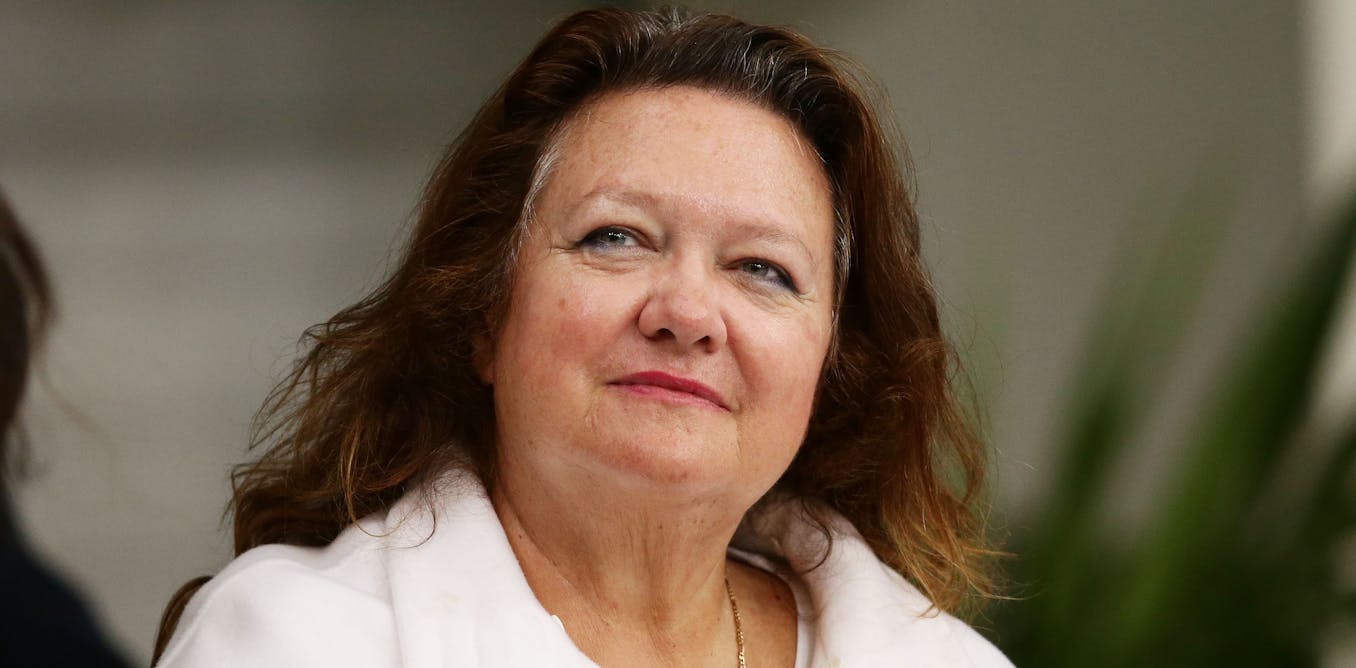
In a decision described by the judge as “a half-win” for each side, mining magnate Gina Rinehart has been ordered to pay hundreds of millions of dollars in royalties to the heirs of Peter Wright, the business partner of her father, Lang Hancock.
However, under the ruling, Rinehart’s company, Hancock Prospecting, will retain ownership of the iron ore mining tenements in question, Hope Downs and East Angelas.
The Western Australia Supreme Court case hinged on agreements made in the 1980s to divide the assets, and was one of the longest-running cases in Australian history.
Rinehart has topped the Australian Financial Review’s Rich List for six years in a row with total wealth of A$38.1 billion in 2025. So the payout of royalties in the “hundreds of millions” will only make a small dent in that wealth.
Litigation lasting for years
This is neither the first nor the last piece of litigation involving Rinehart and various claimants to the wealth she inherited from her father and developed further to become the richest person in Australia, and one of the richest women in the world.
In the 1990s, Rinehart engaged in protracted litigation with her father’s third wife, Rose Porteous. The case ended in a settlement, which left Rinehart in control of most of Hancock’s assets.
And for the past 20 years or more, she has been fighting her own children in a series of court cases that are still continuing.
None of these cases are likely to dent Rinehart’s position at the top of the AFR Rich list. And nearly all the parties involved (except Porteous) are already billionaires.

Gina Rinehart’s children Bianca Rinehart (left) and John Hancock outside an earlier court hearing in 2023.
Aaron Bunch/AAP
Wealth at the top is growing fast
Such disputes over massive inheritances are exactly what would be expected in the “patrimonial” society described by economist Thomas Piketty in his book Capital, a big hit a decade ago. This refers to a society where wealth and social position are dominated by inherited capital, not earned income.
And at less stratospheric levels of wealth, the disputes will resonate with young people whose only hope of home ownership seems to rest on assistance from the “Bank of Mum and Dad”.
There is little doubt that the concentration of wealth at the top end of the wealth distribution in Australia has increased massively over the past 20 years.
The combined wealth of the 200 individuals on the 2025 AFR Rich List was calculated as $667 billion. That’s 100 times more than the total of $6.4 billion from the first BRW Rich list in 1984.
By contrast, Australia’s economy (gross domestic product, not adjusted for inflation) has grown only 15 times. Even allowing for some possible understatement in the 1984 data, it’s clear the wealth of the top 200 has grown much faster than than national income.
But how much of this is due to inheritance?
Examination of the AFR Rich List reveals a mixed picture. The two spots after Rinehart are occupied by real estate developer Harry Triguboff and Anthony Pratt, chairman of the packaging empire Visy Corporation.
Triguboff, now aged 93, will be succeeded by his children and grandchildren when he passes away. Anthony Pratt is the grandson of Leon Pratt, who established the business in the 1940s.
So far, this looks like a list dominated by inherited (or about to be bequeathed) wealth. But those in the rest of the top 10 list, most notably the founders of technology companies Atlassian and Canva, made their own money.

Co-founders of tech company Atlassian, Scott Farquhar and Mike Cannon-Brookes.
Dan Himbrechts/AAP
Beyond the top 10 richest, the rest of the list is similarly mixed. Around half of the top 200 made their own money. But second, third, fourth and even fifth-generation wealth is well represented.
Some other famous family names such as Myer and Baillieu no longer even make this top 200 list. Yet the collective wealth of these long-established families remains immense.
There is little evidence to support the proverb “shirtsleeves to shirtsleeves in three generations”, meaning that one generation makes money from humble beginnings, the next lives in comfort of the accumulated fortune and the third dissipates it, returning to poverty.
In short, you don’t have to be born rich to make big money in Australia, but it certainly helps.
Is it time for a wealth tax?
Since the share of wealth held by the richest Australians has grown so much in recent decades, the fact that as much as half of this wealth is inherited should be a matter of concern to all of us.
The question of whether and how to tax wealth cannot be avoided forever.
One option is a return to inheritance taxes. The abolition of these taxes in the 1970s contributed substantially to the growth of wealth inequality. Literature seems to take this point as self-evident.
Another option would be an annual tax on wealth, reflecting the fact that returns to large concentrations of wealth have greatly exceeded growth in income and wages. This idea has been pushed by the Greens in a plan to tax the richest 1%, but seems unlikely to be taken up by the Albanese government or the Coalition any time soon.
Read more:
Some economists have called for a radical ‘global wealth tax’ on billionaires. How would that work?