
Lee Cronin’s The Mummy is not the film you might be expecting – and that’s precisely its strength. Rather than leaning into the sweeping, action-adventure bombast typically associated with the title, Lee Cronin pivots sharply into something far more intimate and unnerving: a slow-burn, investigative horror story rooted in grief, absence, and the uncanny terror of something returned… wrong.
The premise is deceptively simple. When young Katie (Emily Mitchell), the daughter of Charlie Cannon (Jack Reynor), a journalist based in Cairo, vanishes into the desert without a trace, the emotional devastation fractures a family beyond repair. Eight years later, her sudden reappearance should signal relief, even joy – but Cronin is far more interested in the psychological fallout than catharsis. What unfolds instead is a deeply unsettling portrait of a family trying to reconcile memory with the reality standing in front of them.
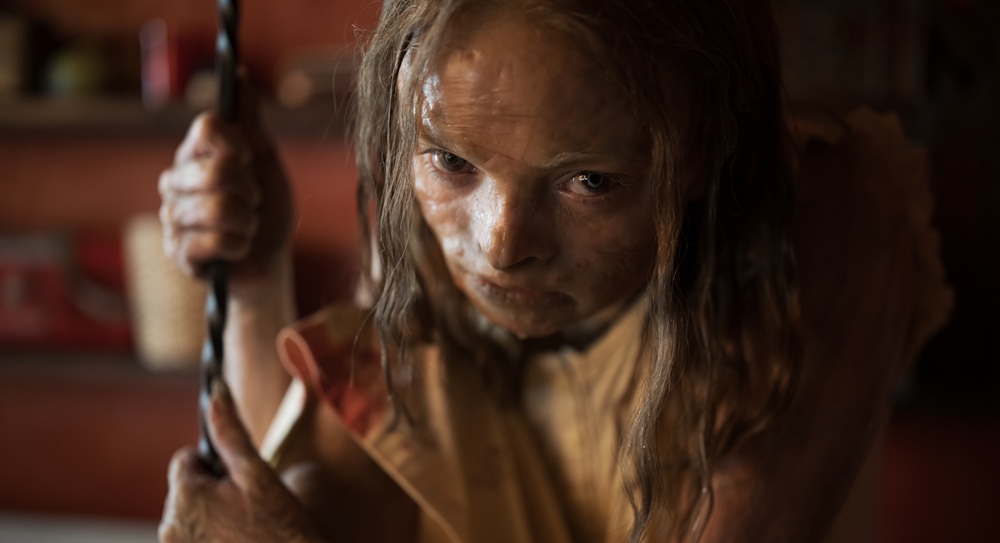
Cronin, building on the oppressive atmosphere he honed in Evil Dead Rise, dials back the outright gore in favour of sustained dread. That’s not to say the film is without its visceral moments – it absolutely has them – but they’re deployed with precision rather than excess. A sequence involving the cutting of Katie’s overgrown nails is a masterclass in squeamish tension, the kind of scene that has audiences recoiling not because of what’s explicitly shown, but because of how deeply it gets under your skin.
At its core, this is a film about performance – and the cast rises to meet its demands beautifully. Reynor and Laia Costa ground the film as parents caught between hope and horror, their grief never feeling performative, but lived-in and raw. May Calamawy brings a quiet authority to Dalia Zaki, the detective assigned to the Cannon’s case, serving as both an audience surrogate and a stabilising force amid the growing unease.
But it’s Natalie Grace as the returned Katie who lingers long after the credits roll. With minimal dialogue, she crafts a performance that is equal parts terrifying and tragic. There’s a physicality to her presence – an unnatural stillness punctuated by bursts of contorted movement – that evokes the best traditions of possession horror, while still feeling wholly her own. She is, at once, the film’s greatest mystery and its emotional anchor.
The film’s structure leans heavily into its investigative framework, slowly peeling back layers of what happened in the desert and what, exactly, has returned. This measured pacing is largely effective, though it does contribute to one of the film’s few shortcomings: at over 130 minutes, it occasionally feels like it’s stretching material that might have benefited from tighter editing. Some narrative beats linger a touch too long, slightly diluting the otherwise razor-sharp tension.
Similarly, the final act shifts gears into more familiar horror territory. After such a carefully controlled build, the last 30 minutes embrace a broader, more spectacle-driven approach that, while effective, feels somewhat at odds with the film’s earlier restraint. It doesn’t derail the experience, but it does soften the uniqueness that defines much of what comes before.
Still, these are minor quibbles in what is otherwise a compelling reimagining of a classic horror concept. Originally titled The Resurrected, the film’s evolution into The Mummy places it in conversation with modern reinterpretations like The Invisible Man and Wolf Man – stories that strip away iconography to uncover something more psychologically potent beneath.
Much was made of rumours surrounding producer James Wan allegedly walking out of a screening, with speculation ranging from excessive violence to outright failure. In reality, as Cronin himself clarified, the truth was far less dramatic – and the film itself proves why those rumours never held weight. This is neither an exercise in empty shock nor a misfire; it’s a confident, controlled piece of horror filmmaking.
The Mummy is less concerned with resurrecting a monster than it is with examining what resurrection does to the people left behind. It’s eerie, emotionally grounded, and anchored by a breakout performance that signals a formidable new talent. Cronin may not reinvent horror entirely here, but he demonstrates a clear command of tone and tension – and, more importantly, a willingness to let discomfort do the heavy lifting.


THREE AND A HALF STARS (OUT OF FIVE)
Lee Cronin’s The Mummy is now screening in Australian theatres, before opening in the United States on April 17th.
*Image credit: Patrick Redmond/Warner Bros. Pictures.