
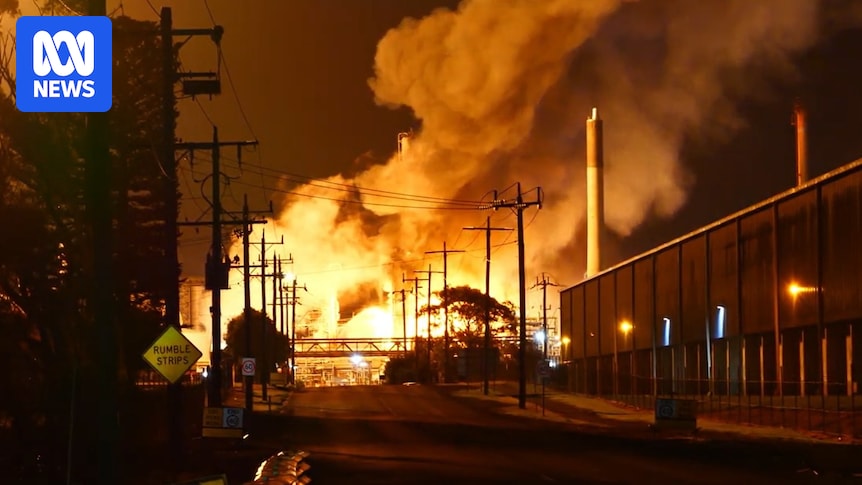
The exact cause of a major fire at one of Australia’s two main oil refineries is still under investigation, as questions persist as to how the blaze will impact the nation’s fuel supply.
The Viva Energy refinery at Geelong employs 1,000 people and supplies around 10 per cent of Australia’s fuel — and more than 50 per cent of fuel in Victoria.
The fire broke out late on Wednesday and was extinguished within 13 hours.
One analyst warned the fire “couldn’t come at a worse time,” though others have said it’s too early to predict the impact of the blaze on fuel prices.
What oil products are manufactured at the Geelong refinery?
Since 1954, the refinery has operated from a site in Corio, north of Geelong and about 65 kilometres south-west of Melbourne.
It is owned and operated by Viva Energy, an energy company that supplies fuels to industry but also consumers through its national network of 1,500 Shell, Liberty and OTR services stations.
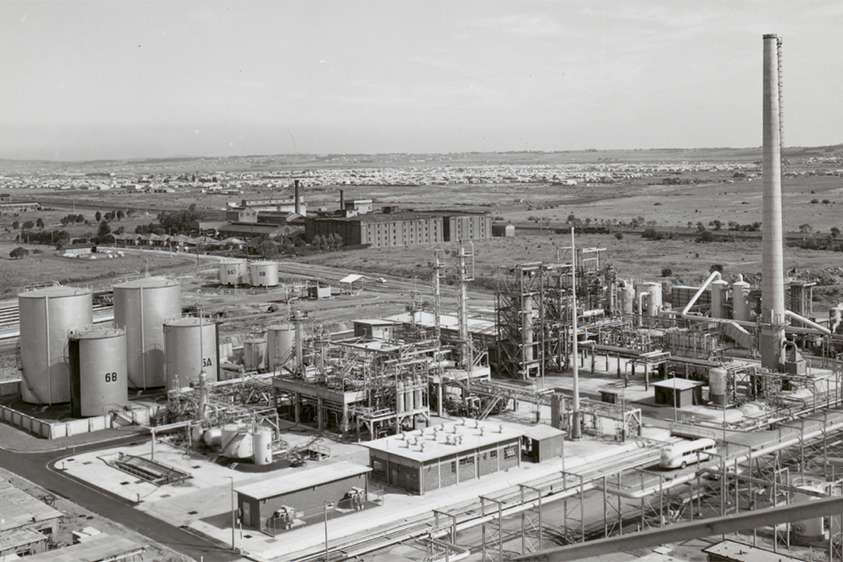
A historic photo of Geelong’s oil refinery, which began operations in 1954 under the ownership of Shell Australia. (Supplied: Viva Energy)
The refinery in Geelong manufactures petrol, diesel, LPG, jet fuel and avgas, refining the products from crude oil.
Viva Energy says the refinery can process up to 120,000 barrels of oil per day.
It also manufactures petroleum products including marine fuel oil, low aromatic fuel and plastic feedstock used to create food packaging, medical equipment and polymer banknotes.
What do we know about the fire?
The fire broke out just after 11pm on Wednesday evening.
Emergency Services were called following reports of explosions. They found flames burning approximately 30 metres high, with one witness reporting the fire sounded like an intense vacuum.
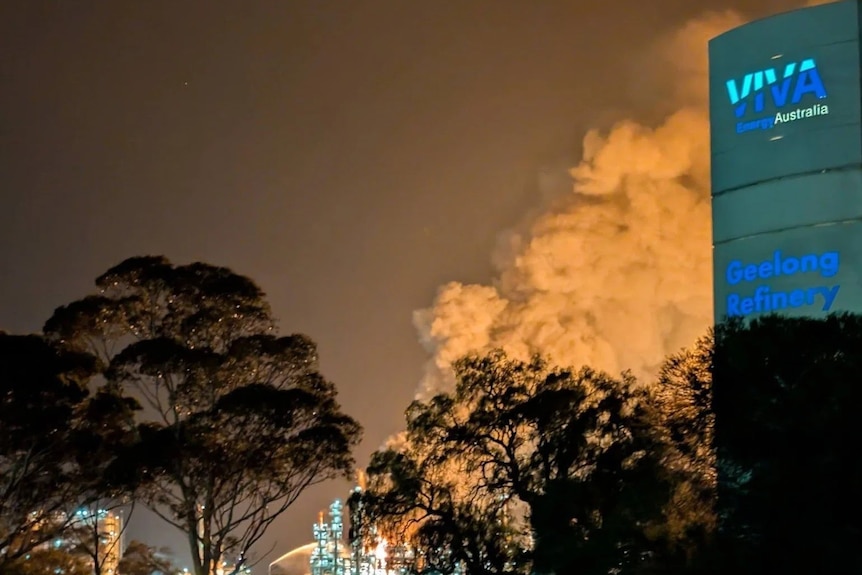
A witness described the Geelong refinery fire as sounding like loud, kind of sucking noise. (Supplied: Ben Young)
Michael McGuiness from Fire Rescue Victoria (FRV) said 50 firefighters worked to suppress the “large and intense” blaze.
But the fire continued to burn for more than 12 hours, with authorities able to contain the blaze by the morning and extinguish it by midday on Thursday.
Investigations will soon get underway to understand the cause, but authorities do not believe it was suspicious.
FRV has said an “equipment failure” was to blame, with the fire fuelled by a “significant leak of liquid hydrocarbons and gases”, which was detected by workers on site at the time of the fire.
This afternoon authorities said the leak was caused by the mechanical failure of a piece of equipment, but further details like how the fire was lit, was still under investigation.
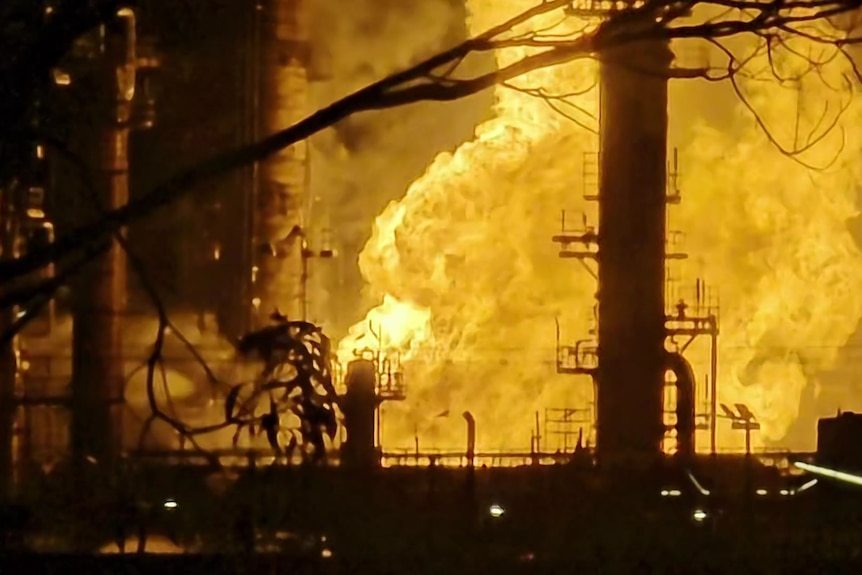
A dangerous fire rages through an oil refinery in Geelong.
Viva Energy’s refinery manager Bill Patterson said he arrived at the plant about 15 minutes after the fire broke out.
He described the scene as “pretty confronting” and acknowledged it was a “significant failure”.
“It’s a failure that we have to really thoroughly investigate and learn from … we can’t have this happen again,” he said.How did crews contain the fire?
Viva Energy said there had been no similar scale fires at the refinery in recent years, though there are many precautions in place to make sure any incidents are contained safely.
Firefighters used large quantities of water and fixed equipment — like remotely controlled water hoses that are permanently installed in high-risk industrial areas — to help manage the blaze while minimising the impact on workers and fire crews.
Loading…
Firefighter union boss Peter Marshall praised the efforts of those who worked to contain the blaze in a challenging environment.
“This could have gone horribly wrong and it’s not far from residential areas … we’re very lucky to have the people that we do have who are actually performing the work as firefighters,” he said.
Specialist hazardous materials crews were also deployed, which Fire Rescue Victoria said was to stop contaminate products going into waterways or smoke produced from the fire.
Queensland University Technology (QUT) science and engineering professor Richard Brown said refineries were designed to minimise the impact of any accident — and while “what happened was bad” — the fire didn’t spread.
“They’re designed with a whole series of measures to contain any problem that might occur,” he said.
Former refinery engineer and consultant Ross Stidolph said it was “very rare” for major fires to break out at refining facilities in Australia or other developed countries.
He said once the area had been made safe, it was likely the plant operator would seek to carry out repairs while an investigation into the incident was conducted by safety regulators.
What area of the Geelong refinery fire was impacted?
While some experts have warned the refinery fire will have an immediate impact on fuel prices, more information about damage caused by the fire is still needed to understand the impact it will have on future production.
Victorian Premier Jacinta Allan said fuel supply was sufficient and urged people not to engage in “unfounded speculation.”
Refinery manager, Bill Patterson told media Viva Energy was still “making petrol, diesel and jet fuel at pretty decent rates.”
“It hasn’t been a large impact at this stage,” he said.
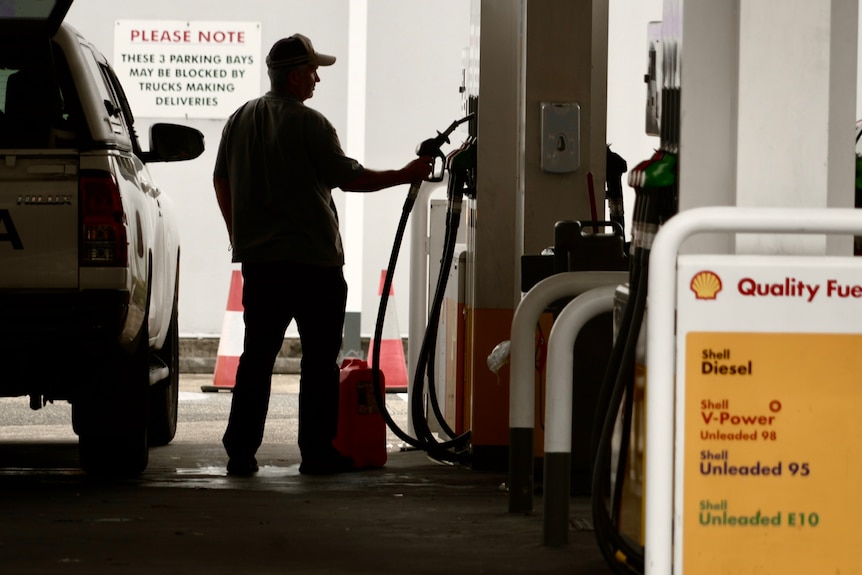
Geelong refinery owner Viva Energy also supplies fuel to its network of Shell, Liberty and OTR service stations. (ABC News: John Gunn)
Mr Patterson said the specific area impacted by the fire is involved in LPG production and low aromatic gasoline (a product designed to reduce petrol sniffing) which is supplied to some remote parts of Australia.
He said the remainder of the refinery has been running at reduced rates while details of the fire were being established.
Viva Energy’s CEO said it would ramp up production once it was it was safe to do so and suggested any shortfalls could be made up by fuel imports.
Which fuel prices will the refinery fire impact?
While there is not clear information about the impact on national fuel supplies, one energy analyst noted the impact on specifically petrol could be significant.
Kevin Morrison from the Institute for Energy Economics and Financial Analysis (IEEFA) said Australia’s two local oil refineries (in Geelong and Brisbane) produce more petrol than diesel or jet fuel.
He said both refineries produce about 100,000 barrels of petrol each day or about a third of Australia’s petrol requirements, and any supply shortfall “couldn’t come at a worse time”.
“Viva are going to be out there trying to secure more petrol supplies when the international market couldn’t be any tighter,” he said.
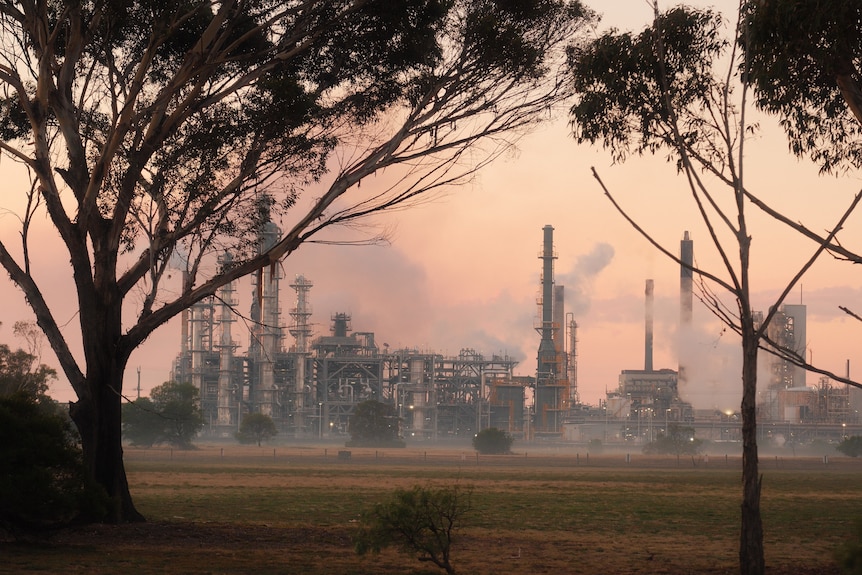
Smoke was still visible coming from the refinery fire on Thursday morning. (ABC News: Tara Whitchurch)
Australian National University supply chain expert David Leaney said Victorians should expect a price jump at petrol stations within days or weeks.
But he said the fire was unlikely to have a broader impact on diesel prices or interstate motorists, because it mainly supplied petrol to the Victorian market.
“Nationally this will not have a major impact,” he said.
Mr Leaney said news of the refinery fire could push up petrol prices quite quickly in Victoria as demand surges, but the actual impact on supply would not be known for two or three weeks.
While that jump in Victoria “may spill over the borders a little bit” it was unlikely to be nationally significant, he said.