
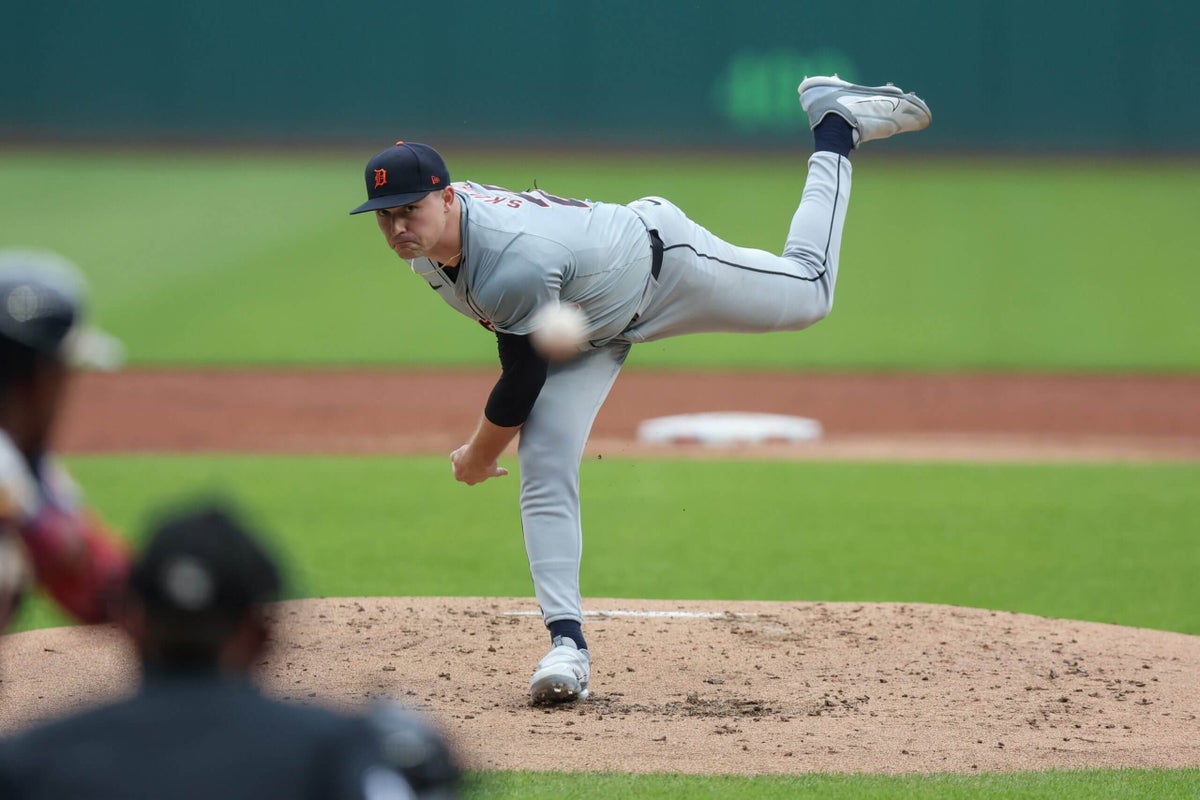
The strike zone is baseball’s sacred rectangle, the place where every bit of action on the field begins. Throwing strikes, taking balls and maximizing count leverage are the unseen forces that translate to fearsome strikeouts and mammoth home runs alike.
What’s lost in the commotion of MLB’s new Automated Ball-Strike challenge system is that, for the first time since 1996, the definition of the strike zone has changed. Everyone in the league is adjusting not only to the ABS challenge system, but also to the differences and ripple effects of what nearly everyone agrees is a smaller zone.
“It’s all the rage right now and everybody is talking about it,” Detroit Tigers right-hander Casey Mize said. “But the way we’ve treated it is it’s an accessory to the game, right? It’s just another rule change.”
The smaller strike zone is having an immediate impact. In MLB, the leaguewide walk rate has been remarkably consistent over time, sitting between 7.6 and 9.6 percent for the entirety of the past 70 years.
As of Wednesday, the MLB walk rate stood at 9.9 percent for the season.
The 9.2 percent walk rate in the shortened 2020 season is the only instance of a walk rate over 9 percent since 2000.
“I actually am curious to see what walk numbers are, strikeouts, OPS,” Tigers ace Tarik Skubal said. “Is offense up? Are pitch counts up? Are pitch counts down? Are guys swinging more because guys are over the zone more? I’m curious to see what the impact will be.”
Season
BB%
K%
OPS
Swing%
Zone%
2021
8.7
23.2
.728
47.2
42.1
2022
8.2
22.4
.706
47.7
41.3
2023
8.6
22.7
.734
47.4
41.9
2024
8.2
22.6
.711
47.8
42.4
2025
8.4
22.2
.719
47.5
43.6
2026
9.9
22.7
.701
46.2
41.1
After the fifth inning of his March 31 start against the Arizona Diamondbacks, Mize stood on the field and chatted with home-plate umpire Bill Miller. Mize and Miller both serve on MLB’s 11-member joint competition committee, a group that helps approve on-field rule changes. Mize said he asked Miller about his experience with ABS. Miller, Mize said, mostly sees it as a force for good. But there’s no doubt the ABS puts a greater challenge on pitchers and umpires.
With an altered zone has come the elimination of visual cues for what constitutes the top and bottom of the zone.
“I feel like everyone’s still learning, honestly,” Guardians right-hander Tanner Bibee said.
In the past, MLB defined the top of the strike zone as “the midpoint between the top of the shoulders and the top of the uniform pants.” The bottom of the zone was “a line at the hollow beneath the kneecap.” Both boundaries were dependent on the hitter’s stance in the box.
Now, however, the top of the strike zone is 53.5 percent of the player’s height, and the bottom is 27 percent. The player’s stance does not matter.
MLB research indicated umpires previously called the zone closer to 55.6 percent of players’ heights at the top and 24.2 percent at the bottom.
For once, pitchers can empathize with umpires relearning the zone and navigating the new system.
“The hitter’s strike zone doesn’t change,” Mize said. “I face nine different strike zones. The catcher sees nine different strike zones. The hitter just has his own.”
With the new definition of a strike comes an element of mystery when it comes to visualization. Where exactly is the top and bottom of the zone for each batter? How are you supposed to know what 27 percent of someone’s height looks like?
And how in the world do you account for hitters with non-traditional batting stances?
“That’s when it becomes difficult,” Mize said. “You think of a player like Juan Soto who really spreads out or a guy like Cody Bellinger who stands straight up.”
Skubal, the back-to-back American League Cy Young Award winner, was considering this very dilemma back in spring training.
“I’m probably going to do a lot of research on mound vision,” Skubal said. “What the top is for that guy, what the bottom is for that guy, so visually I’m ready for it.”
So far, Skubal hasn’t quite taken it to that level. He said he’s always based his visuals more on the catcher, not the batter. But like many, Skubal and Mize are using dugout iPads to seek in-game feedback. With no clear cues such as batter’s kneecaps to rely on, they are learning the true boundaries of the zone as they go.
“For the most part, I still have my sights set on what I believe the bottom of the zone is,” Mize said. “And then I go back and check the ABS and say ‘OK, I have a little bit more room to go,’ or ‘OK, my sights might be a little bit off.’ And I make a micro-adjustment like that.”
In Baltimore, Orioles starter Chris Bassitt has notes with keys showing the top and bottom of the zone for different hitters. But even with those visuals at his disposal, Bassitt isn’t pulling all-nighters memorizing each cue.
“I’m not trying to overwhelm myself by going, ‘All right, I’m facing nine guys today, here’s all nine guys,’” Bassitt said. “I am not really doing that because, for the most part, a lot of them fall in the same bucket. So it’s the outliers. Like Oneil Cruz. Where is his top? Where is his bottom?”
The changes in cues and preparation — plus the tighter zone — are among the ways the ABS is changing the game in ways we might not yet fully grasp.
“I think the general consensus is the top of the zone is lower than it should be,” Skubal said. “I still think the zone should go up a little bit, in terms of what the strike zone is — what it actually is, not what we have it as right now. But the bottom of the zone is also down there.”
For now, many pitchers are still trying to throw their best stuff near the top rail of what they believe to be the strike zone.
“If I’m throwing a good heater, it should be a good result regardless,” Bibee said.
But as time goes on, will hitters adjust? Or might they be adjusting already?
And if so, what does that mean for flamethrowers who love to fire near-unhittable fastballs above the letters?
“I have noticed I don’t get as many swings at the top shelf anymore,” Royals pitcher Seth Lugo said. “Guys aren’t too aggressive up there anymore.”
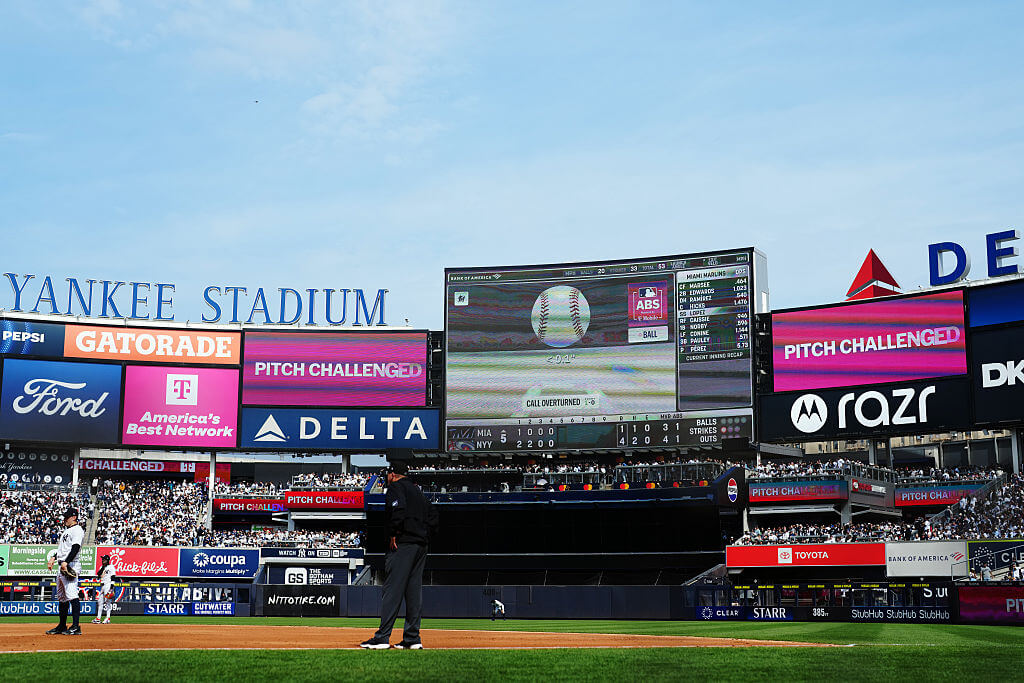
The new challenge system continues to bring unexpected ramifications. (Mary DeCicco / MLB Photos via Getty Images)
In Triple A, the walk rate increased from 9.68 percent in 2021 to 10.94 percent last season, the first year with the ABS challenge system in operation from start to finish. The strikeout rate declined by less than one percentage point in that same time.
So far at the MLB level, strikeout rates have been relatively steady despite the increase in walks.
“I don’t think it changes the way I pitch,” Lugo said. “When things are going well for me, my whole mentality is (to) challenge hitters in the zone. So, if anything, it gives me a little more confidence knowing that some of those borderline pitches, my catchers are going to challenge for me.”
The positive here is that the strike zone no longer varies from game to game or umpire to umpire, at least to the extent ABS challenges can mitigate missed calls.
Despite different zones for each batter, what we now call the strike zone is clearly defined. The zone accounts for the 17 inches of the plate side to side. It’s actually a bit wider, given that any pitch that so much as nicks the edge of that zone is called a strike.
There’s a thought that the ABS zone will help pitchers get more calls on the corners, where umpires before could call the zone more like an oval. The shift from a three-dimensional zone to a 2-D zone, hung like a pane of glass over the middle of the plate, also means certain pitches with extreme movement might be called differently.
So far, four-seam fastballs have still generated the greatest volume of challenges (360), with sinkers (209) and sliders (134) coming in second and third.
Perhaps related to the visual uncertainties about the top of the zone, pitches along the top rail are getting challenged less often than other locations. As of Wednesday, Statcast data indicates hitters and fielders combined have challenged calls at the top rail of the zone 202 times. There have been 340 challenges on close pitches at the sides. The bottom rail of the zone has been the source of the most dispute, triggering 456 challenges.
Batters have had the most success challenging pitches up top, challenging correctly on 51 percent of calls compared to a 46 percent rate at the bottom rail and sides. Catchers, meanwhile, are challenging successfully only 54 percent of the time at the top rail compared to a 60 percent at the bottom rail.
“With umpires, you didn’t really know where the top was,” Bibee said. “You kind of knew where the bottom was and obviously the plate for east and west, but the top was always the one iffy one that you could get. Now I’m just trying to figure out where the top of the zone really is, especially person to person. It’s so different.”
As the season goes on, pitchers, umpires, hitters and catchers alike will all get more comfortable with the zone, and perhaps the subtleties of the game will change in a new way.
For now, everyone is still getting a feel for the sport’s all-important rectangle.
“I understand it’s a big deal. It’s the strike zone,” Mize said. “We think the zone is obviously smaller now. But it’s not going to dominate my thought process when I’m on the mound.”
— With contributions from The Athletic’s Zack Meisel and Stephen J. Nesbitt.