
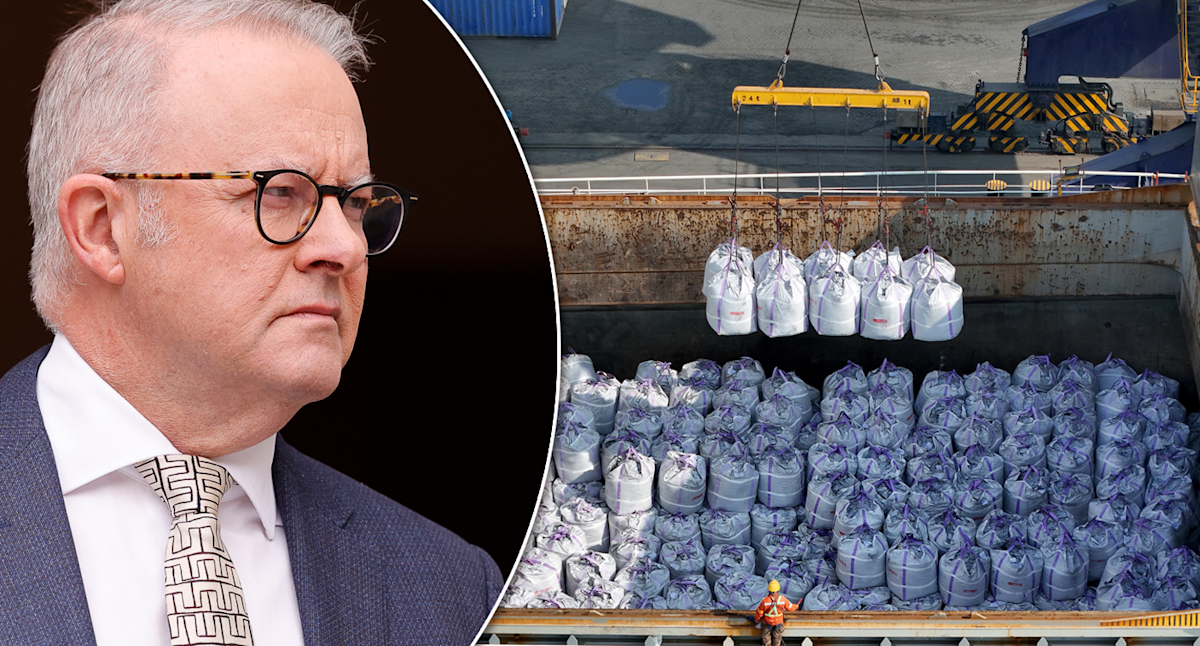
 The Albanese government has scrambled to help lock in more urea shipments to Australia. (Source: Getty)
A backbone industry of Australia remains firmly in “the firing line” as the conflict in the Middle East has exposed our reliance on a critical input that underpins many food products that end up on the shelves at Coles and Woolworths.
The sudden closure of the Strait of Hormuz “has starkly highlighted Australian agriculture’s vulnerability,” the Commonwealth Banks has warned.
It comes as the Australian government on Friday announced it has helped facilitate a massive deal to ensure Aussie farmers have confidence about the ongoing supply of fertiliser. But if the the war drags on, Australia has few other options to ensure key fertiliser products without striking such deals.
RELATED
Australia imports most of the fertiliser and fuel required for agricultural production. That leaves us highly vulnerable to offshore supply chain disruptions, CBA’s chief economist Luke Yearman wrote in a note to investors on Thursday.
“The closure of the Strait of Hormuz has highlighted a range of vulnerabilities across the Australian economy,” he said.
While a fifth of the world’s oil supply goes through the Strait, a much higher percentage of global fertiliser supply relies on the waterway being unimpeded. In 2024, the Gulf accounted for about 43 per cent of all seaborne urea (nitrogen based fertiliser) exports.
“Since 2023, Australia has been 100% import dependent for its urea needs. These import options are heavily concentrated. In 2025, 64% of Australian nitrogen-based fertiliser imports came from the Middle East,” Yearman wrote.
 The Middle East is key for Australia’s nitrogen based fertiliser supplies. (Source: CBA)
The economist noted that the agricultural sector is a key contributor to the economy as well as “a key pillar of our own food security and that of our neighbours”.
But he warned farmers face a squeeze on profits from higher input costs as global selling prices take time to adjust higher. If trade continues to be throttled and input prices stay high, eventually that will mean further price rises.
“If the fertiliser disruption lasts past mid-year and extends into the southern hemisphere grain growing season, global markets should begin pricing in reduced production potential via higher prices. In this case, the most acute price increases would occur towards end-2026 and into 2027,” he wrote.
“Based on discussions with CBA clients, farmers have not yet hit the panic button,” Yearman said, but the conflict has exposed Australia’s huge dependency on stable trade and its fertiliser vulnerability heading into next year.
On Friday, the Albanese government announced it had helped reach a deal with Indonesian companies to lock in the last 20 per cent of fertiliser needed by Australian farmers for the current season.
About 250,000 tonnes of urea will be delivered under the deal inked between NSW-based Incitec Pivot Fertilisers and Indonesia’s PT Pupuk Indonesia.
“This is a significant outcome for our farmers. We understand how critical fertiliser is for Australian farmers, for our food production system and the food security of our region,” Albanese said in a statement this morning.
“This deal also shows why it’s critically important that we have strong relationships with our regional partners.”
Speaking to ABC radio on Friday morning, federal agricultural minister Julie Collins said the deal will now give farmers “confidence that there will be fertiliser in the coming months … this gives farmers certainty going into the future.”
But questions do remain about the future distribution of the secured supply with some farming groups saying they’re already having to make difficult planting decisions.
The deal mitigates a potentially disastrous shortage facing the country. (Source: Getty) · AFP via Getty Images
When asked about what Australia is doing to end its fertiliser vulnerability, she pointed to the fact that urea will be able to be produced here in Australia from next year.
“But obviously our trading relationships, particularly with some our of southeast Asian neighbours, has been really critical in terms of this supply,” she said.
As noted by the Commonwealth Bank economist, the Perdaman Urea Project in Karratha in Western Australia, due to be completed around the middle of 2027, will “significantly reduce” Australia’s reliance on imports for nitrogen-based fertilisers, boosting the resilience of the domestic Agriculture sector.
CBA also expects measures it the upcoming federal budget to shore up Australia’s stockpiles of key agricultural inputs including diesel.
Get the latest Yahoo Finance news – follow us on Facebook, LinkedIn and Instagram.