
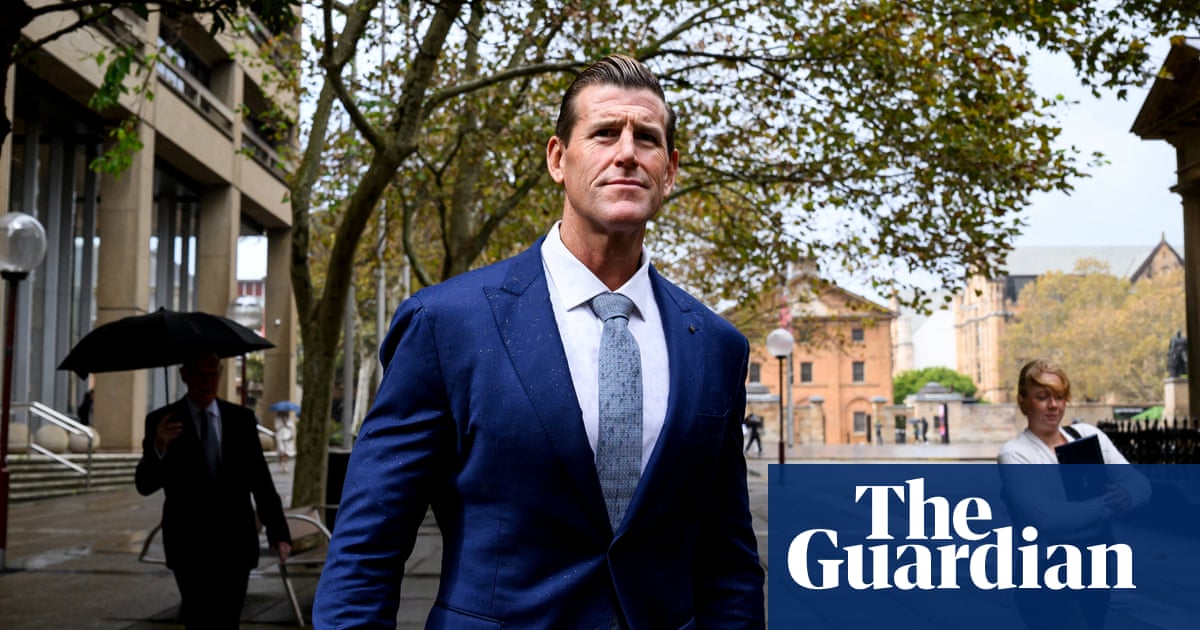
Australian soldiers have told prosecutors they executed unarmed civilians at the orders of Ben Roberts-Smith or in complicity with him, according to a statement of facts tendered to the New South Wales local court.
Roberts-Smith, a Victoria Cross recipient and once one of Australia’s most lionised soldiers, faces five charges of the war crime of murder, allegedly committed while he served in the Australian SAS in Afghanistan.
Arrested and remanded in custody last week, Roberts-Smith was granted bail under strict conditions on Friday ahead of what is likely to be a marathon trial, not expected to go before a jury for a number of years.
Roberts-Smith has not entered a plea to the charges, but has consistently denied any wrongdoing during his military service.
Each charge of the war crime of murder carries a potential life sentence in prison.
Witness accounts of alleged executions
Under the heading “indemnified witnesses”, the statement of facts states that the Commonwealth Director of Public Prosecutions has provided an undertaking to three soldier witnesses relevant to the current prosecution of Roberts-Smith.
“Each of these witnesses has admitted their personal involvement in executing one or more detainees at the direction of, or with the complicity of, Ben Roberts-Smith. In each instance, Ben Roberts-Smith was their military superior.
“These witnesses have provided written accounts of their actions. Each details other murders they witnessed.”
Sign up for the Breaking News Australia email
The statement of facts states there are “common themes … attached to each murder Roberts-Smith committed, directed or facilitated”.
According to the statement of facts:
Each victim was unarmed and present in a location where Roberts-Smith could reasonably have suspected insurgents to be located;
Each offence was committed in a situation where there was no active engagements with enemy forces and the Australian Defence Force was in control of the environment;
Evidence was planted or falsely associated with each deceased to enhance reporting that each of the killings was within the lawful rules of engagement;
Each deceased was handcuffed, detained for a period, and questioned prior to their execution;
None of the deceased was killed in a situation where the Australian Defence Force did not have effective control of the battlespace.
The allegations made in the statement of facts have not been tested in court: they are the basis of the prosecution’s case against Roberts-Smith.
Charges one and two
Charges one and two against Roberts-Smith relate to two alleged murders committed at the village of Kakarak in southern Afghanistan on 12 April 2009.
Two men, a father and son named Mohammad Essa and Ahmadullah, were found hiding in a tunnel in a compound given the designation “Whiskey 108”.
The statement of facts states the two unarmed men had been handcuffed and taken away by Roberts-Smith to another area inside the compound.
They allege Ahmadullah, who wore a prosthetic leg, was then carried outside the compound walls, “thrown to the ground and shot multiple times by Roberts-Smith with a belt-fed machine gun”, in an act witnessed by several Australian soldiers.
Roberts-Smith walked back into the area inside the compound where Mohammad Essa remained, where Person 4 had been summoned by Person 5, the leader of their four-person SAS troop. The facts allege Roberts-Smith “grabbed” Person 4 and walked him to another soldier, instructing that soldier to give their firearm suppressor to Person 4, who attached it to their M4 assault rifle at Roberts-Smith’s instruction.
“Roberts-Smith grabbed Mohammad Essa, placed him on his knees in front of Person 4 and said to Person 4, ‘Shoot that cunt’,” the facts allege.
They allege Person 4, “understanding this to be an order”, shot Mohammad Essa in the head, killing him, before returning the suppressor. Person 4, who has admitted to his role in the incident, was the newest member of the troop and was referred to as “the rookie”.
Prior to the incident, the facts allege Person 5 expressed an intention to “blood the rookie”. At the conclusion of the mission, Roberts-Smith and Person 5 allegedly claimed they had “blooded the rookie”.
Charge three
The third charge relates to an incident on 11 September 2012, during a search for a rogue Afghan National Army soldier, Hekmatullah, who had killed three and wounded two Australian soldiers.
The facts state Roberts-Smith was the commander of a patrol that raided the village of Darwan, detaining a number of men, including a farmer named Ali Jan.
The facts allege these men were “tactically questioned” by Roberts-Smith, involving “punching and physically assaulting detainees whilst they were handcuffed”.
Roberts allegedly singled out Ali Jan, who was taken to the edge of a cliff by another soldier, Person 11.
“Whilst he was still cuffed and physically restrained, Roberts-Smith kicked him causing him to fall approximately 10 metres and causing injuries including the loss of teeth,” the facts state.
Person 4, who allegedly witnessed the act, saw Roberts-Smith and Person 11 climb down the slope to where Ali Jan was lying. He saw the soldiers have a brief conversation.
“Person 4 looked away for a short moment during which a number of shots rang out that sounded like they were fired from an M4 rifle. Person 4 turned back to the direction of the shots and saw Person 11 standing in position with their rifle on their shoulder,” the facts state.
The facts allege person 11 fired the shots that killed Ali Jan, who was not a combatant at the time he was killed.
Charges four and five
The fourth and fifth charges against Roberts-Smith allege he was complicit in the murder of two prisoners who were marched to the edge of a cornfield under the control of Australian soldiers during a mission in the village of Syahchow in October 2012.
The prisoners were shot dead, either by Roberts-Smith or at his direction.
The facts state that after the two men were shot, “Ben Roberts-Smith threw a grenade towards the deceased persons-under control, and it detonated.
“This was an act to support a later false claim, that the deceased persons-under control were killed during a legitimate action within the rules of engagement.”
Bail decision
Roberts-Smith was bailed on Friday under strict conditions about where he can live and travel. He has been compelled to forfeit his passport and must report to police three times a week.
His father, former judge Len Roberts-Smith, offered to pay a surety on his son’s bail, set by the court at $250,000. This will be surrendered if Roberts-Smith breaches bail or fails to appear in court.
Prosecutors argued Roberts-Smith was a flight risk, and might seek to escape Australia to avoid facing court.
But Judge Greg Grogin said the Roberts-Smith case was an “exceptional circumstance”, that it would be years before his trial began. He said Roberts-Smith’s ability to prepare his defence would be unreasonably compromised if incarcerated.
If the matter reaches trial, Roberts-Smith will face a jury trial. A unanimous verdict is required in Commonwealth cases, in which majority verdicts are not permitted.