
Viva Energy is one of Tasmania’s major suppliers of fuel, with its Geelong refinery in Corio producing 50 per cent of Victoria’s and 10 per cent of Australia’s fuel.
This week, a major fire at the refinery has fanned the flames of national fuel anxiety, with petrol production at the site dropping to 60 per cent capacity.
However, the impact on Tasmania’s fuel supply is expected to be minimal, the state government says.
Mapping what we know about the Geelong refinery fire
Viva Energy’s main role for the state is as a fuel importer from Asia, transporting fuel via its Geelong terminal or directly to Tasmania.
The fuel transported is already refined and therefore unlikely to be impacted by the Geelong blaze.
The amount of fuel from its Corio refinery that is sent to Tasmania is significantly smaller.
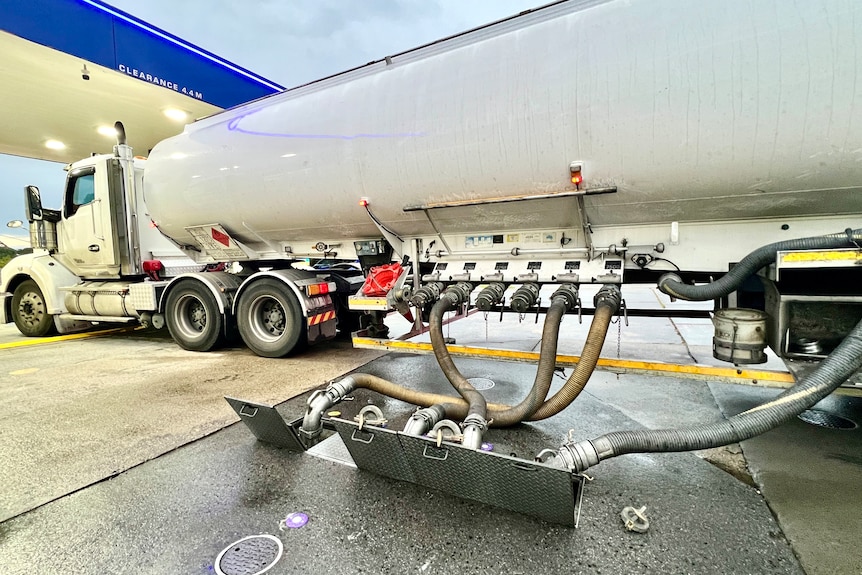
The Tasmanian government says the state has 100 days of petrol and 58 days of diesel supply. (ABC News: John Gunn)
Kevin Morrison, from the Institute for Energy Economics and Financial Analysis (IEEFA), said Tasmania was not “out of the woods” when it came to indirect impacts.
“What we have is the supply from this refinery that normally goes into Victoria is impacted; they will need that oil, which could create increased competition with imported products,” he said.
“Victoria accounts for a quarter of national fuel consumption, and Tasmania is just a small percentage,” Mr Morrison said.Confidence in state’s fuel supply
The Tasmanian government said the state’s fuel supply “remains secure”, with 100 days of petrol and 58 days of diesel supply either on-island or in transit.
Tasmanian energy minister Nick Duigan said earlier this week that a tanker was forced to anchor up in Storm Bay due to the state’s storage levels being at capacity.
Mr Duigan said it was “difficult to quantify” how much fuel Viva supplied to the state.
“Viva is one of the two shippers into Tasmania, so if you do the rough maths, that would say that Viva probably ships in around about half of our fuel.
“Viva Geelong is also a significant trans-shipment hub, so it’s not necessarily fuel that’s refined there that’s coming to Tassie, but it may be being trans-shipped through there.”
He said of the three ships on their way to the state, one was from Viva, with the other two from Asian refineries.
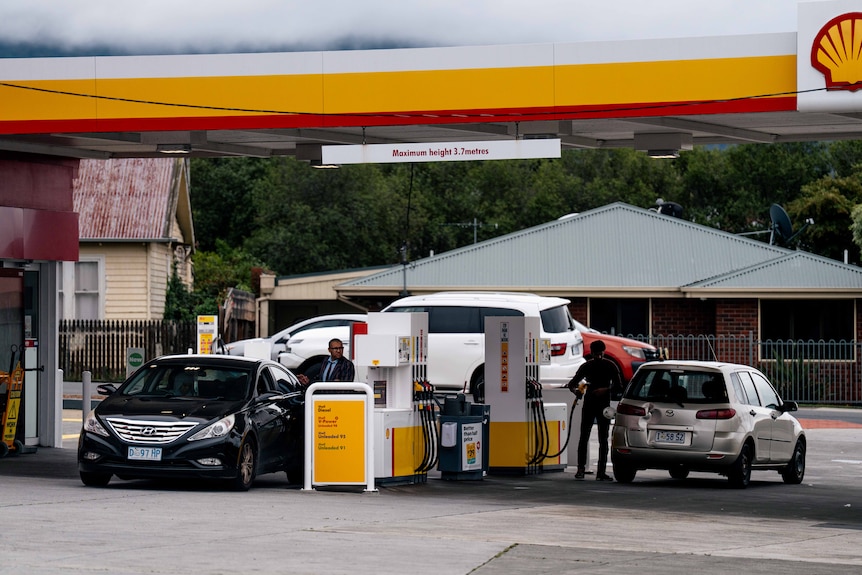
Tasmania’s government says it is working to develop a strategic fuel reserve to provide a buffer against any supply disruption. (ABC News: Ebony ten Broeke)
Mr Duigan said he has written to Viva requesting it inform the government as to how the fire would impact the state.
“The company has made some really encouraging statements around how it can cover what might be gaps in its refining capability on site in Geelong, but it will up its imports to cover any gaps that exist.
“We remain very confident that the Tasmanian situation remains secure,” Mr Duigan said.Government working to create a ‘strategic fuel reserve’
On Thursday, the state government said it was working to develop an on-island strategic fuel reserve to provide a buffer against any supply disruption.
The strategy will look at utilising latent storage capacity, such as decommissioned tanks at Self’s Point, which the government said would provide an additional 12 million litres of storage.
The dos and don’ts of fuel storage
Deputy Premier Guy Barnett said fuel security would be a “key focus” of his trade and investment mission to Singapore next week.
When asked if the trade mission was indicative of the states attempting to out-compete each other on fuel supply, Mr Duigan said the deputy premier’s trip had been planned “for some time”.
“It’s appropriate that if the deputy is in Singapore, where we source a lot of our petroleum products from, that he has those conversations,” he said.
On Thursday, federal Energy Minister Chris Bowen said 11 fuel stations were without diesel in Tasmania, while 22 had no unleaded.
Mr Duigan said service stations that wanted fuel could get fuel in Tasmania.
“It’s certainly not pointing to a lack of supply in the state,” he said.
“I encourage people to buy what they need. Don’t buy more than they need … we’ve got plenty of fuel in Tasmania.”