
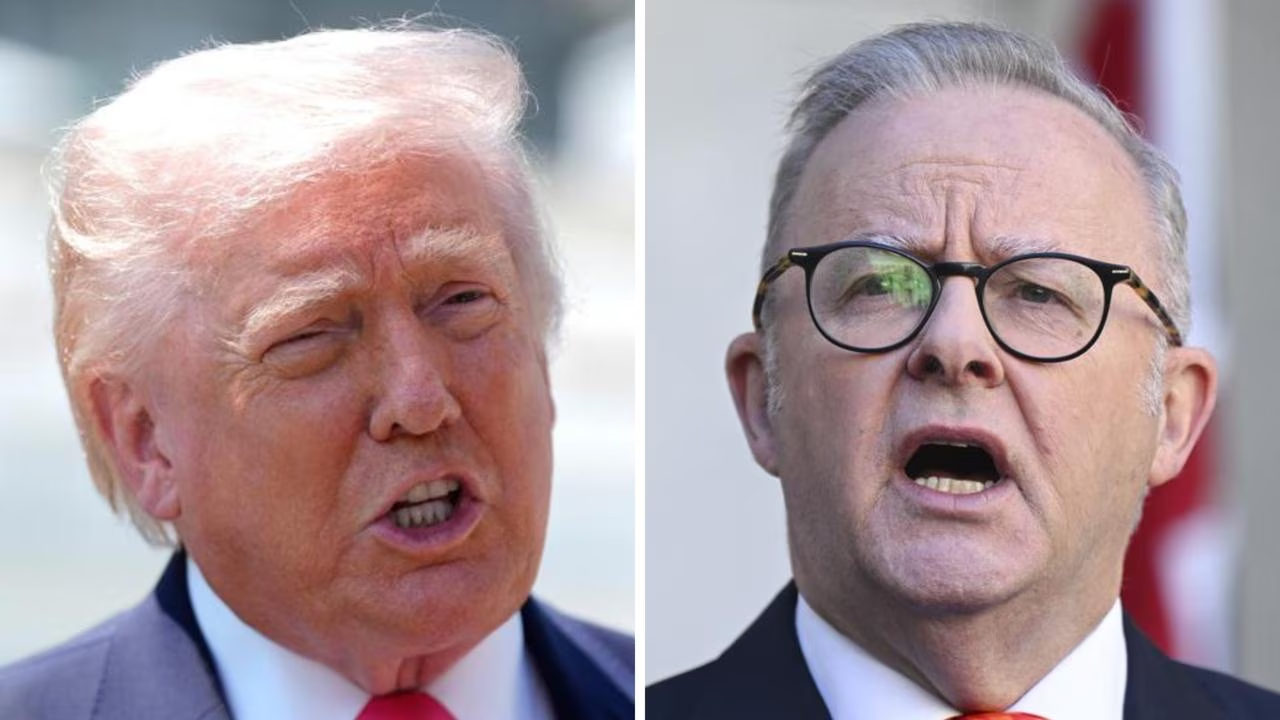
Australia has moved closer to joining an international coalition led by Britain and France to clear the Strait of Hormuz, and joined talks with world leaders tonight.
Prime Minister Anthony Albanese attended the virtual meeting of the new Strait of Hormuz Maritime Freedom of Navigation Initiative at 10pm and told the meeting that the conflict was having far reaching consequences.
He warned that the longer the war goes on, the more significant the impact on the global economy and the greater the human cost.
“Australia and our Indo-Pacific partners are experiencing first-hand the impact of unprecedented disruptions to energy supply chains and impact on oil and fuel prices,” he said.

“Here in Australia we are working around the clock to shield Australians from the worst of the impacts.
“Australia is calling for the Strait of Hormuz to be fully reopened for all countries.”
The meeting, led by French President Emmanuel Macron and British Prime Minister Keir Starmer, focused on efforts to reopen the Strait of Hormuz and restore freedom of navigation and is entirely separate to US President Donald Trump’s blockade.
It follows Mr Trump’s claim he was “not happy” with Australia and other NATO countries for not backing him.
Iran’s declares Strait open
While talks were taking place, Iran’s Foreign Minister Seyed Abbas Araghchi posted to social media that Strait of Hormuz is now “completely open”.
“In line with the ceasefire in Lebanon, the passage for all commercial vessels through Strait of Hormuz is declared completely open for the remaining period of ceasefire, on the coordinated route as already announced by Ports and Maritime Organisation of the Islamic Rep. of Iran,” he wrote on X.
Prime Minister Starmer arrived in Paris today to co-host the virtual meeting of the Strait of Hormuz Maritime Freedom of Navigation Initiative.
Sir Keir was expected to tell the Summit: “The unconditional and immediate reopening of the Strait is a global responsibility, and we need to act to get global energy and trade flowing freely again.”
“Emmanuel Macron and I are clear in our commitment to establish a multinational initiative to protect freedom of navigation.
“We must reassure commercial shipping and support mine clearance operations to ensure a return to global stability and security.”
British reports suggest the plans could include deploying a combined military effort as soon as conditions allow.
Mr Albanese previously declared that Mr Trump’s announcement of a blockade of the Strait of Hormuz was “unilateral” and Australia was not consulted.
Despite the US President’s complaints that Australia hasn’t done enough to help, the US has also made no formal requests for assistance.
“They’ve made this announcement overnight in a unilateral way and we haven’t been asked to participate,” Mr Albanese said.
Earlier, President Trump unloaded on Australia for the third time at the White House on Friday, suggesting it had failed to step up along with other NATO countries.
“I’m not happy with Australia because they were not there when we asked them to be there,” Mr Trump told reporters.
“Australia is another one. They were not there having to do with (the Strait of) Hormuz. So I’m not happy, I’m not happy with them.”
In response, the Prime Minister pointedly noted that the President has also publicly rebuked Australia by suggesting the United States didn’t need our help.
“There’s been no new requests at all, and indeed, President Trump has himself said that he has got this and he has made that position clear,” Mr Albanese said.
“There’s been no change.”
That’s a reference to Mr Trump’s social media spray in mid March when he posted the following on his Truth Social platform: “Because of the fact that we have had such Military Success, we no longer ‘need,’ or desire, the NATO Countries’ assistance — WE NEVER DID!.”
He continued: “Likewise, Japan, Australia, or South Korea. In fact, speaking as President of the United States of America, by far the Most Powerful Country Anywhere in the World, WE DO NOT NEED THE HELP OF ANYONE!”
The US did ask for help protecting Gulf States including the United Arab Emirates and Australia has obliged.
But that doesn’t involve joining the US mission in Iran.
Foreign Minister Penny Wong has also made Australia’s reluctance clear in her public comments.
“What we’ve made clear is that right from the start, we would not be providing boots on the ground,” Senator Wong said.
Why this conflict is different from Iraq and Afghanistan
Professor Rory Medcalf, the Head of the National Security College at ANU, has described the situation as “a mess”.
“Look, my working guess is that the US President wants basically a blank cheque to say, ‘we will put ships into a Coalition led by the US to clear the Strait of Hormuz’, and we’ll worry about the details later,” Professor Medcalf said.
“He was trying to build an international coalition behind the US to clear the Strait. When there was no flood of volunteers for that, then he changed his tune to, ‘Well, you do it yourselves.’
“All of that normal programming has been out the window with this because there was obviously no forewarning or consultation about the actual attack.
“I’m actually quite sympathetic to the government because I don’t see what else they can do, in a way.”
Australia’s former ambassador to the US Arthur Sinodinos says that the President’s “lashing out at allies is an expression of frustration that the war is taking longer than he expected”.
“Anything he says about allies should be just seen as something said at a moment in time, support for the (US) alliance in countries like Australia is pretty strong,” he said.
Why Australia could join an alliance with Britain
Despite Australia not wanting to join the war in Iran, there are behind-the-scenes moves to play a larger role in securing the safe passage of oil supplies.
Defence Minister Richard Marles has confirmed that Australia is in talks with a Coalition of 35 nations to discuss military measures to secure the safe passage of vessels in the Strait of Hormuz and could contribute assets to the plan.
“We will look to what Australia can do,” he said.
“I’m reluctant to speculate in detail about all of that, other than to say our E-7 Wedgetail is in the region right now and it’s providing, or doing important work in terms of contributing to the defence of the countries of the Gulf, in particular the UAE.”
While Sir Keir insisted his nation did not want to be “dragged” into the military conflict and suggested “this is not our war”, he said the most effective way he could support the cost of living in Britain was to push for de-escalation in the Middle East and a reopening of the Strait of Hormuz.
Read related topics:Anthony Albanese