
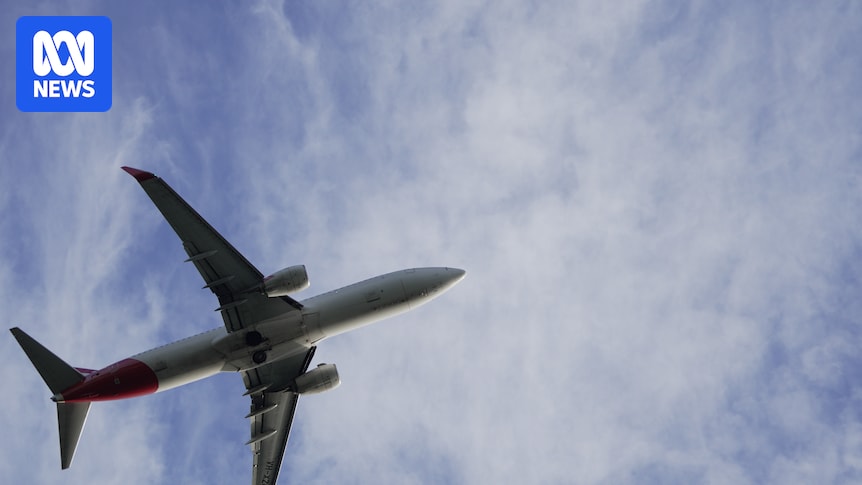
Australians are finding domestic flights for as little as $65 on some routes, while others are paying thousands to travel interstate as airlines quietly reshape the market in response to conflict in the Middle East.
Jet fuel prices have surged since February amid global supply disruptions, increasing costs for airlines and prompting both Qantas and Virgin Australia to cut domestic flights.

Tara Ivanisevic works in the mining sector, and says the cost of getting to regional Australia for work has “almost doubled”. (Supplied)
Experts say clear winners and losers are emerging in the current market, with return fares from Sydney to Fiji as low as $600 return, while a trip from Mount Isa in north-west Queensland to Brisbane can cost more than $700, one way.
The Australian Competition and Consumer Commission (ACCC) said it was watching Australia’s airline industry.
“While market conditions will ultimately determine the cost of flying, we are closely monitoring price movements, market behaviour and the airlines’ representations to consumers, and will act if there is behaviour that contravenes competition and consumer laws,” ACCC Commissioner Anna Brakey said.
Iran war live updates: For the latest news on the Middle East crisis, read our blog
RMIT Aviation Academy operations manager Justin Brownjohn said a widening gap had emerged between heavily discounted leisure fares, regional routes and key capital city services often used for work travel.
“If a market is soft, airlines will discount. If a market can sustain higher fares, they’ll charge more — that’s what we’re seeing right now,” he said.
Jetstar is offering fares from Melbourne to Uluru from $117 for travel in July and August, and Brisbane to Cairns for $89. Virgin has $65 seats between Sydney and Ballina in May, while Qantas has $1,400 return fares from Sydney to Los Angeles next month.
Track the latest petrol and diesel prices around Australia
Mr Brownjohn said airlines use fare “buckets” to manage demand, which quickly pushes up prices for high-demand flights. As fares in lower-priced buckets sell out quickly, remaining seats sit in higher-priced categories — pushing up what travellers end up paying.
This means travellers might pay different prices for the same flight.
He said there was also “an element of marketing” when airlines heavily discounted some routes, at the same time as announcing cuts to services.
“They’re able to point to these fares and say, ‘it’s not all bad — there are still opportunities to fly’,” he said.
Work travel and regional hit hardest
For Perth-based traveller Tara Ivanisevic flying is not optional — it’s part of the job.
The commercial specialist works in the mining sector and says the cost of getting to regional Australia for work has almost doubled in recent months, making routine travel increasingly difficult and expensive.
Qantas cuts domestic flights as fuel costs blowout
“A trip to Kalgoorlie used to cost about $600 return, and I’ve seen flights for $900 one way now,” she said.
Ms Ivanisevic said limited competition on some routes left travellers with little choice, particularly in Western Australia.
The cost pressures were also affecting her personal travel, with a planned trip to Adelaide to visit family postponed after a sharp rise in fares.
“It’s really hard not being able to go back because of the price differences in airfares,” she said.
“You just feel like your hands are tied.”
Aussies still heading overseas
Virgin Australia to trim domestic flights
According to reports from the Associated Press, Europe has about six weeks of jet fuel supplies remaining.
The shortage has led to higher airfares on some carriers and cuts to the number of flights with the potential to strand Aussie travellers heading to Europe for the summer tourist season.
However, despite the global uncertainty, a new Australian Travel Industry Association (ATIA) report showed Australians were continuing to travel overseas in large numbers, but were choosing to stay closer to home.
Aussies ignore travel warnings to keep flying via Middle East
The report, which used Australian Bureau of Statistics (ABS) data, found more than 840,000 Australians headed overseas last month, an almost 10 per cent increase on the same time last year.
In the 12 months to February, Asia had the highest growth, with trips to Vietnam up 16.1 per cent, China 15.9 per cent and Japan 15.6 per cent.
Travel to the United States fell 4.8 per cent over the same period, with a 10 per cent decline in February alone.
Bali was the top destination for Australians in the year to February, followed by New Zealand.
How to get a cheaper fare Be flexible with dates — midweek and off-peak flights are often significantly cheaper Book early for peak periods — especially school holidays and major events Compare nearby airports — flying into or out of alternative cities can cut costs Travel light — basic fares without checked baggage are usually the cheapest tier Watch sale windows — airlines regularly release limited discounted seats on select routes Set price alerts — fares can fluctuate quickly on high-demand routes Avoid last-minute regional travel if possible — prices tend to spike sharply on thin competition routes Loading…