
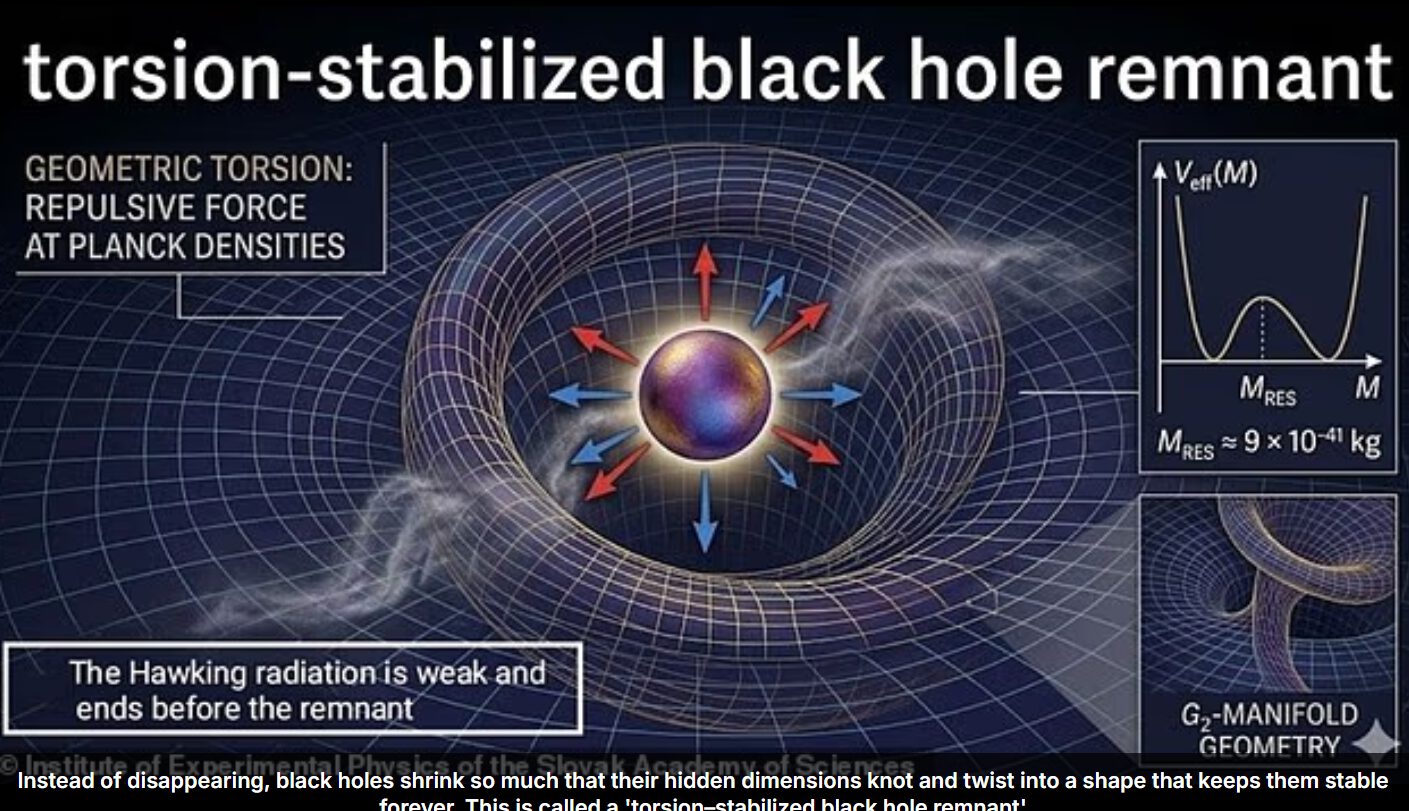
Black holes might not erase information after all—they could shrink into microscopic remnants that preserve every bit of data they’ve consumed while potentially explaining dark matter itself. This isn’t just theoretical physics flexing; it’s a proposed solution to one of cosmology’s most stubborn puzzles that’s plagued scientists since the 1970s.
The Seven-Dimensional Solution
Richard Pinčák from the Slovak Academy of Sciences has published a model suggesting our universe operates in seven dimensions—the familiar four we experience plus three compact, hidden dimensions twisted into special geometric shapes called G2-manifolds. Think of it like cosmic origami where reality folds in ways we can’t directly perceive, similar to how characters in Interstellar navigate higher-dimensional space while remaining anchored to familiar physics.
These hidden dimensions generate torsion fields—essentially twisting forces in spacetime that prevent black holes from completely evaporating. The model suggests mass comes from spacetime’s architecture rather than mysterious particles, proposing that matter emerges from geometric resistance itself rather than external fields.
Tiny Remnants, Massive Implications
When black holes evaporate through Hawking radiation, this theory predicts they leave behind incredibly dense remnants—imagine cramming a smartphone’s entire data storage into something impossibly smaller than subatomic particles. These torsion-stabilized remnants retain all the information that fell into the original black hole, resolving the paradox that had quantum mechanics and general relativity throwing punches at each other.
Even wilder: these remnants might constitute dark matter, the mysterious 27% of universe mass we can’t directly detect. Your standard physics textbook just got a lot more interesting.
The Detection Challenge
The catch? Detecting these theoretical particles lies far beyond current capabilities, making the Large Hadron Collider look like a pocket calculator. String theorists have long proposed extra dimensions curled up at unimaginably small scales, but Pinčák’s model offers specific, testable predictions.
Future gravitational wave detectors or cosmic microwave background analyzers might eventually spot the signatures, turning this mathematical poetry into hard science. The theory builds on established physics showing that universe evolution can naturally favor higher-dimensional realities, explaining why we perceive familiar dimensions while others remain hidden at quantum scales.