
Support CleanTechnica’s work through a Substack subscription or on Stripe.
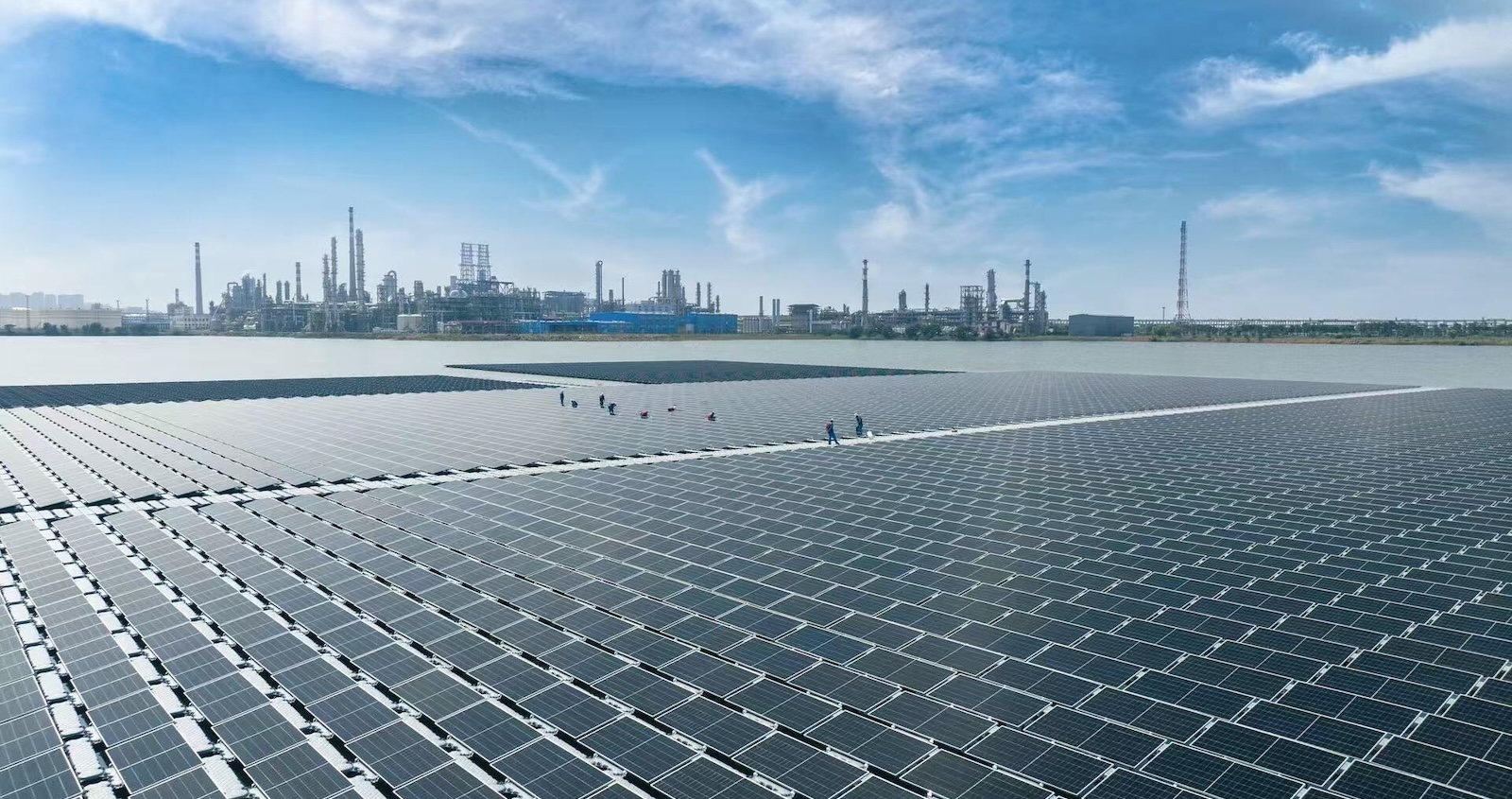
On April 17, 2026, Wang Changlin, vice chairman of China’s National Development and Reform Commission, announced that China intends to double its supply of non-fossil fuel energy by 2035. Most analysts view that initiative as a way for the country to achieve its climate goals, as announced recently in its latest five-year plan. Some complain that plan is not ambitious enough, but China achieved virtually all the goals set forth in its prior five-year plans — often several years ahead of schedule.
The country will “significantly increase” the supply of non-fossil energy by 2030 and double it by 2035 compared with 2025 levels, Wang said. He pointed to a massive hydropower project in Tibet and desert-based renewable hubs will help propel clean-energy generation. China has also announced the construction of a 50 MW concentrated solar installation in Tibet that will be built at an elevation of 14,900 feet — the highest such facility in the world.
Wang’s comments clarify the meaning of a 10-year action plan to double non-fossil energy that was incorporated into the 15th five-year plan. That mention was brief and several details were unclear, including when the start and end dates were, and whether the doubling referred to capacity or generation, Bloomberg reports. Wang’s announcement is seen as supplying some of those details.
Doubling clean energy consumption over a decade is likely a more ambitious target than China’s previous goals of having non-fossil energy comprise 25% of total consumption by 2025 and 30% by 2035, Bloomberg reports. If total energy demand grows around 2.5% a year — which seems conservative considering the race to build data centers to support artificial intelligence — then doubling consumption would lead to a 29% non-fossil energy share by 2029, according to Lauri Myllyvirta and Belinda Schäpe, analysts from the Center for Research on Energy and Clean Air.
“If this means doubling total use of non-fossil energy from 2025 to 2035, it could be significantly more ambitious than China’s existing targets,” the analysts said in a March 6 note after the five-year plan’s publication.
Last fall, China President Xi Jinping told the United Nations his country would reduce its greenhouse gas emissions across its economy and would expand renewable energy sixfold in coming years. The New York Times called it “a moment of global significance for the nation that is currently the world’s biggest polluter.”
There is little question that China is the leading exporter of solar and wind technologies in the world. Solar panels from China have allowed Pakistan to avoid much of the economic pain imposed on the world by the ill conceived and totally unnecessary US war on Iran. Previously, that nation was wholly dependent on LNG supplies from Qatar, but it cancelled 20 shiploads of LNG months before the horror in Hormuz began.
The Bad News
Writing for Yale Climate 360, Isabel Hilton said, “In 2021, Xi Jinping made two important promises intended to signal China‘s commitment to fighting climate change. At the Leaders Climate Summit in that April, he announced that China would “strictly control” coal generation until 2025 when it would start to gradually phase it out. He also pledged that year that China would reduce the energy intensity of its economy — the amount of CO2 used to produce a unit of GDP — to 65 percent below 2005 levels by 2030. This month, as China unveiled its plans for the next five years, both promises appeared to be in trouble.”
In 2015 coal generated 69% of China’s primary energy, and by 2024 it was down to 56% — much higher than the US at 8%. But the actual volume of coal consumed was greater than ever, simply because China’s electricity demand continues to grow. Despite its efforts to reduce coal use, four years after Xi’s pledge, China was consuming 40% more coal than the rest of the world combined.
It would have been more if not for China installing a record 300 gigawatts of solar power and 100 gigawatts of wind power in 2025. That allowed the increase in China’s electricity demand to be met mostly by clean energy. But although China’s decades-long investment in the manufacture of renewable technologies has been a hugely successful industrial policy, its attachment to coal means that this success has not translated into a correspondingly large reduction in greenhouse gas emissions, Hilton said.
 Credit: Yale Climate 360
China at the moment is the biggest installer of renewable energy, the biggest emitter of greenhouse gases, and the biggest user of coal. One explanation for this conundrum is a national concern over energy security: Coal is the only fossil fuel that China is not obliged to import. It is the one fuel that Chinese planners know will remain available in abundance, regardless of what some mentally unbalanced potentate somewhere in the world might decide to do some day.
Coal & National Security
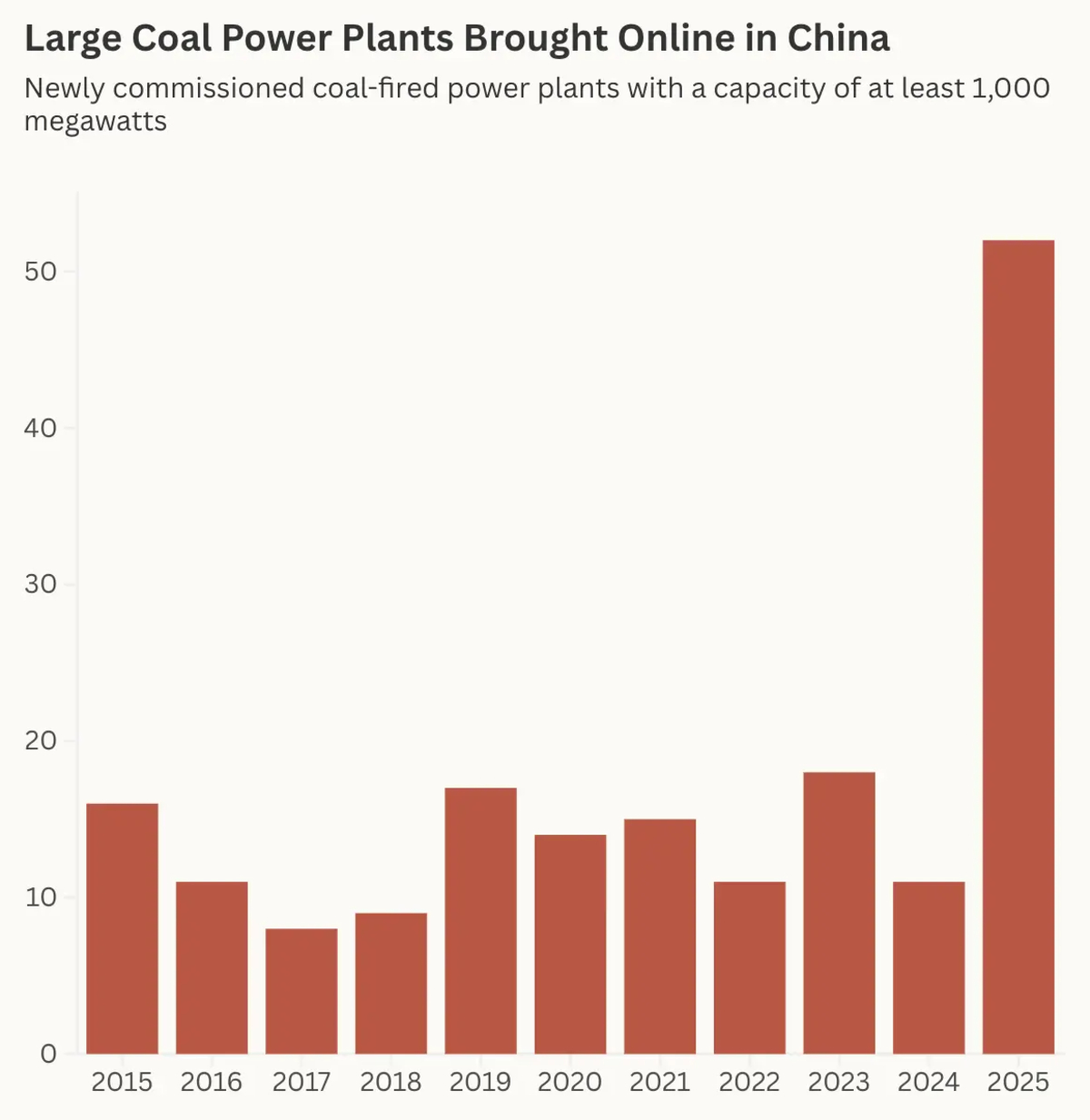
Coal is China’s fallback position when challenges like Covid 19 and reductions in hydropower due to drought put a strain on the supply of electricity. In 2024, China started building 94.5 gigawatts of new coal-fired capacity — 93% of all new global coal construction that year. More than 50 large coal-fired power plants were commissioned in China last year. The upshot is that many of those coal-fired facilities have a far lower utilization rate than needed to make them economically viable, yet still the push to build more continues.
The 15th five-year plan offered a chance to correct these negative trends and get China’s climate ambitions back on track, but it is an opportunity the government appears to have missed. The plan does promise a continuing effort to produce and install renewable energy, and China did install more renewable solar and wind power last year than the whole of the rest of the world, but other signals were less encouraging, Hilton said.
China’s energy demand has continued to rise. Until recently, China argued that its continuing claim to be a developing country meant it did not need to set emissions limits, focusing instead on the energy density targets highlighted by Xi Jinping. In measuring the energy required to produce a unit of GDP, they are essentially measures of efficiency: As long as energy consumption grows more slowly than GDP, energy intensity is reduced.
Energy Density
China set its first energy density target in the 11th Five-Year Plan in 2006, and it has been an important target in every subsequent plan, steadily improving the efficiency of China’s energy use. But greater efficiency does not necessarily mean that emissions fall. China’s energy demand has continued to rise, and so despite its greater efficiency, its emissions have increased. In the last 18 months, emissions have been down slightly, but if energy density improvements slacken off, that trend is expected to reverse.
Over the last five years, China’s continuing dramatic growth in demand seemed largely to have been met by the equally rapidly expanding supply of renewable energy. But on the negative side, China has missed its energy density target for the first time. Aiming at a 17% improvement over those five years, it achieved only 12.4%. Given its GDP growth, that would imply that its emissions increased by 13% over the same period.
That would put the country’s hopes of meeting its Paris commitments and Xi Jinping’s promise to reduce China’s carbon intensity by 65% below 2005 levels by 2030 severely off track. Planners could have compensated with renewed ambition in the 15th five-year plan. Instead, they changed the way they calculate energy intensity, perhaps to disguise the failure to meet Xi’s target, and set a looser ambition for the next five years. Put less politely, Hilton says China is cooking the books.
Vested Interests
If one aspect of China’s reluctance to abandon coal is related to energy security, another major obstacle is the vested interests within the system: Coal-producing provinces want to preserve jobs and local economies, and for provincial governments, a steady supply of electricity is more important than controlling emissions. These concerns can be in competition with national climate goals.
The Chinese government continues to claim that coal is necessary to balance the grid and filling the gaps in supply when demand is at its peak or when renewable output falls. But that is not the best or most efficient use of a coal-fired generating station that has been designed for steady rather than sporadic operation.
It can take several hours to get a coal facility into operation. Once fully online, it cannot be turned down when demand drops. To get around this problem, it appears that many operators are keeping plants running in the background and ready to dispatch energy at short notice — a status known in the industry as “spinning reserves.” That is inefficient both in energy use and in carbon emissions, since the plant just keeps operating while using fuel and emitting CO2.
There have been successive attempts to reform the system to favor renewable energy, and in the 15th five-Year Plan, the government points to its continuing commitment to expanding the renewables sector as the key to its climate policy. But this industrial policy, however successful, will not in itself reduce emissions if coal continues to play a substantial role in the power sector, Hilton claimed.
A Bright Spot
The cure to this tug of war between renewables and coal in China may be solved by the fact that the cost for grid-scale battery storage has plummeted recently, Pumped hydro energy storage has also increased recently in China. Battery storage alone has increased by a factor of 20 in just four years. These forms of storage are cheaper, more efficient, and more climate friendly than keeping a coal fleet on standby and, as they grow, the case for the continued use of coal, let alone its expansion, seems sure to grow even weaker.
“Of concern for investors, the cost of China’s recent coal build-out in long-term stranded assets could run into trillions. The cost to the climate is of concern to everybody.” Hilton concluded.
Sign up for CleanTechnica’s Weekly Substack for Zach and Scott’s in-depth analyses and high level summaries, sign up for our daily newsletter, and follow us on Google News!
Advertisement
Have a tip for CleanTechnica? Want to advertise? Want to suggest a guest for our CleanTech Talk podcast? Contact us here.
Sign up for our daily newsletter for 15 new cleantech stories a day. Or sign up for our weekly one on top stories of the week if daily is too frequent.
CleanTechnica uses affiliate links. See our policy here.