
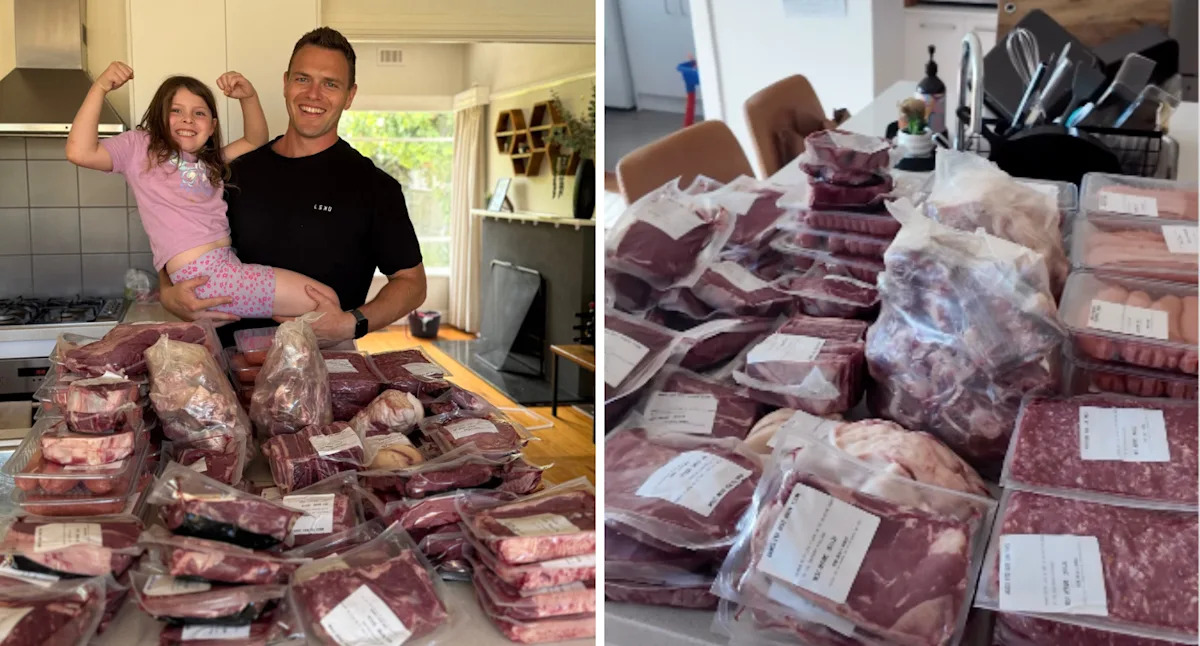
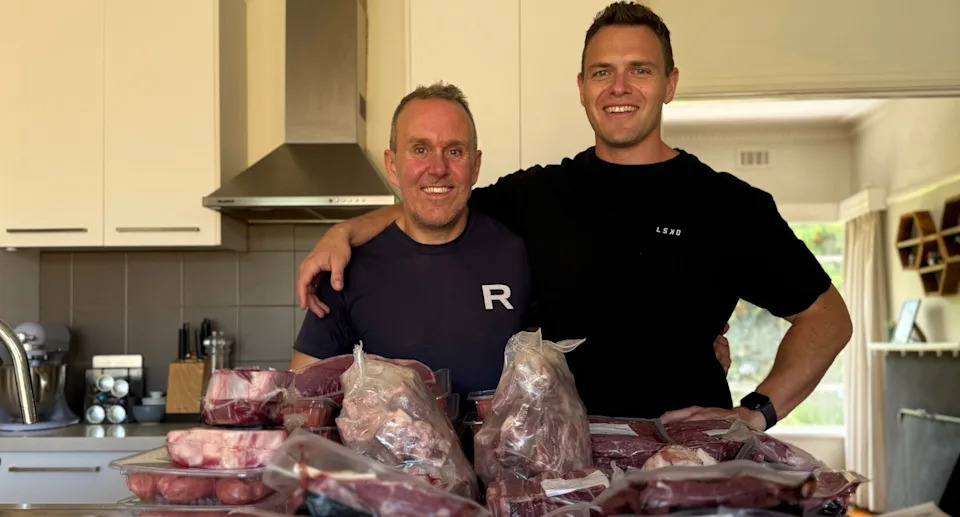
 Matt Hall and Ben Borg split half a cow between their two households and have been impressed with the quality and cost savings. (Source: Supplied)
Two Aussie mates say they’ve been able to enjoy “unbelievable” food and save on grocery costs by teaming up to buy meat in bulk. There’s a growing interest from consumers who are keen to “cut out the middle man” and buy meat directly from farmers.
Melbourne dads Ben Borg and Matt Hall recently split half a cow between their two households. Borg, a nutritionist and gym owner, said he had been thinking about giving supermarket meat from Coles and Woolworths the flick in favour of higher-quality butcher meat.
“But [I was] obviously noticing it was far more expensive, depending on what we were effectively trying to buy,” Borg told Yahoo Finance.
RELATED
Hall, who works in tech, was no stranger to buying meat in bulk, having grown up in the country. So when Borg suggested they order half a cow to split, he was “all in”.
“We’ve got a growing family, we’ve got three girls. Grocery bills are going up all the time. The quality of food is really important as well. The economics of buying in bulk and buying from the farm door [made sense],” Hall said.
“I also like the idea of cutting out the middleman as well and the supermarkets, and supporting a small business owner and buying direct.”
Do you have a story to share? Contact tamika.seeto@yahooinc.com
The friends purchased half a cow from Farmstead Meats, one of a number of paddock-to-plate style meat businesses that have emerged in recent years.
Butcher Jeff Renfrew co-founded the business with Southern Highlands farmer Andrew Johnson about a year ago and has seen revenue grow 200 per cent month-on-month.
He said the pair saw space in the market to offer meat “direct from the farm”, with a growing interest from Aussies to know where their meat is coming from.
 Farmstead Meats co-founder Jeff Renfrew says there’s a growing interest from Aussies to understand where there meat is coming from and to get quality meat at an affordable price. (Source: Supplied)
“It seems to have gotten to the stage where to be able to buy something that’s of good quality, it’s almost out of reach,” Renfrew told Yahoo Finance.
“The other options are people buy things that are mass produced and it loses its integrity in the food chain.
“It’s still not necessarily that affordable anyway anymore. It used to be that it was cheap, but it’s quite expensive now for what you’re getting.”
Prices for beef and lamb were 13 per cent higher compared to 12 months ago, according to the latest Australian Bureau of Statistics data. That’s compared to annual inflation, which was up 3.7 per cent. The annual rise was attributed to strong overseas demand for Aussie red meat.
Story continues
Farmstead Meats sells half a cow, or 100 kilograms of meat, for $1,699.
To buy comparable cuts of grass-fed meat at Woolworths, the business calculated it would set you back roughly $2,504. At Coles, it would be $2,500.
That means households could save roughly $800, or $400 each if split between two families.
Renfrew acknowledged it was a “big investment” at the start, but the meat could generally be kept frozen for 12 months.
Like Borg and Hall, Renfrew said he was seeing a community aspect, where people were buying in bulk and splitting it with families or friends.
Half a cow includes fillets and steaks, sausages and patties, mince and extras like bones and fat. (Source: Supplied)
Borg ran his own “back of the napkin math” comparing the price with the cheapest available cuts at the supermarket and found he was saving hundreds.
“At worst, it’s saving you at least $200. But if I was comparing it to more grass-fed, organic, if it was a quality for quality match, it would have definitely increased the spend difference,” he said.
Borg said he noticed the quality was “instantly different” to the usual meat he buys at the supermarket. He’s also enjoying the variety of cuts and the fact that you get things like bones and tallow included.
“The taste was unbelievable. I was expecting it to be better, but probably not as noticeably better than it was,” he said.
A look at the types of cuts you can get when you buy in bulk. (Source: Farmstead Meats)
Hall said he was previously spending around $350 per week on groceries for his family of five, but that has dropped down to the $280 to $300 range since having the bulk meat on hand.
The pair bought their first half a cow back in January and ended up buying another one recently when their households finished the meat after a few months.
Doing it together has meant they halve the upfront cost, and it’s also been an enjoyable experience for the friends to share.
“It was fun to do it with a mate. Matty will have us over at Christmas and he’s always firing up the barbecue too,” Borg said.
“I wouldn’t have had enough space at home for a half cow, so going in with Ben and getting half of a half each was more workable from a fridge space perspective as well,” Hall added.
Get the latest Yahoo Finance news – follow us on Facebook, LinkedIn and Instagram.