
Profile stage 1: Innsbruck – Innsbruck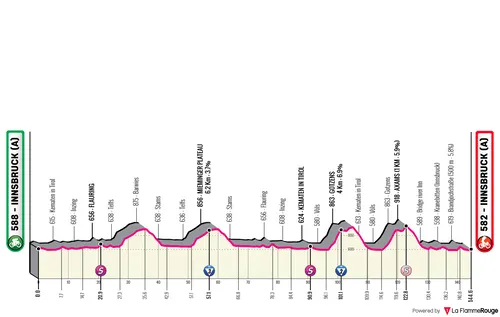
Innsbruck – Innsbruck, 144.5 kilometers
The race begins in Austria in the city of Innsbruck. It is the easiest stage of the race, one that may even perhaps finish in a sprint. The climb to Gotzens is ridden twice, it’s 4 kilometers long at 7% and ends with 25 kilometers to go.
It’s by no means a brutal stage but if it’s attacked hard, then we can see gaps. If not, then we can see a reduced bunch sprint or a finale that can be very tactical in the flat roads leading back into the beautiful city that hosted the 2018 World Champions.
Profile stage 2: Telfs – Val Martello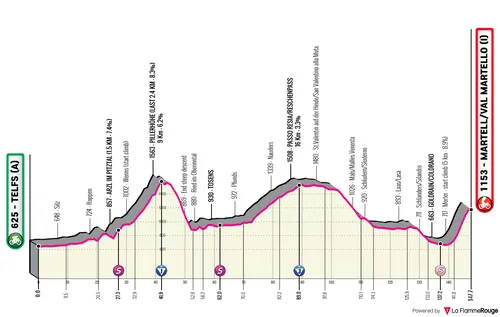
Telfs – Val Martello, 147.6 kilometers
The second stage is rather short, only 147 kilometers in length, but quite hard. The beginning is flat out of Telfs, however the race goes into the mountains and faces three categorized climbs. The first of which is quite difficult, with around 22 kilometers in distance and just under 5% average gradient.
But the action will most likely all be left to the final climb, where the riders return to Val Martello – the climb made famous for being the end of the 2014 Giro d’Italia stage where Nairo Quintana flew away from his rivals in a snowstorm. But the riders won’t go as high, instead racing the first 5 kilometers which average around 9%.
Profile stage 3: Laces – Arco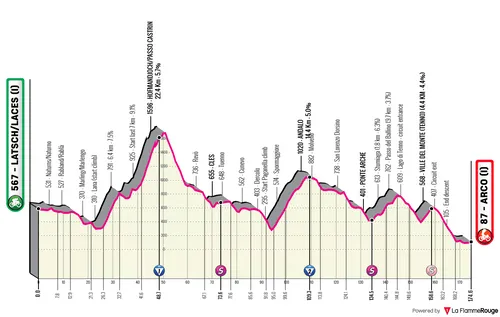
Laces – Arco, 174.5 kilometers
The third day of racing is brutal and can lead to the standings changing completely. The beginning is downhill however early on there is the Passo Castin on the route, 22.4 kilometers at 5.7% however it is a climb with two descents in the middle.
It features 7 kilometers at 9% close to its summit and the rest of the stage is either up or downhill, making it hard to chase attackers. The riders climb to Andalo (14.4Km; 5%; 65Km to go); Passo del Balino (9.7Km; 3.7%; 30Km to go); and the final hilltop to Ville del Monte (4.4Km; 4.4%) which ends with 16 kilometers to go. Most of the way to Arco is downhill, capping off a stage with 3600 meters of climbing.
Profile Stage 4: Arco – Trento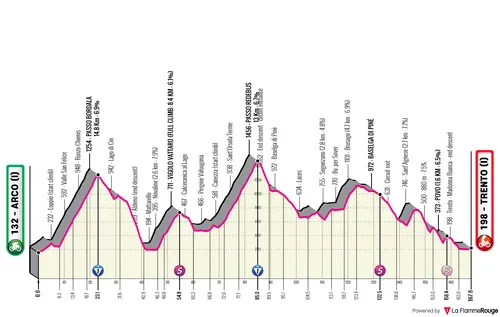
Arco – Trento, 167.7 kilometers
The queen stage? Potentially. The riders depart from Arco where they’ve finished the day before and right from the gun they take on the Passo Bordala which is 14.8 kilometers long at 6.9%. It is a very hard climb but it is followed by two others…
The Vicolo Vattaro (8.4Km; 6.7%) and Passo Redebus (13Km; 6.7%) are each hard enough for big moves and by the time the riders crown it, they will only have ridden half of the stage.
The 167-kilometer long day then doesn’t have any other categorized climb, but by no means no climbing. There are several ascents on the way down to Trento, much more explosive, but where attacks can still happen – whilst if the attacks come early on, they can be solidified.
Profile stage 5: Trento – Bolzano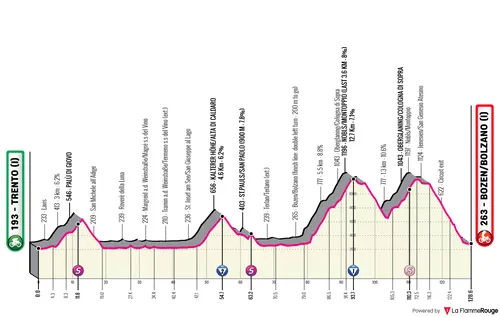
Trento – Bolzano, 128.6 kilometers
The fifth stage of the race is the final one and is also very short, only 128 kilometers in length but with a meaningful ascent right at the star to kick things off. However before ending the week of racing in Bolzano, there will be two climbs that will require tough work from the GC contenders.
The first is Montoppio (12.7 kilometers at 7%) which ends at 35 kilometers to go; whilst the second is Cologna di Sopra – an 8-kilometer ascent which starts off with double-digit gradients and has an intermediate sprint in its middle. The top is with 16 kilometers to go.
Anything can happen there and its still a day for the pure climbers. They will have to be careful with the technical descent to the finish where the race can still be lost.
Prediction Tour of the Alps 2026 overall classification: *** Michael Storer, Giulio Pellizzari
** Derek Gee, Egan Bernal, Thymen Arensman
* Jakob Omrzel, Tom Pidcock, Chris Harper, Damien Howson, Ben O’Connor, Aleksandr Vlasov, Domenico Pozzovivo
Pick: Giulio Pellizzari
Original: Rúben Silva
List of winners Tour of the AlpsYearCountryRiderTeam1962 ItalyEnzo MoserSan Pellegrino1963 ItalyGuido De RossoMolteni1964–19781979 NorwayKnut KnudsenBianchi–Faema1980 ItalyFrancesco MoserSanson1981 ItalyRoberto VisentiniSammontana1982 ItalyGiuseppe SaronniDel Tongo1983 ItalyFrancesco MoserGis Gelati1984 ItalyFranco ChioccioliMurella–Rossin1985 AustriaHarald MaierGis Gelati1986 ItalyTeam editionCarrera–Inoxpran1987 ItalyClaudio CortiSupermercati Brianzoli1988 SwitzerlandUrs ZimmermannCarrera Jeans–Vagabond1989 ItalyMauro SantaromitaPepsi Cola–Alba Cucine1990 ItalyGianni BugnoChateau d’Ax–Salotti1991 VenezuelaLeonardo SierraSelle Italia–Magniarredo1992 ItalyClaudio ChiappucciCarrera Jeans–Vagabond1993 ItalyMaurizio FondriestLampre–Polti1994 ItalyMoreno ArgentinGewiss–Ballan1995 SwitzerlandHeinz ImbodenRefin1996 ItalyWladimir BelliPanaria–Vinavil1997 FranceLuc LeblancPolti1998 ItalyPaolo SavoldelliSaeco–Cannondale1999 ItalyPaolo SavoldelliSaeco–Cannondale2000 ItalySimone BorgheresiMercatone Uno–Albacom2001 ItalyFrancesco CasagrandeFassa Bortolo2002 ItalyFrancesco CasagrandeFassa Bortolo2003 ItalyGilberto SimoniSaeco2004 ItalyDamiano CunegoSaeco2005 MexicoJulio Alberto PérezCeramica Panaria–Navigare2006 ItalyDamiano CunegoLampre–Fondital2007 ItalyDamiano CunegoLampre–Fondital2008 ItalyVincenzo NibaliLiquigas2009 ItalyIvan BassoLiquigas2010 KazakhstanAlexander VinokourovAstana2011 ItalyMichele ScarponiLampre–ISD2012 ItalyDomenico PozzovivoColnago–CSF Bardiani2013 ItalyVincenzo NibaliAstana2014 AustraliaCadel EvansBMC Racing Team2015 AustraliaRichie PorteTeam Sky2016 SpainMikel LandaTeam Sky2017 Great BritainGeraint ThomasTeam Sky2018 FranceThibaut PinotGroupama–FDJ2019 RussiaPavel SivakovTeam Sky20202021 Great BritainSimon YatesTeam BikeExchange2022 FranceRomain BardetTeam DSM2023 Great BritainTao Geoghegan HartIneos Grenadiers2024 SpainJuan Pedro LópezLidl–Trek2025AustraliaMichael StorerTudor Pro Cycling Team