
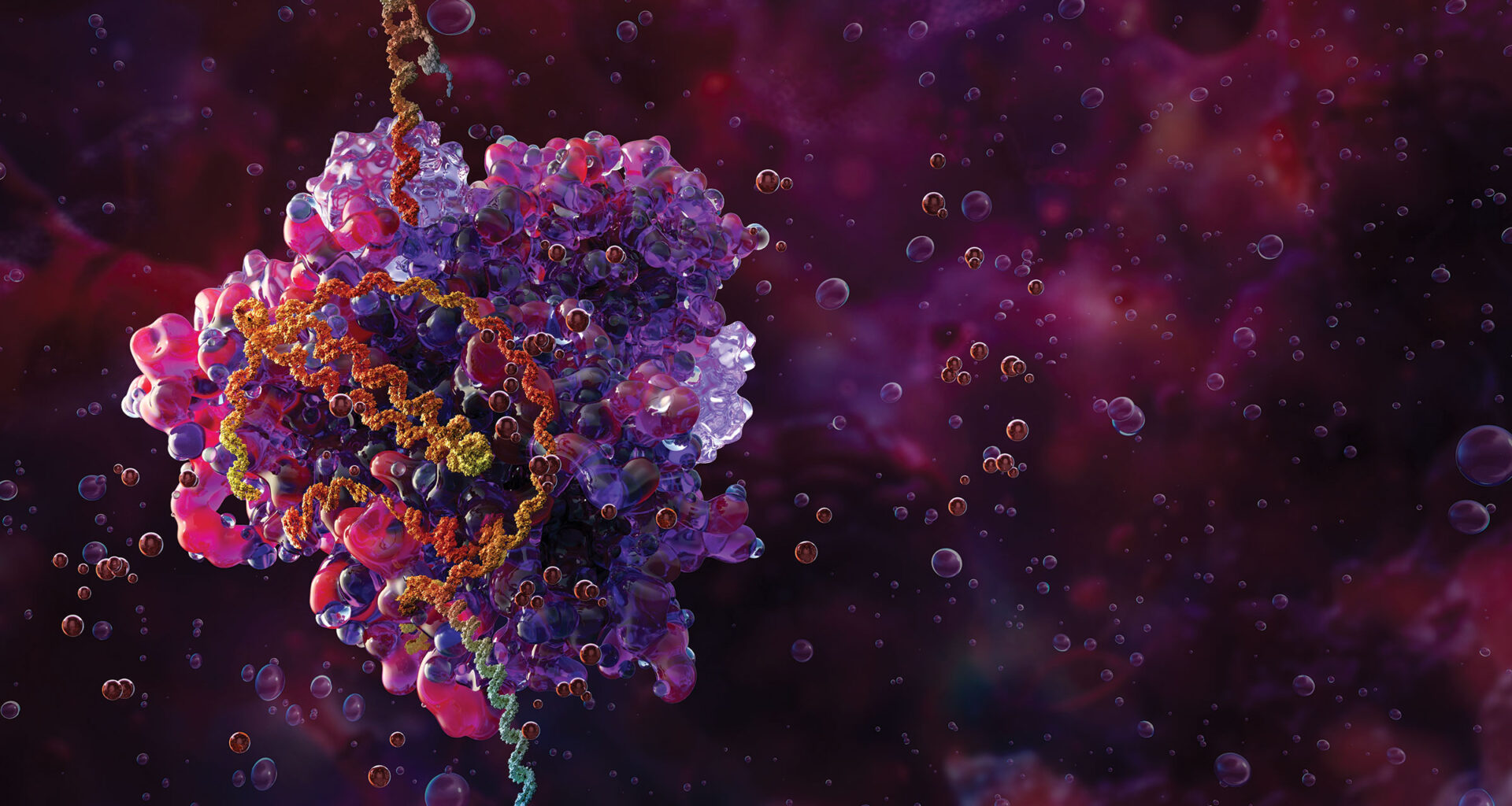
CRISPR-Cas gene-editing tools have revolutionized the world of biotechnology and medicine. And each year, it seems, these tools are iterated on and improved. Now a new research study has detailed a variant of the Cas9 protein that can selectively cut DNA based on its methylation state (Nature 2026, DOI: 10.1038/s41586-026-10384-z).
Hong Li, an RNA structural biologist at the Van Andel Institute, led the work in her lab. The specific Cas9 variant that the lab was studying is called ThermoCas9, and it was isolated from the bacterium Geobacillus thermodenitrificans T12 back in 2017 (Nat. Commun., DOI: 10.1038/s41467-017-01591-4). But it wasn’t until after Li’s lab discovered methylation sensitivity in another Cas9 variant, called AceCas9, that they decided to see if ThermoCas9 was methylation sensitive as well.
But not all DNA methylation is created equal. AceCas9 and ThermoCas9 are both inhibited by methylation on cytosine residues contained within the protospacer adjacent motif (PAM), which is the sequence of DNA that Cas9 binds to next to the cut site. But the two enzymes bind subtly different variants. AceCas9 is inhibited when the methylated cytosine is followed by another cytosine (CpC), whereas ThermoCas9 is inhibited by CpC methylation and when the methylated cytosine is followed by a guanine (CpG).
Rahul M. Kohli, a biochemist and epigeneticist at the University of Pennsylvania who wasn’t involved in the study, says that in mammalian genomes, “the vast majority of methyl cytosine is in a CpG context.” The reason for this, he explains, is because the reverse complement sequence on the opposing DNA strand is also a CpG sequence that itself can be methylated. This allows cellular machinery to identify and maintain a sequence’s methylation state in case one of those marks gets removed.
Li’s group used cryo-electron microscopy to determine the structure of ThermoCas9 and how it interacts with DNA sequences. She says that because the Cas9 rests so closely to the cytosine at the CpG in the PAM, “methylation is going to exclude this ThermoCas9 from cutting or from binding.” That physical interaction results in a Cas9 variant that selectively cuts DNA without a methylated cytosine 100% of the time, she says.
Methylation typically represses a gene’s expression, and when those marks are lost, it can lead to tumor development.
The researchers were able to show that ThermoCas9 could selectively cut DNA in breast cancer cells that had lost methylation at important genes for tumor development, while seemingly not affecting the DNA in healthy cells that were still methylated at those sites. But Li says there’s far more work to be done before this could be useful as an actual cancer therapy.
Beyond cancer, Kohli says the methylation selectivity of ThermoCas9 could have a wide range of purposes in studying basic biology. “In epigenetics, we like talking about how the genome is more than four bases. It’s five bases, with methyl cytosine being this interesting and dynamic base that helps to shape different cell types,” he says. “The idea that to expand beyond four bases to get specificity to now be able to discriminate the fifth state is really the key thing that I took away.”

Max Barnhart is an assistant editor and life sciences reporter at C&EN.
Chemical & Engineering News
ISSN 0009-2347
Copyright ©
2026 American Chemical Society