
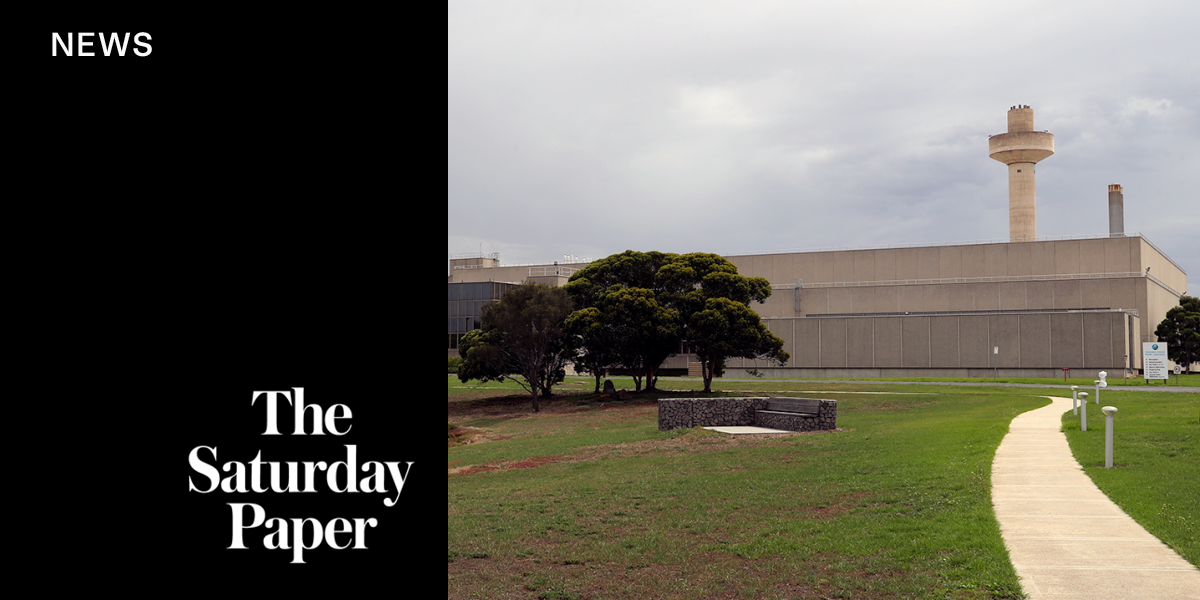
It’s a frontline service, runs 24/7 and contains specimens of some of the world’s most dangerous infectious diseases, including Ebola. Upholding its severe standards of biosecurity – it’s one of the southern hemisphere’s few buildings of which parts are classified as PC4 (for “physical containment level four”), the most secure category – requires sophisticated engineers and niche architectural expertise, and its staff’s unerring compliance with elaborate protocols. It was here the Hendra virus was first identified, and where the first animal testing of the AstraZeneca Covid-19 vaccine occurred.
It’s the Australian Centre for Disease Preparedness and, despite its sensitivity, uniqueness and accomplishments, it’s quite likely you’ve never heard of it before.
What’s more, in a series of recent public hearings and the CSIRO’s own submission last year to a parliamentary committee on public works, the necessity for the facility’s significant upgrading was revealed to be concerningly overdue.
Previously known as the Australian Animal Health Laboratory, it opened at its East Geelong site – beside Stingaree Bay – in 1985, principally as a place to study and test for foot-and-mouth disease. The planning, construction and eventual opening were intensely controversial at the time. Farming groups, and plenty within virology’s scientific community, passionately opposed its existence – the importation of foot-and-mouth disease for research was thought excessively risky.
The site’s construction prevailed, even if it didn’t quite fulfil the vision of then CSIRO chief Dr J. Paul Wild that the compound would eventually be considered, like the Sydney Opera House, “a national cultural symbol and as a world-famous landmark”.
As Covid-19 emerged in 2020, the Morrison government renamed the facility to better publicly reflect its broader mandate. While the facility was still charged with protecting Australian livestock and aquaculture by detecting and researching infectious disease – as well as certifying our livestock exports as disease-free – scientists in the complex “concrete bunker” were also protecting the human population from “zoonotic disease threats”.
Professor Peter Doherty, later a Nobel-winning immunologist, sat on the scientific committee in the 1970s advising the government on its construction. While supportive of the facility in theory, he objected then to its design and location. He hasn’t changed his mind. “[The design] was too rigid and it was built in too low a place,” he tells The Saturday Paper. “It’s too close to the sea and I wonder how rising ocean levels may affect this in the future.”
“It’s now massively out of date.”
“The cost of things increased after Covid – inflation went through the roof. And all the planning we’d done was no longer viable.”
The facility was designed in the 1970s, and the first sod turned in 1978 before its opening in 1985. It was meant to have a century lifespan, though elements of the facility had a shelf life of 30 years. CSIRO has been planning for these redevelopments for well over a decade now.
When Doherty refers to the facility’s rigidity, he means its inability to adapt to or accommodate future technologies. Its nesting of several concrete boxes – 30 centimetres thick and each with a progressively lower air pressure to prevent airborne leakage – is an exceptionally secure design but not a terribly adaptable one.
In a submission dated August last year, CSIRO put in a funding request to the parliamentary standing committee on public works. It was a pitch for the funding of major refurbishments, as well as the construction of a new, adjacent laboratory that would ultimately be connected to the existing facility, at the estimated cost of $372 million and a late 2028 completion.
Contained in the submission were four detailed proposals for the redevelopment and their preference for the one outlined above. Within that, though, was the following: “This refurbishment has been planned for more than 10 years and has been postponed due to various factors,” the submission read. “Further delays will increase the risk to operations from equipment failure and regulatory non-compliance in several key areas.”
The rest of the report was mute, however, on what those “various factors” were. I was curious to know what circumstances might have conspired to delay by up to a decade the significant improvements to such a profoundly sensitive site.
Indeed, in its eventual report, the committee wrote it had “heard that a midlife refurbishment is well overdue to address certain building services and fit outs which are past their planned operational life.
“The CSIRO submitted that the primary deficiencies of the ACDP in its current state are age-related infrastructure and equipment failures, non-compliance placing constraints on capability to handle specific pathogens and conduct research according to modern research standards, and outmoded laboratory design.”
CSIRO says the facility remains world-class and entirely safe, and The Saturday Paper does not suggest otherwise. A current staff member at the facility repeated this assurance to me – one they also frequently share with their family.
Nonetheless, questions remained about the “various factors” that created the delays in upgrading such vital infrastructure. In public hearings held by the committee in November last year, CSIRO’s director of business and infrastructure services, Fiona Rothwell, said: “As ACDP is in its 40th year of operation, certain components, such as some building services and fit-out, are past their planned operational lives and are overdue for refurbishment.
“ACDP was designed to have a 100-year life span, with anticipated refurbishment at 30 years. The original, 1970s-designed laboratory layout was not designed for the advances made in scientific approaches and requires updating to comply with current requirements for laboratories and animal studies. CSIRO has evaluated multiple options for the future of the ACDP facility since 2013.”
One of those components are the facility’s autoclaves – its steam sterilisation machines – which are now well outdated and require constant repairs.
The ACDP produces enormous amounts of contaminated waste, all of which must be treated onsite before its removal. The autoclaves, along with incineration and chemical disinfection, is one way of treating the waste. To give you a scale of the logistics here, in 2024 the ACDP – with ethical approval – performed 248 animal experiments involving just over one million creatures. Of those, 752,000 were humanely killed, of which 645,000 were fish.
The Saturday Paper asked CSIRO if it could elaborate on the “various factors” that have delayed the facility’s refurbishment and construction of a new lab, if it had received any concerns from staff about these delays, and if it was just as safe and secure as it was 10 years ago – before certain elements, like its autoclaves, passed their use-by dates.
CSIRO’s response wasn’t any more revealing than its submission. A spokesperson reiterated the importance of the facility, and that the parliamentary committee for public works had not only approved the funding but prioritised it. The spokesperson added: “ACDP was designed and purpose-built with duplicated and triplicated physical containment systems, ensuring there are multiple containment barriers in place at all times.
“CSIRO has been open about ACDP’s ageing infrastructure, and the challenges and importance of maintaining this vital piece of national infrastructure, including in its submission to the Parliamentary Committee for Public Works in 2025 and with regulators. We continue to be proactive in safely managing the infrastructure until refit construction commences shortly. This includes expediting priority infrastructure upgrades in advance of the refit commencing, conducting regular risk assessments on major plant and equipment, additional engineering controls, and increasing resourcing of site-based health and safety teams. The safety of staff and the community is the highest priority for CSIRO across all our facilities, including ACDP.”
The Saturday Paper also spoke with a current staff member at the facility, one familiar with its requirements and building proposals, to ask what contributed to these delays. “To start, this is an unusually complex facility,” they said. “It’s huge and largely without precedent in the world for its size. There aren’t many contractors who can build to our unique specifications … There aren’t many in the world who build them [autoclaves] as large as we need. We treat cows, horses, alpacas in them. They need to be atypically huge.
“We also thought about gutting the place and keeping the shell. But it’s so difficult to maintain PC3 and PC4 status while doing a major refit. Think of a house renovation, when parts of it are inhabitable and some aren’t, and you’re shifting things between the two. We couldn’t do that. So, aside from the refurbishments, a greenfield build was decided the best option. To build on a nearby grassed area and for the new lab to be tethered [to the existing compound].”
The uniquely complex demands of both the ACDP’s refurbishment and new development, then, were offered by this insider as one reason for the delay. But there was another: “funding pressures,” they said. “The cost of things increased after Covid – inflation went through the roof. And all the planning we’d done was no longer viable. So we went to government and asked for more. We told them it’s blown out.”
The staff member also said colleagues were concerned that recent cuts to CSIRO had reduced support staff at the facility – something echoed to The Saturday Paper by Anthony Keenan, a spokesperson for the Community and Public Sector Union’s CSIRO Staff Association.
The funding for CSIRO’s proposed stage one refit and new development – the $372 million – has been approved, and insiders are grateful. Long delayed upgrades should be addressed.
But that they were delayed, one CSIRO scientist tells The Saturday Paper, is further proof to them that Australia’s highly complex scientific infrastructure – whether it’s Canberra’s super computer or the ACDP – is too often the casualty of political myopia, or short-termism.
If their public value is uncontested, they say, then their maintenance or redevelopment should not be uncertain or piecemeal. Custodianship of their health requires governments to consider their future – a future that extends beyond their re-election.
I shared this with one current staff member of the ACDP and they agreed in principle. However, they said, the facility’s upgrade was still subject to the design and procurement complexities they’d discussed, and supply-chain blockages and inflation played their parts too.
“I suppose it’s a matter of political priorities,” they said, “but it’s also an issue of a really unique design and sourcing issues. But I can assure you that the place is very safe.”
This article was first published in the print edition of The Saturday Paper on
April 18, 2026 as “Damage control”.
For almost a decade, The Saturday Paper has published Australia’s leading writers and thinkers.
We have pursued stories that are ignored elsewhere, covering them with sensitivity and depth.
We have done this on refugee policy, on government integrity, on robo-debt, on aged care,
on climate change, on the pandemic.
All our journalism is fiercely independent. It relies on the support of readers.
By subscribing to The Saturday Paper, you are ensuring that we can continue to produce essential,
issue-defining coverage, to dig out stories that take time, to doggedly hold to account
politicians and the political class.
There are very few titles that have the freedom and the space to produce journalism like this.
In a country with a concentration of media ownership unlike anything else in the world,
it is vitally important. Your subscription helps make it possible.
Send this article to a friend for free.
Share this subscriber exclusive article with a friend or family member using share credits.

Used 1 of … credits
use share credits to share this article with friend or family.
You’ve shared all of your credits for this month. They will refresh on May 1. If you would like to share more, you can buy a gift subscription for a friend.
SHARE WITH A FRIEND
? CREDITS REMAIN
SHARE WITH A SUBSCRIBER
UNLIMITED
Loading…
News
How CSIRO job cuts jeopardise climate predictions
Martin McKenzie-Murray
Further staffing cuts at the CSIRO threaten its ability to model and predict the progress of climate change, reflecting a shift to focus on adaptation.