

When Beyoncé announced her Grammy-winning Cowboy Carter album in early 2024, it sparked something in Jessie Ware.
“I was thinking ‘cowboys, disco, westerns’. That could be fun and quite camp,” the successful British singer, podcaster and mother of three explains.
She envisioned a song that was less Black Country and more sensual synth-disco, with a Wild West twist.
“Whatever this is going to be, it’s about a cowboy,” she told her frequent songwriter-producer collaborators Karma Kid and Jack Peñate.
The resulting track, Ride, nails the brief, filled with playful innuendo (“Jump on the saddle, baby, hold on tight / I need a stallion who can go all night”) and sounding like Giorgio Morder meets Ennio Morricone. Literally.
The main hook interpolates the legendary screen composer’s iconic Spaghetti Western theme from The Good, The Bad and the Ugly.
“I liked the idea that the drop wasn’t me singing, so I was like, ‘What’s the most obvious cowboy thing?’ I was kind of taking the piss but then we all looked around and were like, ‘This sounds really good, actually!’
“Then we had to ask for the permission and they said yes, when they could have absolutely said no.”
Loading Instagram content
Ride was the first track written for Ware’s sixth album, Superbloom, and its instinctual approach and opulent sound sets the tone for what is a fun, flirtatious pop album for grown-ups.
It’s a natural extension of the space Ware first inhabited with 2020’s acclaimed What’s Your Pleasure?, reinventing herself as a powerhouse vocalist hosting a confident, campy after-hours dancefloor.
An empowering transformation
After emerging in the 2010s as a buzzed-about guest vocalist for UK producers, Jessie Ware soon went solo, making soulful, electronic indie-pop.
After a fallow period of insecurity in which her label wanted her to be Adele, Ware changed labels and management and released What’s Your Pleasure?, further cementing her 1970s funk, disco and house credentials on the follow-up That! Feels Good! — one of 2023’s best releases.
Ten years in, Jessie Ware is enjoying her career more than ever. But it wasn’t always that way.
Her career is almost the inverse of a traditional arc. At 41, her music sounds more liberated, sex-positive and party-facing now than her sophisticated but politely reserved early work.
As such, Ware told Double J in 2023 she was having more fun than ever. From the sound of Superbloom, that continues to be the case.
“I really am. I’m feeling great and I want to celebrate that. This album feels like I finally know what I’m doing as an artist.”
“I want everyone else to have a good time when they’re listening to the record, too.
“I want them to feel romantic, sexy, gorgeous, intimate; I wanted to feel like we’re getting to know each other.
From the elegant euphoria of I Could Get Used To This to the closing Mon Amour, everything hearkens back to an era of sophisticated pop songwriting, with savvy key changes and a lusher, more organic and orchestral sonic palette.
Buttery bass and scratchy guitar meet swooning strings, Age of Aquarius choral revelry and — a Jessie Ware first — flute (performed by the “absolutely amazing” Gareth Lockrane, Ware gushes).
Don’t You Know Who I Am? sounds like Barbara Streisand doing a James Bond theme with a Studio 54 house band.
“I love that one, I’m really proud of it,” Ware remarks. “I wanted to tell a story and that’s very much inhabiting a character.”
Loading Instagram content
There’s more of the vintage dance music DNA of previous albums (think Chic, Evelyn ‘Champagne’ King, Chaka Khan) but Superbloom’s influences go broader and deeper.
Ware name-checks an obscure Pet Shop Boys and Liza Minnelli collaboration, Italo disco, ABBA, Grace Jones, and getting “as close as [she] could get” to Minnie Riperton’s Le Fleurs. “But I also wanted to croon.”
Where the music is designed to get bodies moving, or swooning, Ware finds new spaces for her exquisite voice to go, whether simmering, soothing, or soaring to the rafters.
“I wanted to test myself and I wanted to see how much I could push it, whilst also remaining it being a groove record.
“I’ve been absorbing a lot of musical theatre and I like the melodrama. I wanted to try that, and with disco and dance music I knew that could work.
“I wanted to paint this picture of this world that you’re coming into, that is romantic, luscious, beautiful.”
Good life, good music
As a Platinum-selling artist, music is Jessie Ware’s main gig but it’s far from her only occupation. She’s also a charming, relatable presence on her hit food-and-conversation podcast Table Manners.
Co-hosted with her mum, Lennie Ware, the show now spans more than 400 episodes and featured everyone from Robert DeNiro and Nigella Lawson to Sir Paul McCartney.
Loading Instagram content
Being fulfilled in other parts of her life — author, podcaster, wife, mother — has helped Jessie Ware bring more personality and efficiency to her music.
“It’s really helped me productively and creatively. Not only is it another kind of outlet where I can switch off from the music and it isn’t all-consuming, it’s also great for ideas.”
For example? The track I Could Get Used To This was inspired by a conversation with Gillian Anderson concerning “seminal book” My Secret Garden, Nancy Friday’s 1970s compendium of women’s sexual fantasies and desires.
“This is great material for me. Thank you, Gillian,” she chuckles.
A podcast-prompted trip to New York City also connected Ware to actor, playwright and director Coleman Domingo. “Then I can ask him to do the voice of God on a song [Automatic]. It’s amazing, really fulfilling.”
The same NYC jaunt spawned Sauna, a suitably steamy track where, between pulsing synths and suggestive heavy breathing, Ware declares:
“If you wanna / Last longer / I don’t need faster / I need stronger /Take it to the sauna.”
“That song came out of me going to the sauna a lot with my girlfriends. But also going to the best party in New York with these beautiful new friends of mine and wanting to make a song that felt like it encapsulated that night.”
When the topic of parenthood came up during an episode with British comedian Jason Manford, inspiration struck again.
“[He said] ‘You’ve only got sixteen summers, so you should enjoy it’. I’m like, ‘Oh god, hang on. That’s a really good title!”
Loading Instagram content
The resulting ballad, 16 Summers, is a sweeping strings-and-piano ode to savouring the present moment, dedicated to Ware’s daughter and two sons, aged between five and 10.
“I see three children growing up, I want the hourglass to stop / or at least slow down,” she sings.
The ‘days are long, but the years are short’ sentiment is likely to make any parent’s eyes wet.
Music and motherhood
Historically, the music industry has stigmatised female pop stars, commodifying and objectifying their youth before threatening them to reinvent or be made irrelevant, or worse, abandoned them in motherhood.
Ware’s career, which emphasises rather than downplays her multiple dimensions as musician and family matriarch, is an inspiring success.
But even as she shortens tour commitments and makes the time for school pick-ups, “the guilt still creeps in,” she says.
“But I think that’s like in any working woman’s job. The guilt is always kind of there in some shape or form. You never feel like you’re doing enough.
“Or if you are doing enough, then you’re probably reaching burnout because you’re so exhausted from trying to be the perfect mum, the perfect employer.”
She’s grateful and trying to enjoy every aspect of her success but “I’m also aware that this time wont’ always last”.
“That’s what scares me slightly. Not necessarily in my career, it’s more my kids will only be little for so long, and I want to be able to take that all in,” she says.
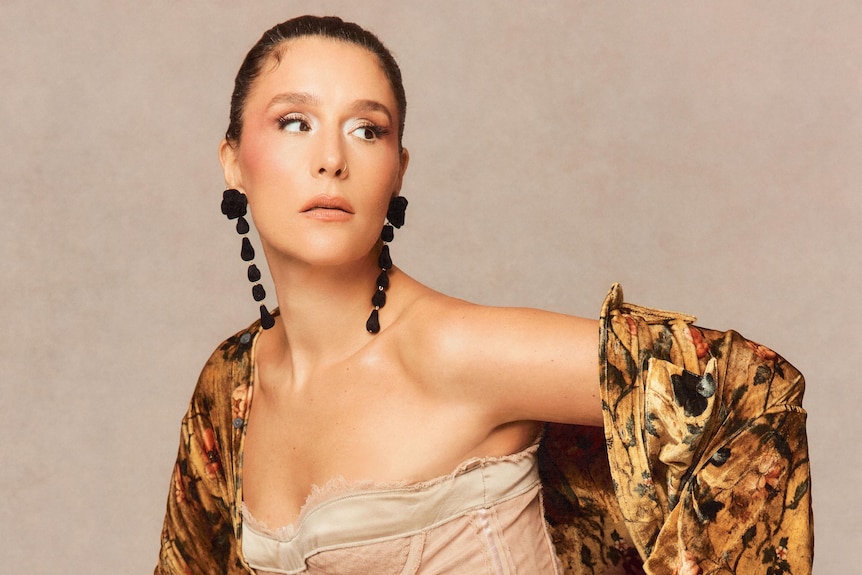
Ware suspects her children “resent me having a job that takes me away. But they do like the travelling circus feel of it, too.” (Supplied: Jack Grange)
And what do the kids make of mum’s job? Especially when it comes to Ride’s saucy music video, where she’s doing naughty things with (largely shirtless) actor James Norton.
“They’re not looking at the video right. Ever!” she deadpans.
“I don’t think they’d understand what mummy was doing. And they think I was being a bit mean to James,” she chuckles.
“When my husband had said to my son, ‘Mummy bit James’s ear’, he said, ‘Mum, you know that biting is wrong!'”
Her daughter prefers Taylor Swift and Grace Abrams. Though her son did offer a stamp of approval recently.
“I was singing something in their room and he went, ‘Mummy, you’ve got a really nice voice.’ Thanks darl!”
“They think I’m really uncool,” she continues.
“Maybe somebody comes up to me once in a while and says, I like your music, and they say, who’s that? They usually think it’s someone that I know.
“But I think they — thank god — don’t really know what’s going on because they have a very normal life. They’re not kind of privy to any of it because I don’t want them to be. I want to be their mum.
“I want them to think I’m bad cop because I’m making them go to bed at the right time. And I want to be at their community show doing their makeup in Sweeny Todd. That’s what I want to do, because I want to be present for them.”
In all its playful freedom and glamour, Superbloom combines the worlds of Jessie Ware: The Artist and Jessie Ware: The Human.
“I wanted to test whether I could marry these worlds of domesticity with pure melodrama. And I think I’ve done that.
“If you know me by now, through the podcast or my music, I am many different things and I don’t want to shy away from any of them.”
Superbloom is out now.