
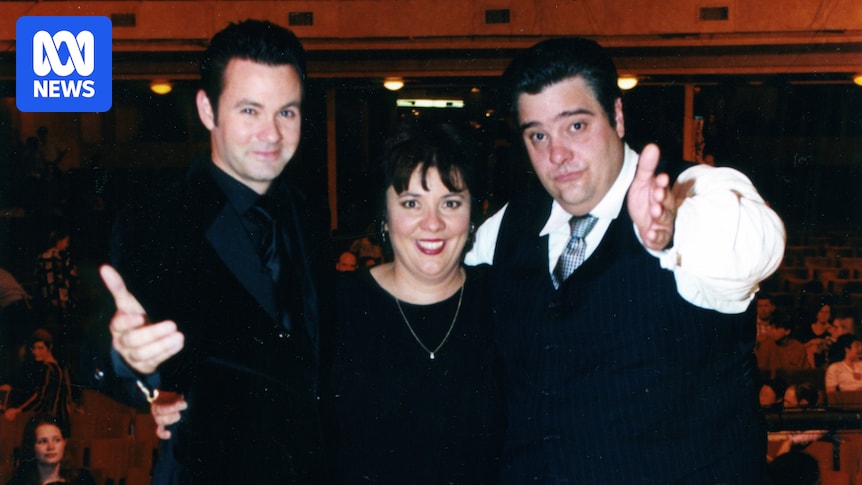
“Thank you, thank you, thank you and welcome to Witness with Paul McDermott,” the fresh-faced comedian greeted a cheering in-studio audience at ABC’s Gore Hill studio on Friday, April 19, 1996.
“Tonight, we ask Rupert Murdoch the tough questions: Who does your hair? Would you like red or white wine? And are you the same Rupert who signs my pay cheques?”
That’s how the then-33-year-old comedian introduced the first-ever episode of comedy news game show Good News Week 30 years ago.
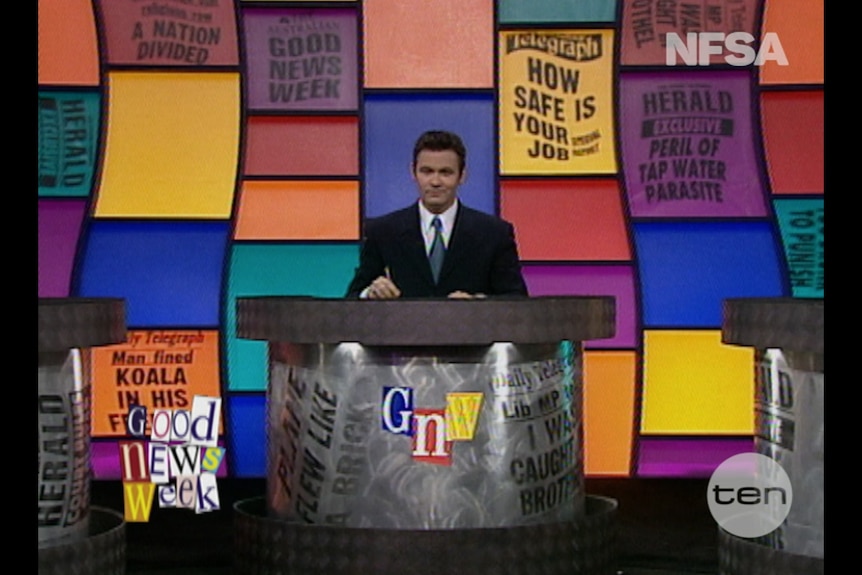
In 2014, McDermott said the transition from live comedy to TV was easy: “I had to chop off my dreadlocks and that was about it.” (Supplied: NFSA)
The opening gambit was a reference to the Channel Seven current affairs program, hosted by Jana Wendt.
Then McDermott dove into a monologue about his favourite news stories of the week, holding a collection of newspaper clippings in one hand. At the end, he flung them into the air.
The brainchild of executive producer Ted Robinson, the original half-hour Good News Week was a satirical look at the news, in the style of British panel show Have I Got News for You.
McDermott — then known for playing the “angry, bitter, upset, tortured” character in comedy trio Doug Anthony All Stars — would go on to host the show for its initial run, from 1996 to 2000, and then its return, from 2008 to 2012.
That April 1999 episode kicked off nine seasons. In 1997, the show picked up an average of 750,000 viewers nationally. In 2010, McDermott even landed a Gold Logie nomination as the show copped an average of just under a million viewers a week.
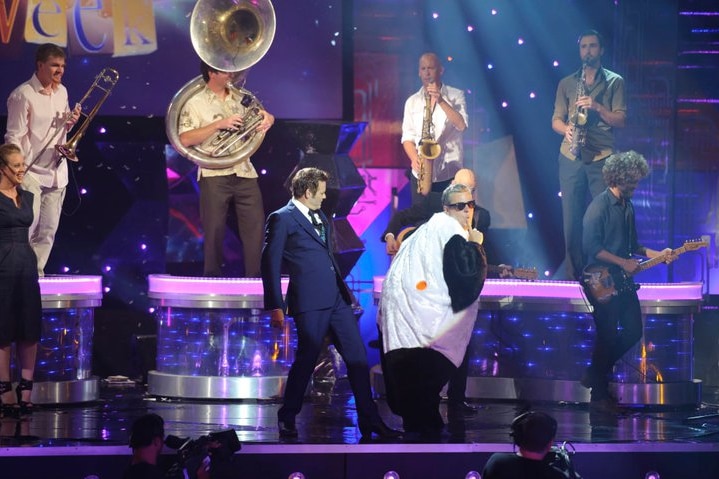
“Paul McDermott owes me $45 from about 1999 and I’d be very happy if you printed that,” Robins says. (Supplied: Network Ten)
It also offered early opportunities to local and international comics like Daniel Sloss, Josh Thomas and Wil Anderson, often placing them beside politicians like conservative Amanda Vanstone and Australian Democrat Natasha Stott Despoja.
A dynamic trio
Mikey Robins, then-host of triple j Breakfast, would sit beside McDermott through all nine seasons. In that first episode, McDermott introduced a bemused Robins as “radio star, sex god and leader of our first team”.
Paul McDermott’s ‘painful but exciting’ early MICF appearance
“Because of the radio, they knew I was quick on my feet and I was across current events,” Robins tells ABC Arts, of why he was picked as a team captain.
“And I suppose physically Paul and I look so different. It’s that sort of thin-guy, fat-guy thing.”
He recalls filming the pilot, when he and McDermott started trading barbs halfway through the shoot.
“I remember smiling, and we looked at each other and went, ‘Yeah, this might work’,” he says.
The other team captain was comedian Anthony Ackroyd. He and Robins were joined by four panellists: actors Kate Fischer and Alison Whyte and comedians James O’Loghlin and Sandy Ireland.
That first year, that second captain spot would be also filled by the likes of broadcaster Amanda Keller and comedian Lynda Gibson, until broadcaster Julie McCrossin landed the job permanently midway through the first season.
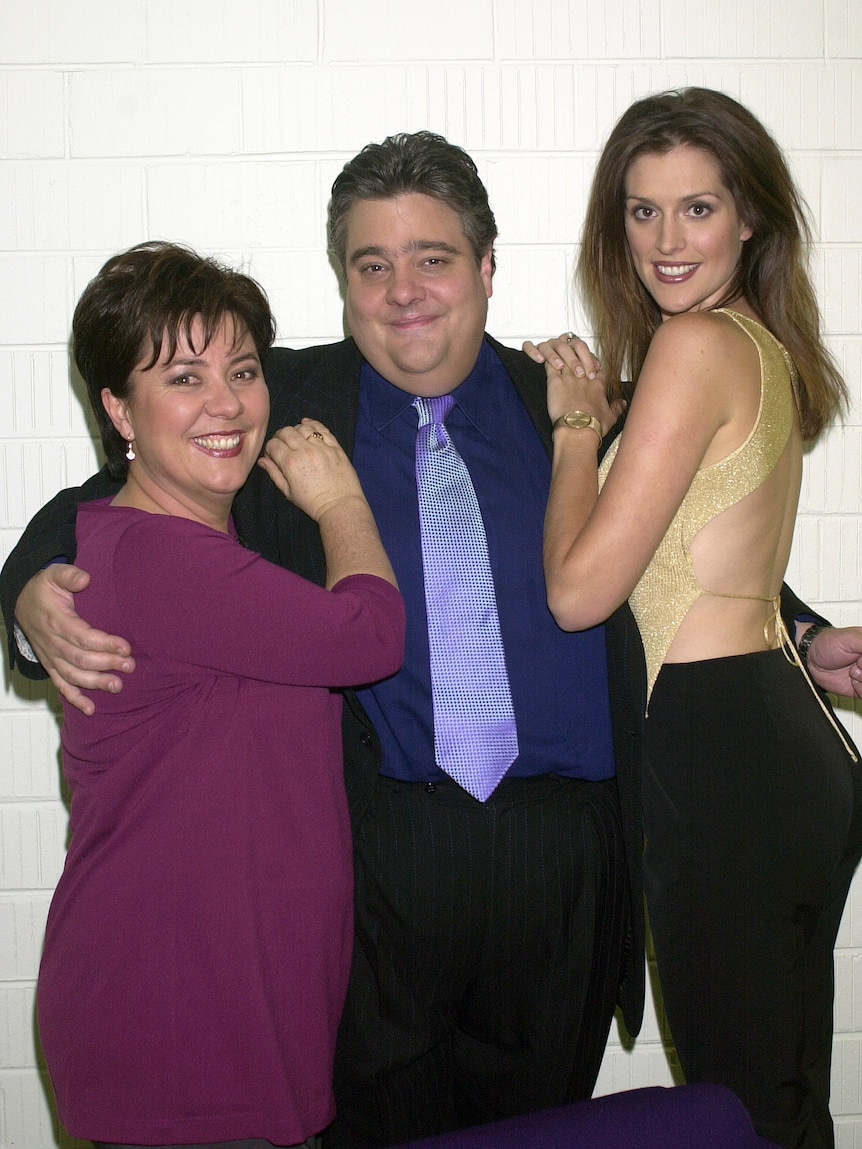
Robinson told McCrossin: “I’ve heard you can make people laugh and you’ve got an opinion on everything.” (Pictured with Robins and Kate Fischer.) (Getty Images: Peter Carrette)
She’d worked at ABC Radio National, as a character comedian and in children’s theatre, experiences which set her up to succeed in her new gig.
But so did her big, outspoken family: Surrounded by gregarious comedians, fighting for the spotlight, she didn’t shut up.
“I discovered I was prepared to fight back,” she says. “I wasn’t overly confident that I would be amusing [and] I often thought I was the only one seriously trying to answer the question.
“I think Ted kept me because I kept trying and I had a kindness about me … He used to say, ‘Julie, you bring a lot of heart to the show’.”
The first reviews of the show were positive, but Robins reckons the ABC didn’t “get” the show initially.
“We were constantly told we were being cancelled at the end of the year and then we’d find out we were doing more shows next year,” he says.
“I used to joke that we were taking away ABC budget from buying more British classic sitcoms.”
Going commercial
In 1999, Robinson’s production company GNW TV sold the rights to Good News Week to Channel 10 for $6 million. The move angered some fans, who accused the show and its cast of selling out.
That year, Robinson told The Age the switch was about “reinventing ourselves”, adding that the team felt heartened by the editorial independence afforded 10’s talk show The Panel.
Robins scoffed at the idea of being called a sell-out then — and now.
“I didn’t give a f***,” he says.
He says the difference between Good News Week under ABC and Channel 10 was minimal — beyond expanding the length of the show to an hour.
“There was absolutely no change in terms of policy or censorship or anything like that,” he says.
What changed was the audience.
“A fair amount of the ABC stalwarts didn’t come with us,” he says. “The studio audience got a little bit younger and I had hot water in the shower in my dressing room.”
McCrossin describes the show’s commercial audience as “more working class and less familiar with news and current affairs”.
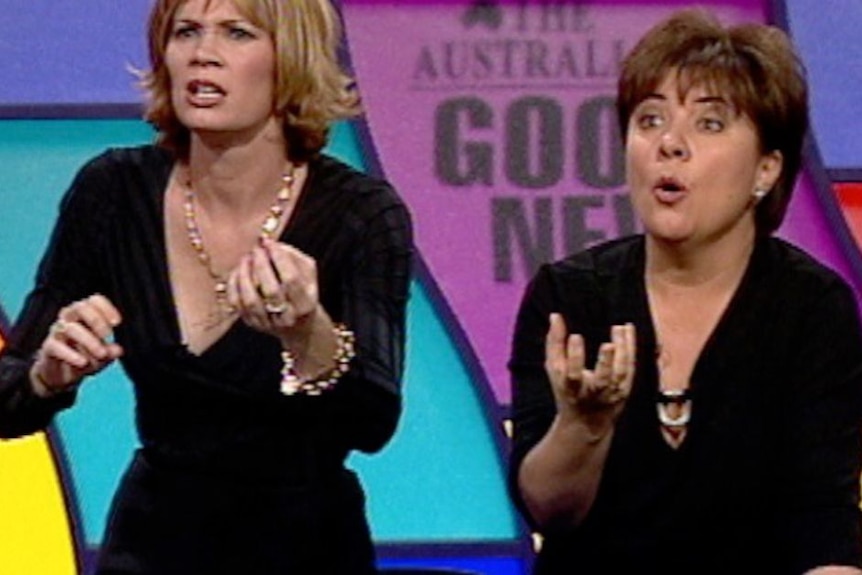
“I had to be prepared to make a complete goose of myself in front of hundreds of thousands [of people],” McCrossin says. (Pictured with swimmer Tracey Wickham.) (Supplied: NFSA)
“I had to stop making reference to [Gough] Whitlam and that sort of political commentary and become much more populist,” she says.
But McCrossin saw the move as an opportunity. A queer woman, she had been a “78er”, participating in the first Mardi Gras in Sydney in 1978. She also hosted queer and women-focused radio shows, including ABC Radio National’s The Coming Out Show.
“I thought, I don’t want to be an elitist egghead, I actually care about social change, and I want to be able to communicate with all sorts of people,” she says.
Nevertheless, after the 1999 season, she tried to quit the show, telling Robinson she felt like “a fish out of water”. He tearfully responded: “Don’t leave me.”
So, McCrossin stayed until the show was cancelled for the first time in 2000.
“I always knew it would end suddenly,” she says. “But it was five full years — which is pretty good in that [TV] world.”A second chance
In 2008, the two-month writers’ strike in the United States left Channel 10 with a gap in programming, which led them to announce the return of Good News Week.
McDermott and Robins returned, with McCrossin replaced by then-emerging comic Claire Hooper.
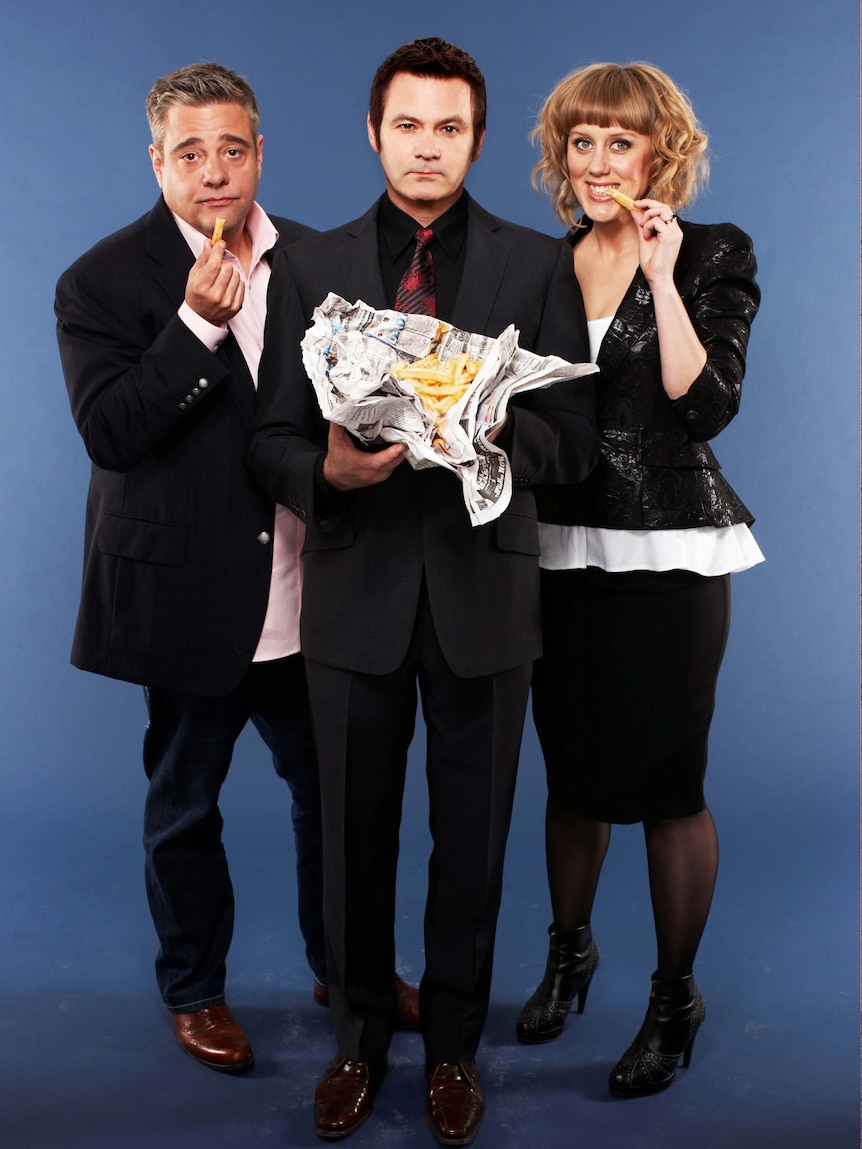
For Hooper, the most challenging part of the job was the level of news consumption: “Sometimes it’s a bit grim.” (Supplied: Network Ten)
When Robinson called to offer her the job, Hooper was relatively new to comedy but had appeared on ABC TV’s variety show The Sideshow in 2007, also hosted by McDermott.
“The phone call almost felt like I was getting pranked, because [Good News Week] was a show that hadn’t been on TV for eight years that I watched well before it had ever occurred to me to do comedy,” Hooper says.
McDermott and Robins were “incredibly welcoming”, she says, with Robinson giving her advice on how to thrive on the show.
“He would say things like, ‘Make sure you speak early. The longer you wait to talk the harder it is to start talking’,” she recalls. “[And] ‘Treat it like a dinner party. Don’t think about it as making TV — just think about it as jokes with friends’.
“I’d love to have that time over again, and I’d tell myself to swagger into that studio and not be so full of imposter syndrome.”
But while she was a little uncomfortable at first, Hooper didn’t feel pressure to be a direct replacement for McCrossin.
“She was incredibly smart, and I knew the least out of everyone in the room,” Hooper says.
“I don’t think I was there to be mischievous youth or a more progressive voice … I didn’t get the impression I was meant to do anything other than just be myself.”
She came to realise her role as a team captain was simply to “throw the spotlight” on the other people in her team “to make sure everyone gets a chance to shine”.
“It gave a lot of young performers from more than one generation their first go on telly,” Robins says, pointing to the likes of Tom Gleeson and Adam Spencer. “That’s the thing I’m most proud of.”
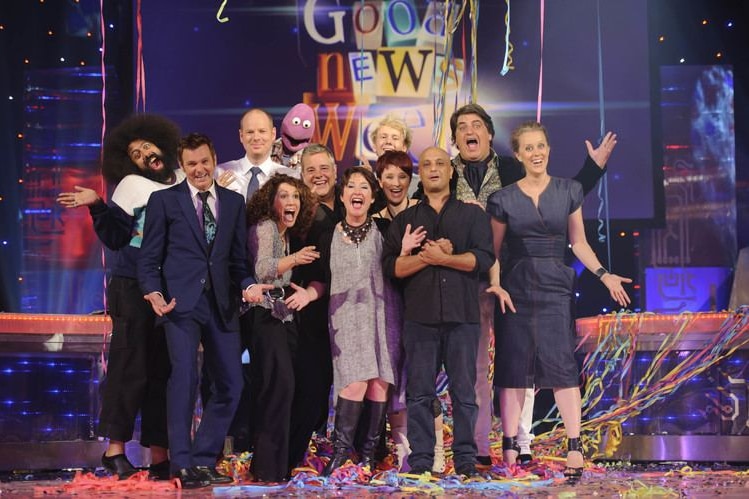
A 2011 episode of Good News Week featured this stacked guest line-up: Reggie Watts, Tom Gleeson, Kitty Flanagan, Randy, Fiona O’Loughlin, Josh Thomas, Cal Wilson, Akmal Saleh and Matt Preston. (Supplied: Network Ten)
After three more seasons, Good News Week was cancelled for good in 2012, with a series of live shows at that year’s Melbourne International Comedy Festival (MICF), which were cut into one final episode.
Now, 14 years later, both Hooper and McDermott appeared at this year’s festival — Hooper with her new live show, and McDermott as moderator of its annual debate.
Robins, meanwhile, is happily retired, as McCrossin continues her work as a cancer community educator, having survived throat cancer.
No-one ABC Arts spoke to seemed interested in being involved in a new iteration of Good News Week. But Robins thinks the show could return with a younger cast.
“I think the biggest difference is that 30 years ago ‘US president attacks the Pope’ would be a gag; today it’s a headline,” he says.
Claire Hooper: fun show xx is at Melbourne International Comedy Festival until April 19, before touring to Sydney Comedy Festival from May 9-10 and Brisbane Comedy Festival from May 14-17.