
Australia has never quite fulfilled its demographic and geographic destiny. Australia is a wealthy continent in the Asia-Pacific, with the institutional depth, skills base and strategic real estate that should make it a regional heavyweight. For every generation, the door opens to that role — yet for every generation, something slams it shut again.
Familiar panic keeps pulling Australia back
Xenophobia is the handbrake to realising Australia’s role as a heavyweight. The economic and demographic logic is unambiguous: Australia needs to scale, integrate more deeply with its region, and keep the migration pipeline open. Every time the country moves in that direction, a social and political panic rises to pull the brake — in every generation since the turn of the last century.
Australia had 7.5 million people in 1945. It has 27 million today. Most of that growth comes from migration — new arrivals and their children. Rapid post-war industrialisation needed migrants, and 1950s and 1960s migrants from Southeastern and other parts of Europe arrived. The services economy of the 1980s and 1990s was fuelled by Asian migration. Aged care, construction, healthcare, the tech and the university sectors today run on the same pipeline.
When Australians argue about whether migration is working, they are really arguing about whether the country they live in should exist.
Yet the panic always returns — the same architecture and a rotating cast of targets. It kinks the skilled migration pipeline at exactly the moments the economy needs it open and tells existing diaspora communities, the country’s single biggest source of soft power into Asia, that their belonging is conditional.
It signals to Jakarta, Kuala Lumpur, New Delhi, Seoul and Beijing that Australia is a country that tolerates Asians, rather than one that lives with them. That has cost trade, investment, students, talent and standing, quietly and cumulatively, for decades.
It also eats political bandwidth. Every cycle we waste time arguing whether a particular migrant cohort ‘belongs’ — energy not spent on productivity, housing supply, or a regional strategy.
I think about this every time another round starts. Partly because the pattern is unmissable once you’ve lived through a few rotations of it. Partly because I grew up inside one of them. I was born in Footscray and spent my first years in Northcote. In both suburbs I was cocooned. ‘Wog’ kids everywhere. Greek was spoken at home, at the shops, over the kitchen tables of every household on our street. Racism was a word the adults used about a country I’d never seen.
Then we moved to Meadow Heights. Meadow Heights in the 1980s sat on the hard edge of Melbourne. A Housing Commission estate built on the old Broadmeadows North paddocks. Anglo-Celtic working-class families on one side of the line, new migrants on the other. Racism was constant. Walking to and from school meant fights, constantly. ‘Wog bashing’ wasn’t a phrase, it was a physical reality and a regular one.
On two occasions, teenage Anglo kids forced their way into our house, trashed what they could reach, and ran off before our parents got home. That was the texture of the place.
It forced newly arrived migrants and the children of migrants to do what frightened people have always done — to organise and fight back. It shaped the street politics of the area. The King Street Boys, the Anglo side, against the Black Dragons, a coalition of Greeks, Turks, Croats — whoever was getting bashed that week.
By the mid-1980s, nearly every suburb seemed to have a dojo. Kids were joining karate, kung fu and taekwondo, and boxing classes, not for the trophies but because the footpath was a theatre and you needed to be ready for the next act.
I think about Meadow Heights every time an Australian politician announces that this migrant wave is ‘different’. That ‘this’ time, the newcomers don’t fit. They always say the same thing, and the country has always said it back.
The pattern is older than any of us
Post-war Australia needed workers. The state sold the migration to a reluctant public on the basis that the migrants would be British. When fewer than 7,000 Britons signed up, Canberra turned to the displaced persons camps of Europe — the Hungarians, Poles, Czechs, Latvians and other mainly Central and Eastern Europeans. Finally, when those sources dried up, Australia was forced to import the ‘less white’ — Southern Italians, Greeks, and Yugoslavs — into a country that had spent 60 years telling itself it was an outpost of Britain.
Migrants arrived and were warehoused. Bonegilla, in north-east Victoria, processed around 300,000 of them between 1947 and 1971. Conditions were grim, work was scarce, and in 1952 the Italians rioted over the food and the unemployment. The government sent 200 soldiers to put it down.
The press baptised it the “spaghetti riot”. In 1961, the Italians and Germans went again, smashing the employment office, erecting signs that read “Bonegilla, place of no hope”. Six Germans and five Italians were arrested. The riot was covered across Europe and helped kill the Italian migration agreement.
The Australians who lived near these camps wrote to the papers complaining that the new arrivals had been given Italian cooks and olive oil. “My kids are still called dagoes,” one Greek railway worker told a community leader in the same period.
That was the first wave’s welcome.
Same script, different actors
The Southern European cohort copped it first in 1915 and 1916, when soldiers and civilians attacked Greek-owned businesses across Sydney, Haymarket and Manly, and large-scale violence in Perth and Western Australia’s eastern goldfields saw businesses burned and Greeks forced to flee.
Then again as post-war immigrants in the 1960s and 1970s. In Broadmeadows, where I later lived, Anglo working-class youth gangs called the Sharpies ran the streets. The former Victorian Labor Minister, Theo Theophanous, said “if you looked like a wog, you were a target by default”. The Sharpies were later replaced by skinheads, punks and bogans. In the public estates, where migrants lived, the response — as I lived it in Meadow Heights — was defensive formations, street-level retaliation, and then dojos.
Fear then violence, a tired script
In March 1984, Professor Geoffrey Blainey stood up at a Rotary Club lunch in Warrnambool and announced that Asian immigration was running ahead of public opinion. The Warrnambool Standard picked it up. The Age picked it up from the Standard. Within a week, the country was debating whether Indo-Chinese refugees — people we had taken in because we had helped wreck their country — were being imposed on a population that didn’t want them. Blainey warned of “invaded neighbourhoods” and suburbs on the “front line”. Malcolm Fraser later said Blainey’s speech began the race debate that ended in Tampa.
Twelve years after Warrnambool, Pauline Hanson stood up in the House of Representatives for her maiden speech and said Australia was “in danger of being swamped by Asians”. She said they formed ghettos and didn’t assimilate. The quote became one of the most repeated lines in modern Australian political memory. John Howard declined to condemn it. He won the following election and, crucially, did so by absorbing a sanitised version of her argument into his own.
Then came Tampa. In August 2001, a Norwegian freighter carrying 433 rescued Hazara asylum seekers was refused entry to Christmas Island. Howard boarded the ship with the SAS. Six weeks later, in the lead-up to the election, his ministers claimed the passengers on another boat had thrown their children overboard. The Senate later found it was false. The photographs that ran on every front page had been taken after the boat had sunk. Howard won. “We will decide who comes to this country,” he said — and that was carved into the Australian political psyche.
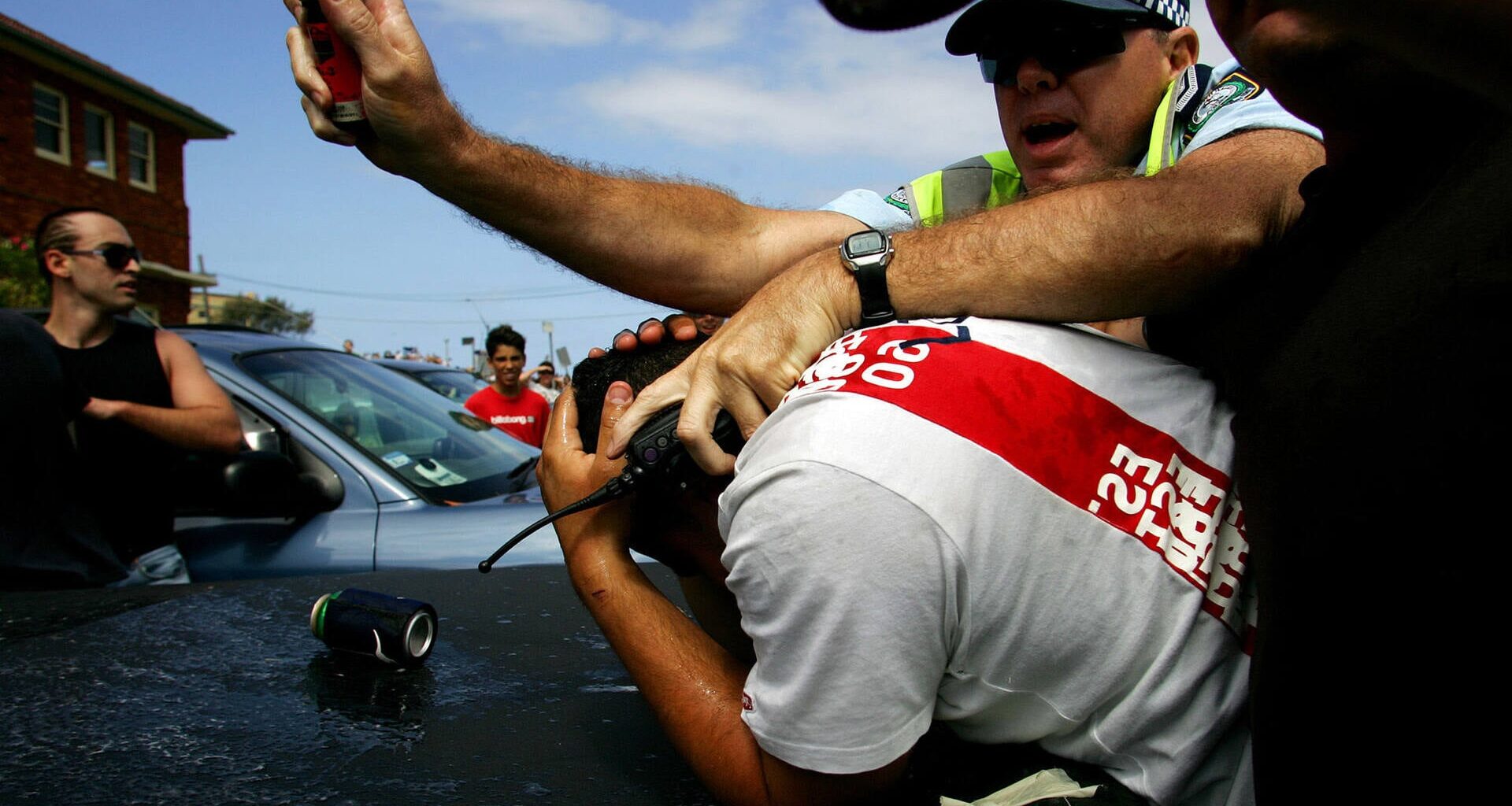
December 2005 is marked by the Cronulla riots, sparked by text messages circulated in Sydney’s beach suburbs calling for “Leb and wog bashing day”. Shock jock Alan Jones read them out on 2GB and called for a “community show of force”. ACMA later found the broadcasts were likely to incite violence and vilify Lebanese and Middle Eastern Australians. Five thousand people arrived at the beach and violence erupted. The second-generation Lebanese Australians at the centre of the panic were, overwhelmingly born and raised in Australia.
Then, in March 2016, a fight at the Moomba Festival was retrofitted into a pan-ethnic crime wave. The Herald Sun ran 173 stories mentioning “Apex” in a year. A third of them included the words “African” or “Sudanese”. Victoria Police said the gang was essentially a social-media brand. Peter Dutton said Melburnians were “scared to go out to restaurants”. The Liberal Party ran the 2018 Victorian state election on it and lost in a landslide. The coverage collapsed the day after the election was called. So did the ‘panic’.
What doesn’t change
Each wave of this has the same architecture. A migrant cohort arrives. A cohort of Australians — usually those living nearest to them, often themselves working-class and under economic pressure — reacts. A media outlet finds the temperature and turns up the heat. A politician sees the readings and runs on it. And a generation of migrant kids learns, the way I learned walking home from school in Meadow Heights, that the country they were born in does not regard them as entirely its own.
The targets rotate: Italians, Greeks, Vietnamese, Chinese, Afghan, Lebanese, Sudanese, Muslim. The script barely changes. ‘They form ghettos. They don’t assimilate. They bring their culture here. They’re taking our jobs, our houses, our safety, our beaches’ -that narrative is delivered as though it has just been discovered — a rerun.
Meadow Heights — the fights, the home invasions, the broken bones — is not just a story about the 1980s. It is the Australian story. It is what happens on the ground when the top of the national conversation decides that a particular group of newcomers is the problem — Greeks and Italians, Vietnamese in Footscray, Lebanese on Cronulla beach, South Sudanese in Melbourne.
National amnesia fuels the old engine
We never seem to remember that we already ran this experiment. And we never seem to notice that the people doing the fighting in the streets, on both sides, are almost always the ones who lost the argument about whose country this was going to be. I know, because I grew up in the middle of one of those panics. And because decades later, I still notice when some politicians start warming up the same engine. When the cycle comes around again — and it will — the damage will not stop at the suburb.
Australia has already seen what targeted economic coercion looks like from its most important trading partner. Between 2020 and 2022, Beijing tariffed wine at 218 per cent, suspended beef, locked out barley, left lobster rotting on Chinese tarmacs and turned coal ships around at port. Industries are still rebuilding from a single round of it. This was a direct response to the Morrison Government’s ‘anti-China’ narrative, as they hunted for votes, but cost Australian industry millions.
The national response was to diversify markets and deepen ties across the region. Our diaspora is at the frontline of that diversification. Every migrant community in this country is a live network of trade, family and professional links into the region Australia must operate in, not on the sideline.
A country that keeps running panics against its own diasporas is a country that keeps cutting its own lines of economic defence — in the decade it will need them most.
*Kosmos (Kos) Samaras is a Greek-Australian pollster and founder of the influential political consultancy RedBridge, and a former Victorian Labor strategist. He comments and contributes to Neos Kosmos, among other publications – this piece was first published on his Substack.