
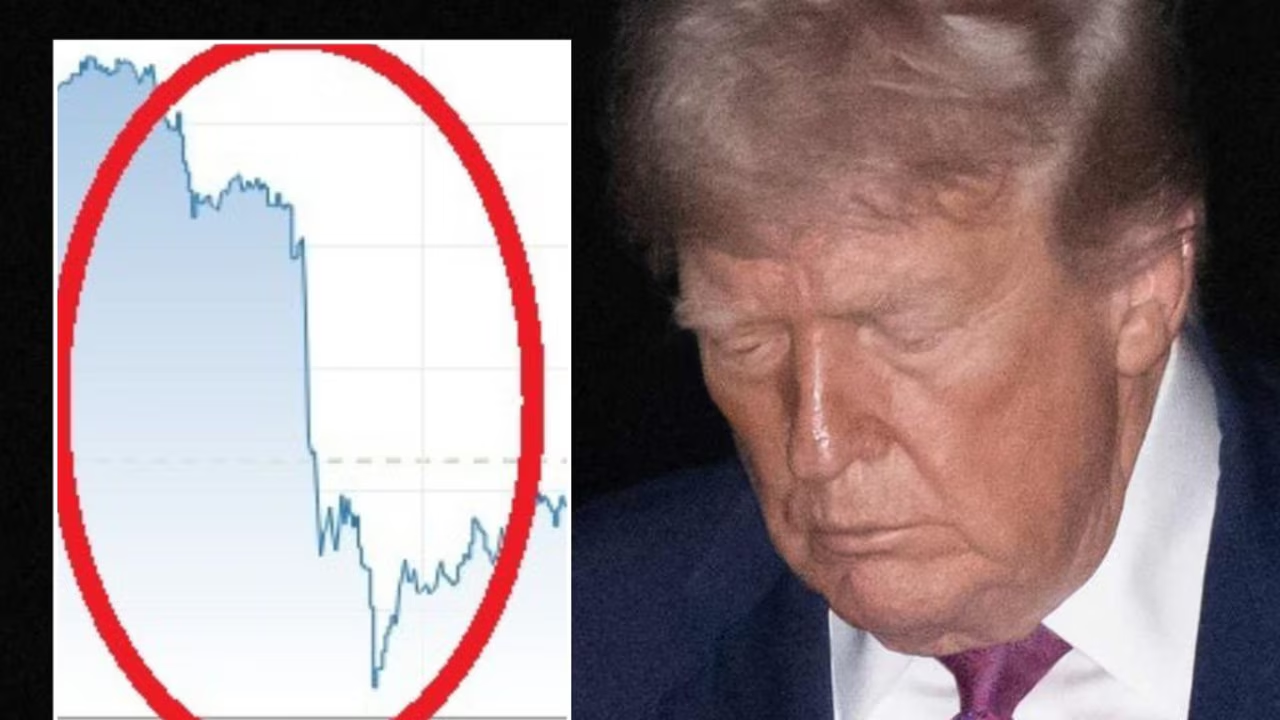
More conspicuously well-timed bets on the price of oil have caught the attention of the financial world, amid fears that people with inside knowledge of developments in the Iran War have been racking up illegal profits.
On Friday, a mere 20 minutes before the Iranian foreign minister, Seyed Abbas Araghchi, declared the Strait of Hormuz was “completely open”, investors “placed a bet worth about $US760 million (AU$1.6 billion) on a falling oil price”, Reuters reports.
Within the space of a minute, traders sold a combined 7990 lots of Brent crude futures. The statement from Araghchi was posted on social media less than half an hour later, and it caused the price of crude oil to drop by about 11 per cent, to its lowest point since mid-March.
Financial publication The Kobeissi Letter suggested it was, collectively, “the best timed trade” of the year so far, yielding profits worth tens of millions of dollars.
But there is quite stiff competition for that title.
Just last week, we learned that the Commodity Futures Trading Commission (CFTC), the American regulator of derivatives markets, was investigating multiple instances of suspicious trading activity related to the war.
At issue are multiple times when, hours or minutes before US President Donald Trump said something that affected the price of oil, there was a significant spike in the volume of trading on oil futures. Bets, essentially, on the oil price going either up or down.
The trades in question were unusually large and very well timed. When Mr Trump’s announcements caused the market to move a short time after they were placed, the people or entities behind them, whose identities are unknown, made a ton of money.
The question for investigators is whether those profits resulted from astute trading, coincidentally excellent luck, or foreknowledge of what the President was about to say. There is no suggestion of any wrongdoing by Mr Trump.
According to Bloomberg, the CFTC is leading an investigation into trades that happened on two specific platforms, belonging to CME Group and Intercontinental Exchange.
“The CFTC is looking into at least two instances over a period of about two weeks where trading volumes surged shortly before major announcements,” it reported, citing people with knowledge of the investigation, who were not named.
The CFTC and Intercontinental Exchange both declined Bloomberg’s invitation to comment on the matter.
CME Group, however, gave a statement stressing that it “vigorously surveils” its markets and “works closely with the CFTC to oversee trading activity”.
“Any review of market behaviour must include all venues, including prediction markets like Polymarket and Kalshi that list related products with little to no visibility,” it said.
Fortunate timing
News of the regulator’s investigation came a week after two of Mr Trump’s political opponents, Democrats Sheldon Whitehouse and Elizabeth Warren, wrote to it and requested information on trading they identified as suspicious.
The senators pointed to two dates: March 23 and April 7.
On both days, Mr Trump announced a de-escalation in the war, causing the price of oil to drop sharply. And both times, unknown investors had bet on exactly that happening.
“I am pleased to report that the United States of America, and the country of Iran, have had, over the last two days, very good and productive conversations regarding a complete and total resolution of our hostilities in the Middle East,” Mr Trump posted on social media on the morning of March 23.
“I have instructed the Department of War to postpone any and all military strikes against Iranian power plants and energy infrastructure for a five-day period, subject to the success of the ongoing meetings and discussions.”
A mere quarter of an hour before he posted that, $US500 million (AU$700 million) worth of bets were placed on the oil price in the space of a single minute.
Mr Trump’s post then caused the price of Brent crude to drop by 15 per cent.
CNBC reported that the volume of trading in that period was nine times higher than usual.
The same thing happened on April 7, when Mr Trump announced a two-week ceasefire with the Iranian regime 90 minutes before his deadline for reopening the Strait of Hormuz was due to pass.
He had threatened to annihilate Iran’s energy infrastructure if the regime failed to comply, warning that “a whole civilisation will die tonight”.
“Based on conversations with Prime Minister Shehbaz Sharif and Field Marshal Asim Munir, of Pakistan, and wherein they requested that I hold off the destructive force being sent tonight to Iran, and subject to Iran agreeing to the COMPLETE, IMMEDIATE, and SAFE OPENING of the Strait of Hormuz, I agree to suspend the bombing and attack of Iran for a period of two weeks,” Mr Trump said, again on social media.
This time, investors had bet about $US950 million (AU$1.3 billion) on the oil price falling. The spike in trading volume happened less than three hours before the announcement.
Again, Mr Trump’s shift in policy caused a double-digit drop in the oil price.
‘No explanation’: Growing suspicion
Ms Warren and Mr Whitehouse explicitly highlighted those two incidents in their letter to the regulator.
They stressed that “no public news” had preceded the trades, the implication being there was no publicly available information that could have spurred them.
“On the morning of March 23, oil futures trading surged dramatically in the minutes before
President Trump posted on Truth Social, announcing talks with Iran to potentially de-escalate the war – a post that sharply increased stock market indexes and lowered crude prices,” the senators said.
“There was no public news preceding the announcement to explain the price movement.
“The same pattern appears to have recurred on April 7. In the hours before President Trump announced a two-week ceasefire with Iran – an announcement that sent oil prices down approximately 15 per cent – traders placed an approximately $UA950 million bet on oil prices falling.
“As with the March 23 incident, there was no public announcement preceding the trade to explain the directional wager.
“This is now a recurring concern during the Trump administration. A Reuters review found at least three other instances in which well-timed trades appeared to anticipate major decisions before they were publicly announced across oil futures, equity options, and prediction markets.”
The letter went on to mention other times, since Mr Trump took office again last January, that large trades had been made before major government announcements.
In April of last year, for example, “traders reportedly made millions in the minutes before” Mr Trump announced a pause in his so-called “Liberation Day” tariffs.
In January of this year, an anonymous trader on Polymarket made hundreds of thousands of dollars betting that Venezuelan dictator Nicolas Maduro would be ousted. Their last bet was placed mere hours before the successful US operation to seize Maduro.
And in late February, just before the US and Israel launched their war against Iran, six Polymarket accounts made more than a million dollars betting that strikes would happen imminently.
“This pattern raises serious questions about whether there has been recurring misappropriation of material nonpublic government information and about the extent to which individuals inside or outside the government have acted on such information,” the senators argued.
The CFTC has not specified which trades, precisely, it is investigating.