
Scientists have uncovered a 100,000-year-old site in Ethiopia that preserves an unusually complete record of daily life and death.
Stone tools, animal bones, and three partial human skeletons were found. portraying life before wider migrations occurred from Africa.
A floodplain used by early humans

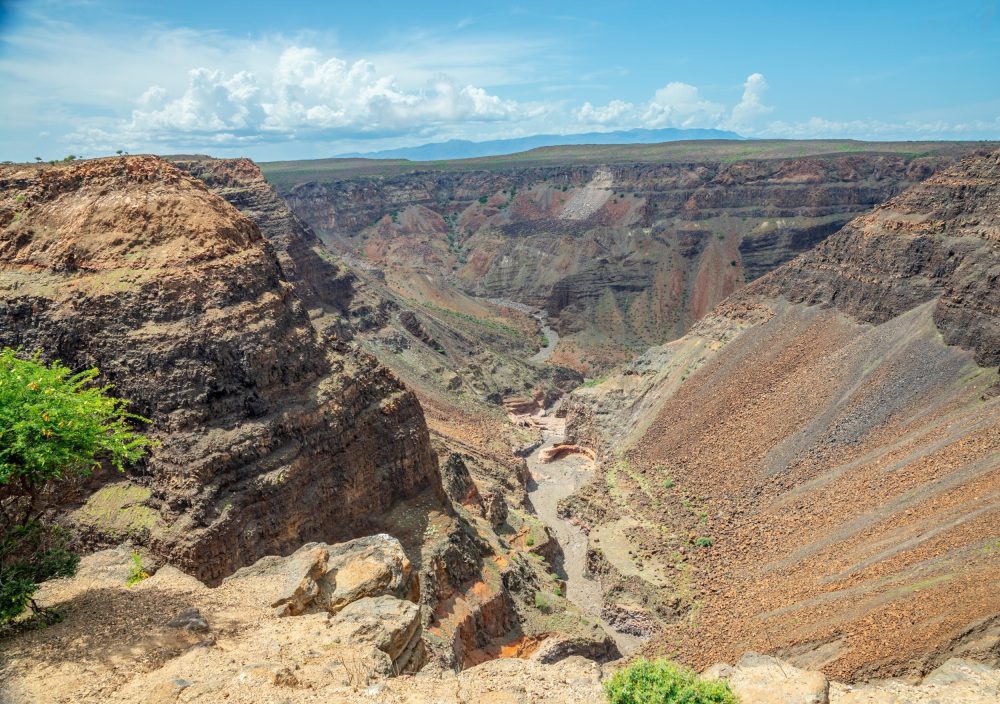
Across a flat strip of eroding sediment in Ethiopia’s Afar Rift, artifacts and bones remain scattered almost where they originally fell.
The site was discovered at Faro Daba, a sedimentary outcrop within Ethiopia’s Afar Rift in northeastern Africa.
There, archaeologist Yonas Beyene of the French Center for Ethiopian Studies (CFEE) documented a floodplain repeatedly used by early humans.
Unlike many African sites that preserve fragments in caves, these layers hold open-air traces of ordinary activity across an ancient landscape.
That rare continuity gives the material unusual power, while also leaving key questions about human movement and behavior.
Anchored in a known timeline
Earlier dating work had already pinned Halibee, a sedimentary member within the Dawaitoli Formation in Ethiopia’s Afar Rift, to roughly 100,000 years ago by linking rock layers across the region.
At roughly 100,000 years, the site sits within the Middle Stone Age, an African period before migrations.
Older fossils from the same basin were dated to 160,000 to 154,000 years ago, anchoring early Homo sapiens nearby.
What makes Halibee stand out is that it contextualizes a region already famous for bones, not just isolated skulls.
A workshop on the floodplain
More than 1,800 mapped artifacts, each larger than about half an inch, clustered across the beds with little signs of mixing.
Between 65% and 82% were made from basalt, a common local rock, and scattered chips show how people would have shaped their tools from local resources.
The occurrence of repetitive, short visits is proven, as these tools were seemingly both made and discarded during brief returns to the floodplain.
Because the pieces stayed in one area, the pattern showed behavior instead of a jumbled stone scatter.
Clues to movement and exchange
Only a few tools were made from obsidian, volcanic glass that snaps into sharp edges, even though Halibee itself lacks that material.
Less than two percent of the assemblage used obsidian, making each piece a clue to movement or exchange.
Beyene also warned that vanished outcrops can fool raw-material stories, because erosion may hide certain sources.
Still, the imported stone remains intriguing without turning a tiny sample into a full map of trade.
Meeting point of food and risk
Animal bones placed people in a seasonally flooded wooded plain beside the ancient Awash River, where food, shade, and danger were present.
Monkeys, rodents, and medium-sized hoofed animals were common, while giraffes, birds, reptiles, and large carnivores appeared less often.
“No butchery-related, or unambiguously humanly induced bone modifications were found,” wrote Yonas Beyene, an archaeologist at the French Center for Ethiopian Studies.
In this animal-rich landscape, the site was most likely not a sole butchery spot, even though humans and animals kept returning there.
Visits cut short by seasonal floods
Seasonal flooding likely forced short stays, then erased traces of camps without fully scrambling the stones and bones.
Shade, water, and stone for tools would have drawn people back, while high water and animal traffic made every visit temporary.
Short, repeated use fits a mobile way of life, with groups revisiting useful patches instead of building permanent settlements.
Seen over time, Halibee becomes a snapshot of repeated choices rather than one dramatic event.
Sealed beneath sediment
One partial skeleton seems to have slipped quickly beneath sediment, avoiding the tooth marks and weathering common on exposed remains.
“Available information suggests rapid burial without prolonged surface exposure,” wrote Beyene, describing the rapidly buried individual that escaped heavy weathering and scavenging.
Rapid burial can happen when flood sediment seals a body fast, cutting off scavengers and slowing damage from sun and trampling.
Even so, the team stopped short of calling it a deliberate burial, because nearby animal bodies can vanish quickly too.
Burned remains raise questions
Another individual survived only as a tooth and small bone pieces cracked, darkened, and broken by intense heat.
Burning at that temperature changes bone color and structure because heat drives out water and reshapes its mineral crystals.
Natural fire remains possible, yet intentional cremation would push that practice far earlier than any accepted case.
The evidence remains hard to pin down, leaving fire as a clue without a clear cause.
An interconnected landscape
From a smaller adult, a third partial skeleton carried tooth marks, fractures, and missing joints that fit scavenging soon after death.
Carnivores often target soft joints first, pulling apart a body before bones scatter across a short distance.
Compared with the quickly buried individual and the burned fragments, this trail shows that it was not a singular ending that dominated Halibee.
Within one site, there are at least three causes of death, filtered by water, fire, or animals.
Halibee ties tools, landscape, wildlife, and human remains into one open-air scene, not separate fragments from separate places.
More excavation could reveal whether these returns were local routines, wider circuits, or contributed to later journeys beyond Africa.
The study is published in the journal Proceedings of the National Academy of Sciences.
—–
Like what you read? Subscribe to our newsletter for engaging articles, exclusive content, and the latest updates.
Check us out on EarthSnap, a free app brought to you by Eric Ralls and Earth.com.
—–