
Australia cannot cut its emissions by buying someone else’s wood — yet a $3 billion import bill last year suggests that is precisely the trade being made.
That accounting sits awkwardly alongside the Carbon Leakage Review by Chris Bowden, Australia’s Minister for Climate Change and Energy, which examined 75 commodities and recommended a border carbon adjustment covering cement, clinker, ammonia, glass, lime and steel, with timber nowhere on the list.
Led by the Australian National University’s Professor Frank Jotzo from July 2023 through to March 2025 and released by the Department of Climate Change, Energy, the Environment and Water in February, the Review is the federal government’s most serious attempt yet to answer whether domestic climate policy is genuinely cutting emissions or simply exporting them.
The mechanics of the failure on timber are straightforward — the vast majority of wood entering the country does so in manufactured form, which means huge volumes of imported timber fall outside the Safeguard Mechanism’s reach entirely, and the Jotzo commodity list does nothing to close that gap. By building a domestic emissions architecture that captures the local plantation mill but not its offshore competitor, whilst omitting timber from the border carbon adjustment instruments the Review proposes for heavy industry, the policy actively incentivises the carbon leakage it was designed to stop.
Carbon leakage is the polite term for offshoring pollution, and when strict climate policy in one jurisdiction pushes production into another with weaker rules, global emissions stay flat or rise whilst the compliant producer carries the cost. For traded timber, internationally recognised leakage rates are above 80 per cent, rising to 86 per cent when illegal logging is in the chain.
 China (Mainland) supplied 43.8 per cent of Australia’s $3.011 billion wood products import bill in calendar year 2025, more than the next four source nations combined. Source: ABS; analysis by IndustryEdge.
Fresh Australian Bureau of Statistics figures show where that offshoring is happening, and the scale is striking — China alone supplied $1.318 billion of Australia’s wood products last year, 43.8 per cent of the total, more than the next four countries combined, and a 9.1 per cent jump on the previous year. Plywood, LVL and glulam were the single largest category at $792.8 million, followed by builders’ joinery at $562.4 million and sawnwood at $556.4 million, with those three groupings alone accounting for close to 64 per cent of the entire spend.
Every one of those categories is a product that Australian plantation fibre can produce domestically, which is what makes the carbon leakage arithmetic so damning — the emissions attached to that $1.9 billion of plywood, LVL, glulam, joinery and sawnwood are not avoided by sourcing offshore; they are inherited. Domestic processors have argued that point for years; what is different now is that the federal government is being handed the arithmetic to prove it.
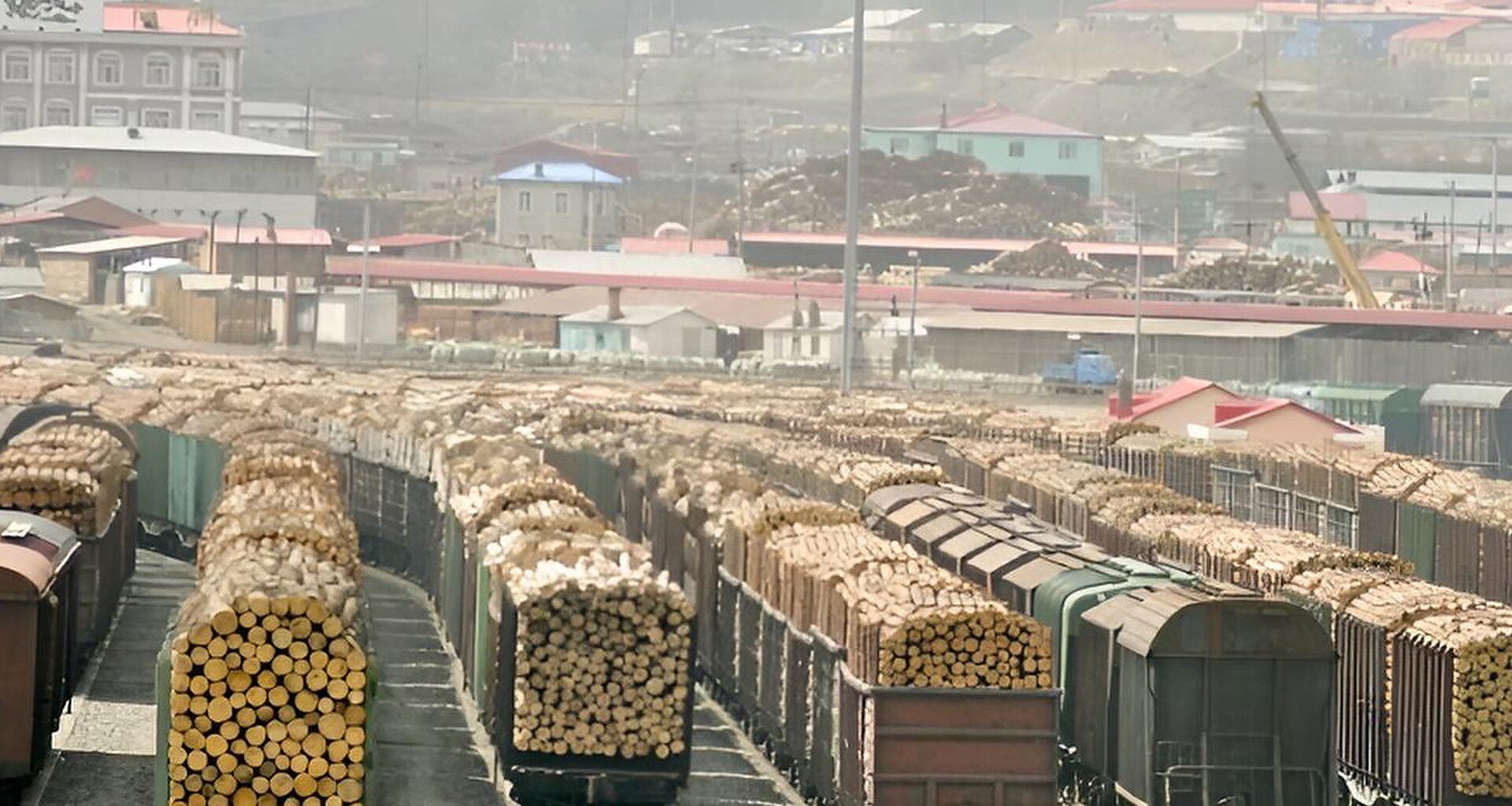
 Huge volumes of tropical timbers are traded from across Asia (including Cambodia), where they are manufactured into plywood and used as construction materials in China, Vietnam, and Malaysia and exported into the highly lucrative Australasian, European Union and North American markets, where they are cores in engineered timber flooring. (Photo Credit: travelib prime / Alamy Stock Photo)
The supply chain behind those imports is itself under severe stress, with Wood Central reporting last year that roughly 60 per cent of Russian timber exports — about 11.2 million cubic metres in 2024 — were absorbed by China, and volumes falling 10 per cent year on year through the first half of 2025 as Chinese prices stayed depressed. September’s reporting in Wood Central flagged that ruble strength and softer Chinese demand, on top of the near-total closure of European export routes after sanctions, had driven a significant share of Russian timber companies to the brink, which makes the current flow of third-country structural timber into Australian construction less a trade relationship than an arbitrage on weak environmental governance.
The Carbon Leakage Review’s recommendations now sit with the Department of Climate Change, Energy, the Environment and Water, and any reform of the Safeguard Mechanism that ignores the 64 per cent of Australia’s $3 billion wood product spend flowing to categories the domestic plantation estate is built to supply will deliver a policy that balances the national emissions ledger on paper whilst unbalancing it in the atmosphere.

Jack Rodden-Green, with 30 years of experience as a forester in New South Wales, combines a deep understanding of forestry with legal training to address social and environmental issues.