
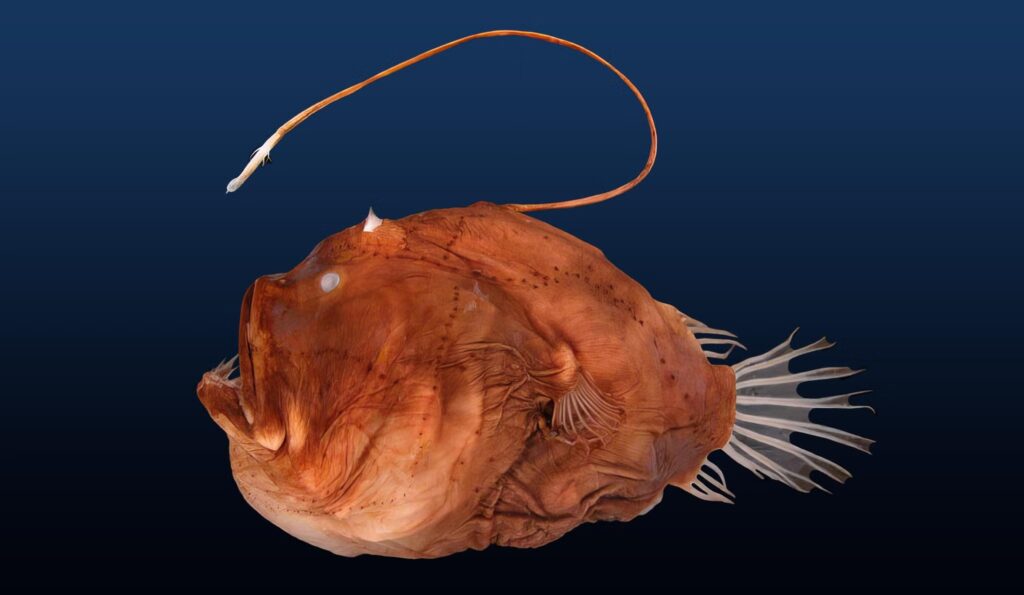
 Bufoceratias wedli, a deep-sea anglerfish species, is one of the most extreme species. The much smaller male temporarily attaches to the much larger female. Image: Masaki Miya/ Wikipedia Commons (CC BY-SA)/
Anglerfishes look almost too cartoonishly gruesome to be true, especially the famous rod bait dangling in front of the grim mouth with oversized teeth. But a new study describes how this tool (and many others that anglerfish use) came to be.
It turns out they developed them gradually, over the years, and sometimes multiple times.
Diverse and Dinosaur-Aged
Imagine you are a small, hungry fish swimming in the shallow, sun-drenched seas of the Late Cretaceous. The dinosaurs are about to go extinct soon, but of course, you don’t know anything about that. Down here, life is a simple game of eat or be eaten. You spot a tiny shrimp wiggling just a few inches away, you try to eat it. You see a bigger fish coming, you run away.
But how would you go from a regular fish to something as extreme as modern anglerfish?
To get to the bottom of it, researchers Alex J. Maile and Matthew P. Davis studied a fossil-calibrated family tree and measurements from 118 specimens representing 102 species, 49 genera, and 13 families, noting how different features evolved. They found a surprisingly diverse group.
 Different anglerfishes. Image from the study.
“Anglerfishes probably have as many species as turtles and tortoises on the planet right now,” said lead author Maile, a doctoral student with KU’s Biodiversity Institute and Natural History Museum. “The really interesting thing is they’re found across the planet in different oceans and habitats. They’re in coral reefs, continental shelves, deep-sea habitats, floating on giant algae mats in the middle of the ocean. All of them are doing this really cool thing using this lure in so many ways.”
The ancestor of all anglerfish didn’t live in the dark abyss, but it was a bottom-dweller in the shallows. In the late Cretaceous, their first dorsal fin started modifying into a pole-like structure called an illicium. At first, this may have not only been used for tricking fish, the researcher adds.
“The conventional idea was they’re using this to attract prey,” he said. “We think it’s actually serving a dual purpose, especially in the deep sea, where you’re taking a lure, adding a glowing element to it, and now you can attract food, but you can also attract a potential mate.”
You Get a Rod, Everyone Gets a Rod (but they’re different)
Since their common ancestor, the anglerfish lineage has shown impressive branching out and variation.
×
Thank you! One more thing…
Please check your inbox and confirm your subscription.
Frog fishes, for instance, are a type of anglerfish where the lure is often positioned so that prey end up within striking distance of the mouth. Batfishes, another branch , can direct their lure toward the seafloor and “aim” it while probing for benthic prey. Others are less mobile.
Evolution didn’t really select the fanciest or easiest solution. It took whatever worked; and that meant a combination of cheap, effective, and good enough.
But then, the anglerfishes went into chemistry.
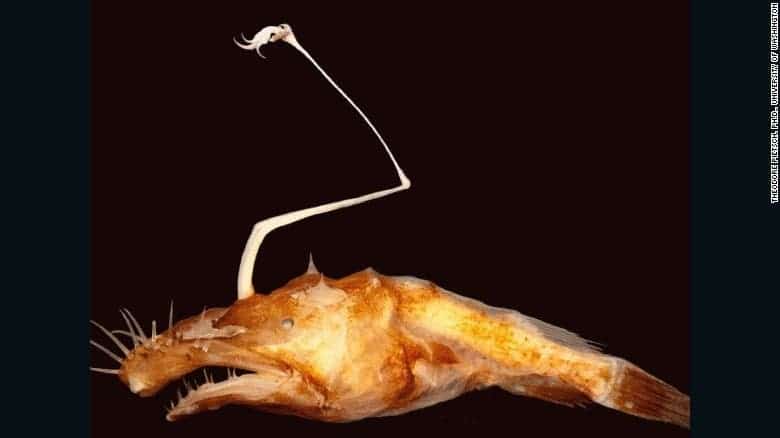 Some anglerfish have developed strikingly specific lure rods.
Chemical luring is the release of chemicals that are attractive to their prey. Remarkably, this evolved twice, independently, in different groups.
Why evolve smell when motion already works?
Because some prey hunt with chemistry, not eyesight. On a dim or cluttered seafloor, a chemical cue can travel into the sensory world of worms, crustaceans, and other invertebrates long before a shape becomes obvious. Anglerfish were already starting to fill in this niche. The chemical lure was only the next logical step.
Then, There Was Light
The research team found that anglerfish with better-developed decoy rods seem to fare better and diversify more than those without. But some anglerfish took things even one step further, developing light. Those who did this seemed to fare even better. Part of this is, of course, that it works; it tricks unsuspecting fish. But there’s another reason: sex.
Females carry ornate, species-specific lures. Males in many of these lineages are tiny, lack lures, and have enlarged sensory systems that may help them find females by detecting light and chemical signals. That means the lure may do two jobs at once: catch dinner and advertise identity.
The study also answers a practical question a reader might ask: how do you study behavior in animals that live thousands of meters down? Mostly, with difficulty.
The authors had to lean heavily on museum specimens, photographs, prior observations, and a phylogenetic framework. They could measure likely motion ranges and compare anatomy across lineages, but they openly acknowledge a major limit: live luring behavior in deep-sea species is still rarely observed. Much of what happens in the wild remains hidden simply because the animals are so hard to watch.
There’s still much we don’t know about this iconic group. But we know more than we did before this study. We know that sometime in the Late Cretaceous, a fish started waving a modified spine in front of its mouth. Tens of millions of years later, its descendants were dangling chemical decoys across the seabed and glowing signals through the deep.
The study was published in BioOne