
This is a rush transcript. Copy may not be in its final form.
AMY GOODMAN: This is Democracy Now!, democracynow.org, The War and Peace Report. I’m Amy Goodman.
Last week, when I was in Los Angeles for the theatrical opening of the documentary Steal This Story, Please! about Democracy Now!, I visited the gallery of the artist Shepard Fairey. He created the artwork for Steal This Story, Please! poster. Shepard Fairey gained national prominence in 2008 as the artist who made the iconic poster of then-candidate Barack Obama, accompanied by the word “hope.” He has roots as a street artist with well-known images wheat-pasted on walls around, including one of professional wrestler André the Giant and the word “obey.”
I asked Shepard Fairey about his thoughts about art and politics and to describe some of the pieces hanging in his latest exhibition.
SHEPARD FAIREY: I think art can help turn things around by taking something that’s, you know, a feeling more in the ether and crystallizing it in a way that’s very direct, clear and resonates with someone’s emotion. You know, art can be used to persuade people in bad ways, too. I’ve always looked at my art as not propaganda in that it’s meant to be the end of the conversation, but that it’s — if you want to call it propaganda, it’s meant to initiate a conversation, a counternarrative that isn’t happening in a robust enough way.
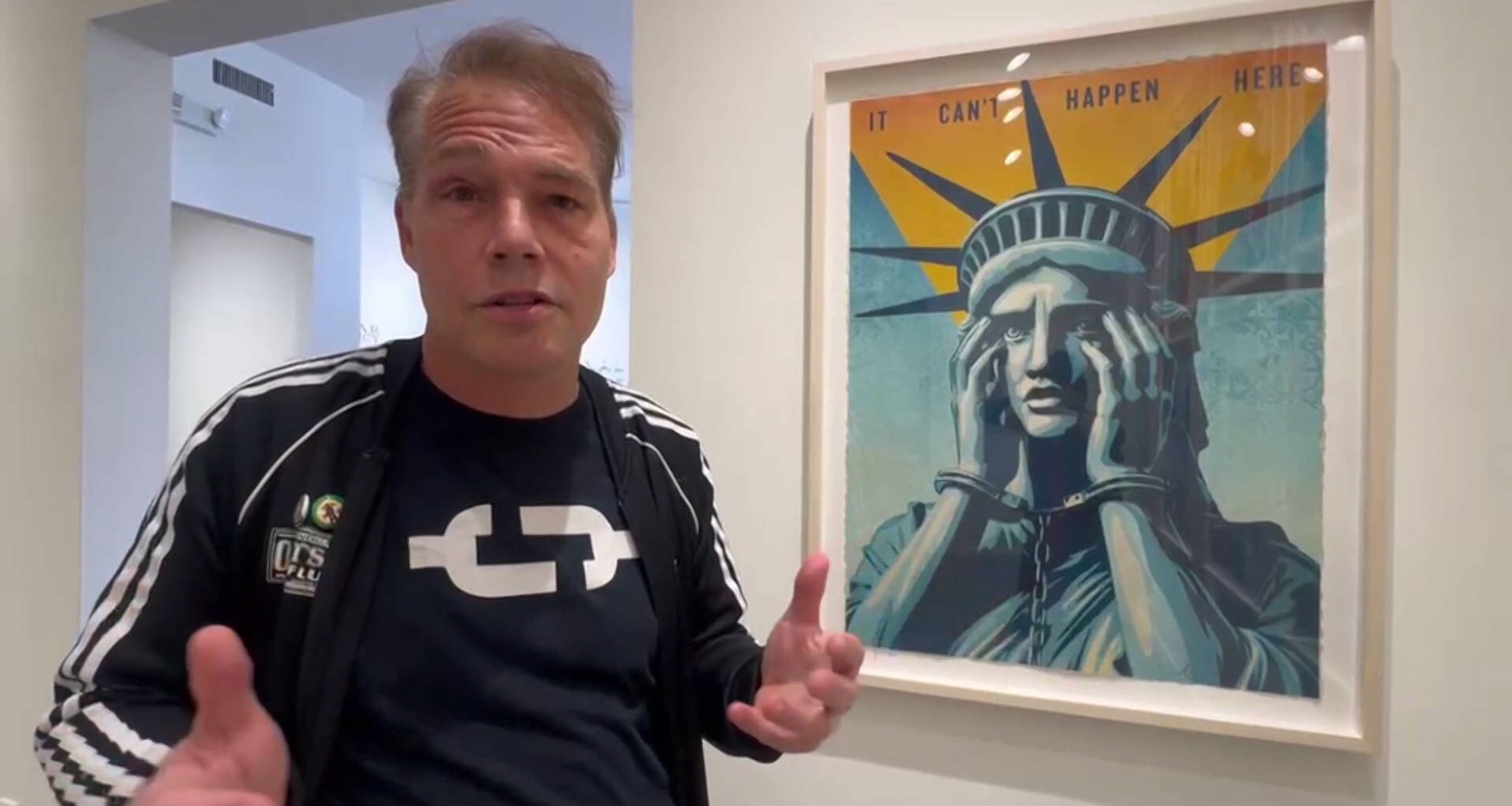
AMY GOODMAN: Can you tell me about the Statue of Liberty in handcuffs?
SHEPARD FAIREY: Of course. The “It can’t happen here” is a reference to Sinclair Lewis’s novel of the same name, that’s examining the rise of fascism in the United States, and it’s a cautionary thing based on some of what was happening in the ’20s and ’30s in the United States. But we are experiencing it in a more intense way here now. So, it can happen here, and it is.
AMY GOODMAN: Shepard Fairey then walked me around his gallery, showing me some of his other work. We then walked over to a quartet of posters. Each showed an ICE officer in riot gear holding a baton. Above each is a label: “paid agitator,” “domestic terrorist,” “intent to massacre” and “worst of the worst.”
SHEPARD FAIREY: And they have differences, but it’s the same dominant figure in each one. But, I mean, I did these because this is — it’s called Projection Mirror. These are based on all the things that Kristi Noem and Stephen Miller threw out there about the — about the protesters and about the immigrants that were being targeted, that really is what they’re up to. They’re the paid agitators. They’re the domestic terrorists. They’re, you know, out there with intent to massacre. And they’re the worst of the worst. So, yeah, the series was meant to be a mirror back at the people projecting.
AMY GOODMAN: We went to another image that showed an oil derrick.
Can you say what it says?
SHEPARD FAIREY: “Extracting blood at the world’s end, igniting the globe.” Yeah, it’s basically about how this extracting oil, that fossil fuels are heating the planet up and killing the planet. And, you know, a lot of people are still saying, “Drill, baby, drill. Keep the price of gas down.” And we need to be investing in renewables.
AMY GOODMAN: I’m intrigued by how much you use newspapers. Like, here we have Frida Kahlo.
SHEPARD FAIREY: Oh yeah. Well, newspapers, I think, are great in, first of all, like, making sure that you can read what the idea is succinctly, or it creates a little bit of an amplification to what the primary narrative of the piece is. But it also demonstrates that we frequently have been warned about mistakes that we’re making, or we’re making the same mistakes again and again. I can pull newspaper things from 40 years ago about civil rights or global warming or any number of other issues. And we think we progress, but we always relapse to bad behavior. And I want to remind people that, hey, we should know better.
AMY GOODMAN: Tell me about this Frida Kahlo. You have a lot, this one with the newspaper that says her name.
SHEPARD FAIREY: So, you know, I’m a big admirer of Frida Kahlo’s work and, you know, her feminism relative to her era especially, and the ways in which she talked about art as a tool of resilience, that art helped her to overcome the pain of her bus accident she had when she was young, that was — gave her chronic pain through her life. But also I love that Frida Kahlo was initially seen as like this cute romantic partner to the important Diego Rivera. Now she is more well known and more celebrated than Diego Rivera. They’re both very important artists, but I think that the progress we’ve made in terms of her being someone who’s taken very seriously as a woman artist is — it’s important progress, but we still have a long way to go.
AMY GOODMAN: That’s the acclaimed artist and activist Shepard Fairey speaking at his Los Angeles gallery. He made the poster art for the film about Democracy Now! called Steal This Story, Please! I’m here in the Bay Area as the film opens in different theaters. Tonight, I’ll be in Sebastopol at the Rialto Cinema Sebastopol for the 4:00 and 6:00 screenings of the film. And then, tomorrow, we’ll be in Sacramento at the Tower Theatre, Sacramento, at 7:00. On Wednesday, we’ll be at the Rialto in Elmwood in Berkeley, as well as the Roxie.
This is Democracy Now!, democracynow.org. We’ll look at the Trump administration’s plan to restructure the U.S. Forest Service, which many fear will dismantle the 120-year-old agency. Back in a minute.
[break]
AMY GOODMAN: “Jaano Jot,” Sonny Singh, performing in our Democracy Now! studio.