
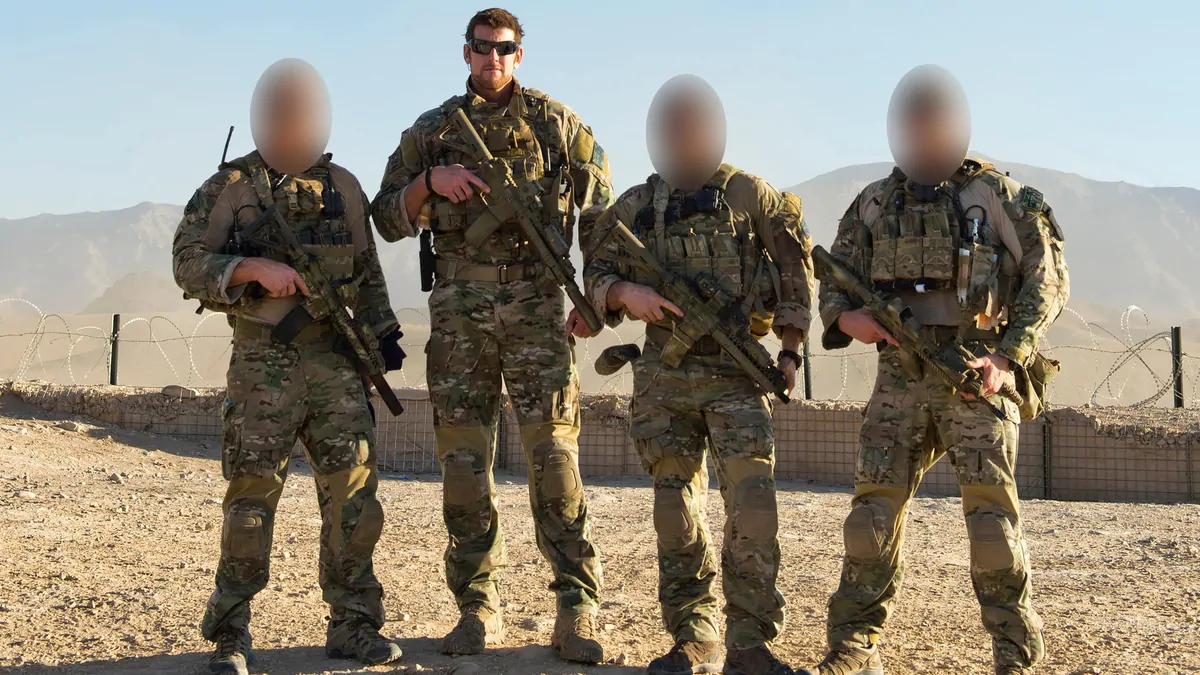
Jason Peters used to say he loved Ben Roberts-Smith like a brother.
In recent days the former Special Air Service Regiment trooper, once his friend’s rival for the Victoria Cross, has emerged as the man who might send Mr Roberts-Smith to jail for life.
But as one of the lead prosecution witnesses, the veteran known as Person 4 will enter the witness box with a war record that both enhances and harms his credibility: he too is accused of murdering prisoners.
Sign up to The Nightly’s newsletters.
Get the first look at the digital newspaper, curated daily stories and breaking headlines delivered to your inbox.
By continuing you agree to our Terms and Privacy Policy.
The allegation is not military or media gossip. It was made by the same barrister who convinced a Federal Court judge that Mr Roberts-Smith committed war crimes in Afghanistan, Nicholas Owens, now a judge in the same court.
“Your Honour, to be clear, we do allege that Person 4 is a murderer,” Mr Owens said during a defamation lawsuit in 2022.
Mr Peters, a pseudonym, will not go to jail for murder. Formal allegations tendered to court on Friday suggest he has been promised immunity for war crimes in return for testifying against Mr Roberts-Smith, who has been charged with five counts of war crimes — murder.
Federal prosecutors believe Mr Peters is a killer. He told them that on April 12, 2009, he executed a prisoner at a compound in southern Afghanistan that had been used by the Taliban to attack regular Australian soldiers, according to court documents.
Prosecutors will allege that after the building, known as Whiskey 108, was partially destroyed by a bomb dropped from a Western aircraft, a father and son were pulled from a tunnel.
The son, Ahmadullah Essa, who had one leg, was allegedly killed by Mr Roberts-Smith with a machine gun. Then “Roberts-Smith grabbed Mohammed Essa, placed him on his knees in front of Person 4, and said to Person 4, ‘Shoot that c..t,’” according to the allegations.
“Person 4, understanding this to be an order, shot Mohammad Essa in the head, killing him,” the 24-page document states. “Person 4 has admitted their role in this incident.”
Mr Roberts-Smith told a court in 2021 the allegations were “ridiculous” and he shot an insurgent running near a cornfield carrying a bolt-action rifle.
No excuse
Australian soldiers sent to Afghanistan received briefings from military lawyers that it was illegal to kill prisoners. Following orders is not an excuse under laws developed to prosecute Nazis and Japanese commanders after World War II.
Melanie O’Brien, a University of Western Australia law professor writing a book on war crimes in Afghanistan, said prosecutors should not protect soldiers who committed crimes to secure the convictions of their superiors.
“You can’t be acquitted because you carried out an unlawful order especially if you knew it was unlawful,” she said. “Our soldiers receive quite extensive training under the laws of war so they know they will not be allowed to execute someone who is unarmed and not a combatant.”
A lawyer who represented Mr Peters in Mr Roberts-Smith’s defamation lawsuit said revealing his identity “will knowingly potentially inflict severe harm”. Mr Peters was a witness for Nine, which Mr Roberts-Smith unsuccessfully sued in 2018 for accusing him of murder.
Mr Peters’ real name has not been made public, although the Australian War Memorial inadvertently published his first name in 2012.
A father of two, he describes himself as a farmer who was older than most of the SAS soldiers during the war. The greatest achievement of his military career was on June 11, 2010, when he attacked a machine-gun position in the village of Tizak with Mr Roberts-Smith and another SAS soldier known as Dean Roddan.
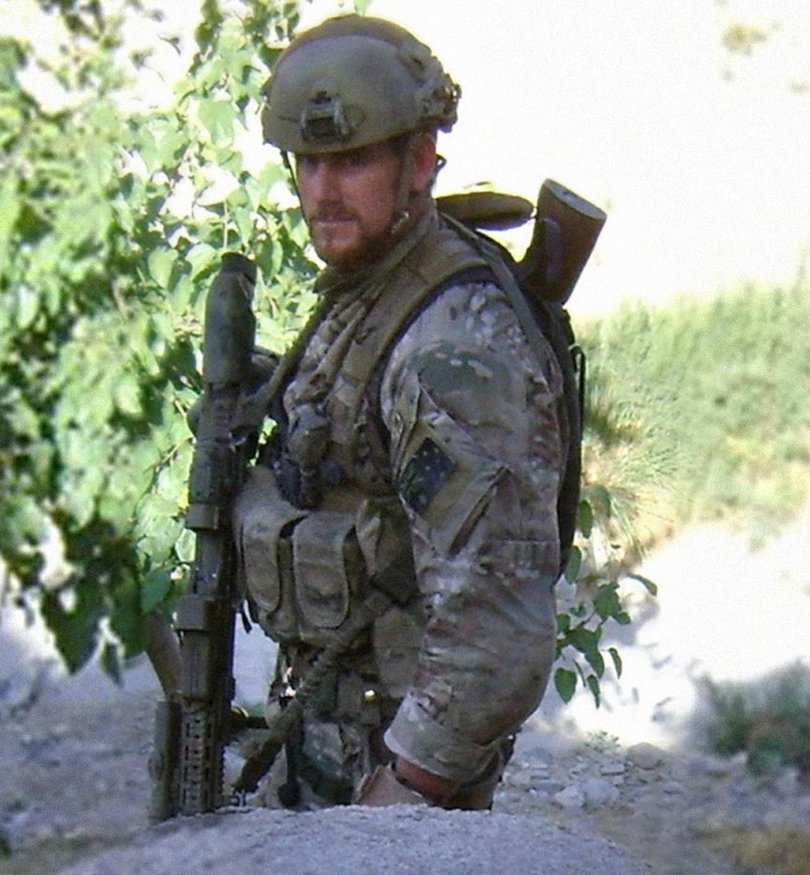 Ben Roberts-Smith has vowed to clear his name. Credit: AWM/PR IMAGE
As the three men desperately fought three Taliban machine gunners and several firing assault rifles in the courtyard of a mosque, Mr Peters leaned out from behind a tree several times to protect Mr Roberts-Smith as he threw a grenade and charged the courtyard. Mr Peters followed and helped kill two men who had fled inside the mosque.
After the battle, all six SAS soldiers in the team posed for a group photo in front of six dead Afghans and their weapons. Mr Roberts-Smith was the only one who didn’t smile for the camera.
The corporal was recognised for his actions with a Victoria Cross, the highest medal for bravery. Mr Peters was initially passed over, a slight that left him “hurt and disappointed”, according to Anthony Besanko, the judge who oversaw the defamation case.
Three years later, after the army reviewed the battle, Mr Peters was awarded a Medal for Gallantry, the third-ranked bravery decoration.
Mr Peters has said that he was told by other SAS soldiers that he deserved the Victoria Cross, not Mr Roberts-Smith.
At an SAS barbecue in Perth in 2011, his wife approached the sergeant in charge of their team and demanded to know why her husband did not receive the venerated medal, according to court evidence.
The sergeant told her to “pull her neck in”, he said in court.
Second in charge
In between the fight at the Whiskey 108 compound and the belated decoration, the two men worked closely together. In 2012, they returned to Afghanistan as members of the same team, Gothic 2. Although Mr Roberts-Smith was still a corporal, he had been promoted to team leader, an influential position in the SAS. Mr Peters became his deputy.
They both preferred the Mk 14 Enhanced Battle Rifle to the special forces’ standard M4 assault rifle. Although the gun was much heavier, its large-calibre bullets inflicted far greater damage.
No evidence has emerged that Mr Peters asked to be assigned to a different team, or leave the SAS, after allegedly being ordered to execute Mohammad Essa.
He was present for the most notorious allegation against Mr Roberts-Smith — that the giant soldier kicked Ali Jan, a farmer, off a river embankment in the village of Darwan on September 11, 2012.
Mr Peters told the court that after the handcuffed man plunged down the slope, suffering facial injuries, he was dragged to a large tree by Mr Peters and another SAS soldier, who shot him. He said the murder was covered up by placing a two-way radio on his corpse to create the impression the dead man was a Taliban insurgent.
Mr Roberts-Smith said he shot a Taliban spotter who was found carrying a radio. “There was no kick,” he said in court. “I don’t remember seeing a cliff either.”
Investigators allege that six weeks after the Darwan incident, near the village of Syahchow, two Afghan prisoners were lined up on the edge of a cornfield and shot on Mr Roberts-Smith’s orders. To cover up the deaths, a grenade was allegedly thrown at their bodies.
Whether Mr Peters, the second-in charge, saw or heard anything is unclear from court papers filed in the murder case.
Mr Roberts-Smith denied he executed anyone at Syahchow.
No comment
In 2022, Mr Peters was asked in court what happened at Whiskey 108, the compound where the one-legged man died. “Your Honour, I object on the grounds that I may incriminate myself,” he told Justice Besanko.
Even when offered a deal that nothing he said could be used against him in other cases, including a murder trial, he refused to talk. The judge decided not to force him to answer questions, which meant Mr Roberts-Smith barrister, Arthur Moses, could not ask him if he killed anyone there.
Mr Moses suggested in court that Mr Peters might have agreed with Nine, the media company, to testify against Mr Roberts-Smith if he wasn’t asked about Whiskey 108.
“I will put to him directly that he has done a deal with the respondents in respect of this matter, and he has come here to give evidence about this point and wasn’t going to be the subject of having to be pressed to answer a question about whether he’s a murderer,” Mr Moses told the judge.
That was when Nine’s barrister, Mr Owens, took the unusual step of accusing his side’s witness of being a criminal.
“Your Honour, to be clear, we do allege that Person 4 is a murderer,” he said. “We say that he shot a PUC (person under control) at Whiskey 108, after Mr Roberts-Smith kicked that PUC to his knees and said, ‘Shoot him’.
“Of course, in the context of this proceeding, that accusation is made not directly in order to impugn Person 4. We make it because … we say that in the circumstances Mr Roberts-Smith was complicit in, and responsible for, that murder. So the murder that we allege against Person 4 is one that is an important building block in our case against Mr Roberts-Smith.”
Mr Peters left the Army in 2021 on medical grounds.
After telling his psychiatrist that he might hurt himself if required to give evidence, he was not forced to answer some questions about Whiskey 108. The five types of medicine he was being treated with were blocked from publication by a suppression order.
Immunity deals
Even his lawyer, Ben Kremer, told the court he might have broken the law at Darwan by not protecting Mr Jan.
“And not all steps were taken, or no steps may have been taken, so that there is (criminal) liability engaged or responsibility engaged on behalf of the person with effective authority, that is, the 2IC over the member of the troop,” Dr Kremer told the court.
As for Mr Peters, he said in court his bravery at Tizak, when both men stormed the Taliban courtyard, was equal to Mr Roberts-Smith’s. The other soldier received the Victoria Cross because “we lost a lot of people and they wanted a good news story”.
Asked by Mr Moses if the medal “has caused you to deeply resent Mr Roberts-Smith?” he answered: “I loved him as a brother.”
Three other SAS veterans have been promised legal protection to testify against Mr Roberts-Smith. One was a medic in the Battle of Tizak. The other was a member of his team at Darwan. The third executed a prisoner at Syahchow, according to investigators.
“Each of these witnesses has admitted their personal involvement in executing one or more detainees at the direction or with the complicity of ROBERTS-SMITH,” the written allegations state. “In each instance, ROBERTS-SMITH was their military superior. These witnesses have provided written accounts of their actions. Each details other murders they witnessed.”
Which may lead Australians to ask: how do you get away with murder in war?