

Comment: I’m not going to pretend that higher power bills don’t hurt. For many households, affordability is real, immediate, and stressful. When power prices rise, the impact is felt straight away, especially by those with the least room to move.
When the price of nearly everything is going up like it is now, value for money becomes very important. The distinction between affordability and value often gets lost in the debate – they are not the same thing. And when you look closely, electricity delivers extraordinary value for every dollar you spend.
My team at Electricity Networks Aotearoa created a simple graphic in response to the question: what does $1 of electricity actually get you?
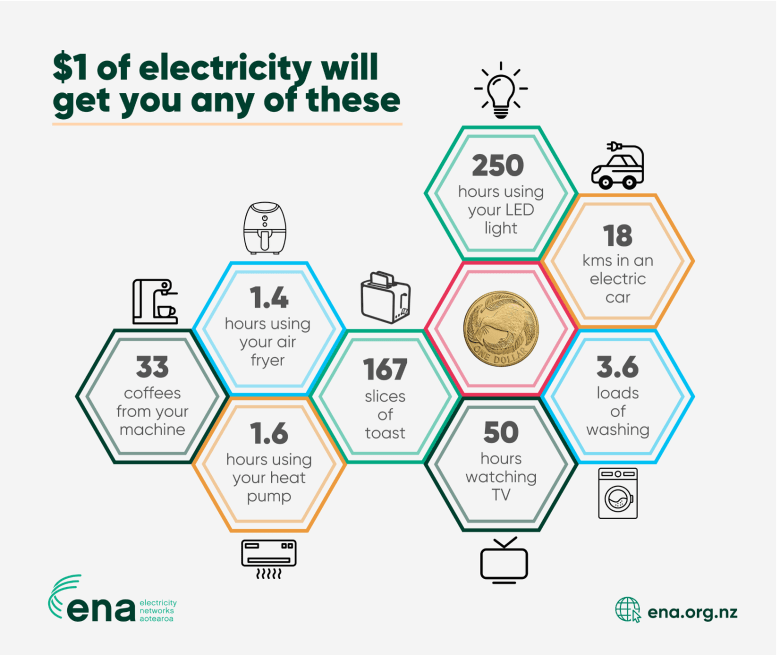
That single dollar can power an LED light for 250 hours, keep the TV on for 50 hours, or heat your home for 1.6 hours. It can wash three and a half loads of clothes, or make you 33 coffees from your little coffee machine at home. It can run your air fryer for 1.6 hours, or cook you 167 slices of toast.
It will even get you over 1km down the road in an electric vehicle. To put that in context, driving the same distance in a typical petrol car would cost around $4. And this $4 would be based on about $2.80 per litre at the pump – a very generous assumption given current global pressures on fuel prices.
Pause for a moment and compare that to almost anything else you can buy for $1.
You won’t get far on public transport. You won’t get much data on your phone. You won’t get more than a few minutes of professional services, childcare, or healthcare. In most cities, you can’t even park for $1. A single flat white will cost you at least four times as much, but most of us have got used to that.
Electricity by its nature is invisible. At a flick of a switch, it’s always available, instantly useful, and underpins nearly every aspect of modern life. Heating, lighting, food safety, communication, transport, healthcare, education, and now decarbonisation, all depend on it. Strip electricity away, and daily life becomes almost unworkable.
All this doesn’t mean electricity prices should be stretching household budgets. It shouldn’t. Affordability matters, and targeted support for people who need it is essential.

Start your day informed. Make room for newsroom’s top stories. Direct to your inbox daily.
At the same time, focusing only on price risks missing the bigger picture: electricity is one of the most productive dollars we spend as a society. Electricity isn’t just another consumer product. It’s a system, one that has to be built, maintained, upgraded, and made resilient against storms, climate impacts, and rising demand.
Transpower, the state-owned enterprise that operates the national grid, is responsible for 11,000km of high-voltage lines. And the local lines companies that I represent distribute power through 150,000km of medium- and low-voltage lines.
The same grid and power lines that provide electricity to your heat pump also support hospitals, schools, data centres, and emergency services.
The energy sector is investing billions of dollars in new infrastructure and generation (wind, geothermal and solar) as the country transitions to a highly renewable electric future.
New Zealand’s electricity system also performs strongly by international standards. The World Energy Council ranks us 9th in its global Energy Trilemma Index, which assesses how well countries balance reliability, affordability, and environmental sustainability.
When prices are pushed down without a plan, the costs don’t disappear. They re-emerge later as outages, deferred maintenance, and higher bills in the future. Value isn’t just about what we pay today, but what costs we avoid tomorrow.
The challenge, then, isn’t to pretend electricity should be held at artificially low levels. It’s to ensure all New Zealanders can afford access to something that is demonstrably worth it – and to have an honest conversation about how we share those costs fairly.
Because when you really look at what $1 of electricity can do – heat your home, clean your clothes, move your car, or connect you to the world – it may be one of the best value purchases we make every single day.