
 How does a supposedly democratic society – whose First Nations people are still impacted by structural and systemic injustices as part of ongoing colonization (“Genocide brings to mind Hitler and the Jews, not Australia and Aborigines”[1]) and where the widespread rattling off of Acknowledgement to Country by the white man, and woman, has become a quick fix for colonial guilt – come to additional terms with the fact that 70 odd years ago they allowed for The Sinister to cross their borders undeterred and undetected?
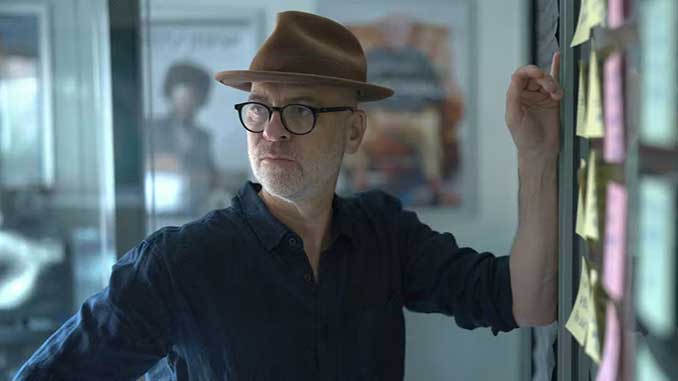
In the revealing new documentary The Hunt for the Last Nazis, which premieres 31 May on SBS and SBS on Demand [2], Jewish filmmaker, film producer and former journalist Dan Goldberg – recipient of a Walkley Award, an Asian TV Award, a New York Festivals Award, a Screen Producer of Australia Award, a Gold Remi Award, an Asian Academy Creative Awards, and a BANFF Rockie Award and whose work “straddles the fault lines of race, culture and society”[3] – gets to the point without preliminaries in a stark documentary that reveals just to what extent a persona non grata could literally get away with murder as they escaped to vast Australia”[4].
Its sheer size and remoteness from Europe were in their favour, as was the passage of time [5]. WWII monster criminals got off scot-free and off the hook by lenient migration policies or what has been described as a country “built on pragmatism” and with a “flimsy security screening system” (The Hunt..).
During the Australian ‘populate or perish’ postwar migration program [6] these genocidaires were given the green light to enter the country under false identities (some claiming to be farmhands and immediately disassociating themselves from their given names and original identities upon setting foot on foreign soil. No see, no hear, no speak). They stayed on and made Australia their home for two or three decades. A second lease of life. A good life. Non existing guilt removed from a non-existing conscience.
The Albury/Wodonga Bonegilla reception centre became a new home away from home during their initial steps towards freedom; dark Europe left behind in the far away distance and their recent heinous crimes relegated to the past, erased from memory as soon as they were able to disassociate themselves from their names and identities; schizophrenic style. THE GREAT ESCAPE and then Great Australian Dream.[7]
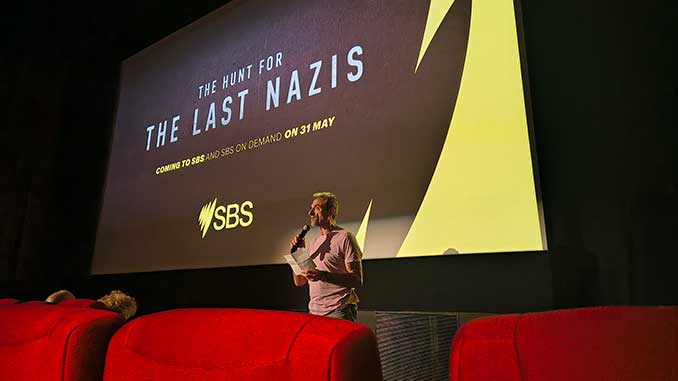 Presented by the Classic Cinemas in Elsternwick as: … a feature-length documentary investigating how Australia’s post-war migration program enabled hundreds of alleged Nazi war criminals to hide in our suburbs. Driven by an investigative journalist’s decades-long search for answers, the film unfolds as a true crime history-mystery, revealing a cover-up at the highest levels of government, and a last-ditch bid to hunt down and prosecute men accused of the worst crimes in history [8], The Hunt for the Last Nazis specifically focusses on the following ‘baddies’: Houdiniesque Konrad Kalējs (1913-2001), who arrived in Bonegilla in 1950 and evaded prosecution from 4 countries.
Using his Australian citizenship “and money from property deals to evade attempts to prosecute him in Britain, the US, Canada and Australia”, Kalējs “was the first and almost certainly the last suspected war criminal to face extradition from Australia for trial for war crimes in Latvia. Both countries have been criticised for failing to bring any Nazi war criminals to justice.”[9]
The Latvian soldier and alleged Nazi war criminal managed to keep up appearances by lying low and died in Melbourne aged 88. Goldberg’s revealing documentary, where the director breaks down in tears as he peels away layers of evidence and confronts the harsh truth also hones in on fellow Latvian, deft executioner Lieutenant Karlis Aleksandrs “Ozols-Ozolins” Ozols (1912-2001[10]).
Aforemementioned Kalējs had served in the Arajs Kommando and “executed thousands of Jews and liquidated entire Latvian villages during World War II’”[11]. Like Osolz, he emigrated to Australia 1949 and is buried in Fawkner memorial park [12]. Neither Ozols nor Kalējs faced trials. Last but not least, Ivan Polyukhovich – an alleged Nazi war criminal widely believed to have been involved in the horrific massacre of over 800 people in Ukrainian Serniki [13] and whose case is unique – and shocking.
The Special Investigations Unit (SPU) established in 1987 by the liberal Hawke government, in what has been seen as an astonishing move by “a country prone to burying its head in the sand about the past activities of some of its European immigrants [14], was a taskforce successful at arresting Polyukhovich in 1990. [15] The internet (and the documentary) informs us that it was closed down by Paul Keating in 1994.[16]
 The first Australian citizen taken to court (he “remains the only Australian citizen to have faced a Nazi War Crimes trial”[17]), Polyukhovich was eventually acquitted and walked away a free man in 1993. He died in Adelaide four years later and used age decrepitude to his advantage, thereby escaping punishment.
According to former ABC journalist Mark Aarons as one of several key people interviewed in Goldberg’s documentary: “[t]here is a significant group of such men here in Australia who were drawn like butterflies to a light globe … Australia stands almost as a pariah for its failure to take concerted and ongoing action.”[18]
The Hunt for the Last Nazis importantly brings attention to alternative killing method ‘The Holocaust by bullets’ and combines recorded digital footage with interviews, with stark images reflective of unfathomable human cruelty. It sheds light on the survivors and how they were given a chance at some kind of restoration at a time of lingering grief (“I’m going to the funeral of all my friends”).
In terms of Australia, we are told that the perfect migrant was one that blended in seamlessly (until they opened their mouths to produce broken English) with the natives, did not stand out from the crowd, were preferably white males and non “wogs”; or southern Europeans too dark to pass for a British Aussie, were “non-Jewish and anti-communists. Hitler could not have done better”).
Long story (not) short, the case against Polyukhovich in particular, and the documentary in general, raises the following questions: How come a jury of Adelaidean civilians were given the power to judge a criminal of this calibre in a case hitherto unheard of and where the sheer magnitude of the crime should have required a stronger justice and penal system? And how long until a legal system allows for convictions relating to the past, that do not require the assistance and presence of live witnesses? (given they had, in this particular case, mostly passed away).
Do not miss the final encore screening of the documentary, only at the Classic Cinemas in Elsternwick this Sunday 26 April 2026.
The Hunt for the Last Nazis – The dark side of the Land of Milk and Honey: Australia, Land of War Criminals
Words: Dr Jytte Holmqvist
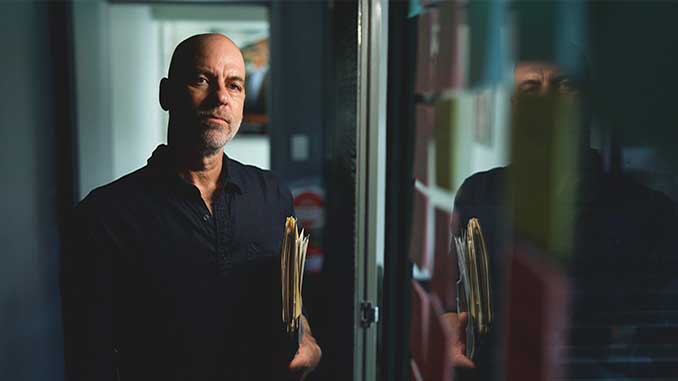
Images: Dan Goldberg in The Hunt for the Last Nazis (supplied) | Eddie Tamir at the Classic Cinemas’ screening (*) – photo by Dr Jytte Holmqvist | Dan Goldberg in The Hunt for the Last Nazis (supplied)
Recommended reading:
Footnotes:
[1] www.australian.museum See also www.onlinelibrary.wiley.com
[3] www.aidc.com.au and www.mintpictures.com.au
[4] Once part of Gondwana, what is now Australia existed on the massive landmass or southern supercontinent that comprised South America, Africa, Antarctica, Australia, India, and Madagascar: www.britannica.com
[5] We are told that the film, which “stains the postcard image of Australia as this great southern land”, “…really is about the passage of time” – but does time heal all wounds?
[7] Not (in)directly welcoming as Australia, in Argentina European war criminals took their fate into their own hands by venturing all the way over and hiding for years and years in the vastness of it all. The home of the free – nature is all accepting and ‘doesn’t judge’.
[11] In a 12-page report by Zandy Alter and Michael Kapel in The Australia/Israel Review Vol. 22 No. 14 (1-22 October 1997): www.chesshistory.com
[16] The Jewish Independent says the ICU investigations were not in vain; its stance constituting a counterweight to Goldberg’s overall very sombre documentary: www.thejewishindependent.com.au
[17] Ibid.
Note: (*) Eddie Tamir expressed his frustration with there having to be security guards at the door at the Classic Cinemas for the 19 April Q&A screening of The Hunt for the Last Nazis