
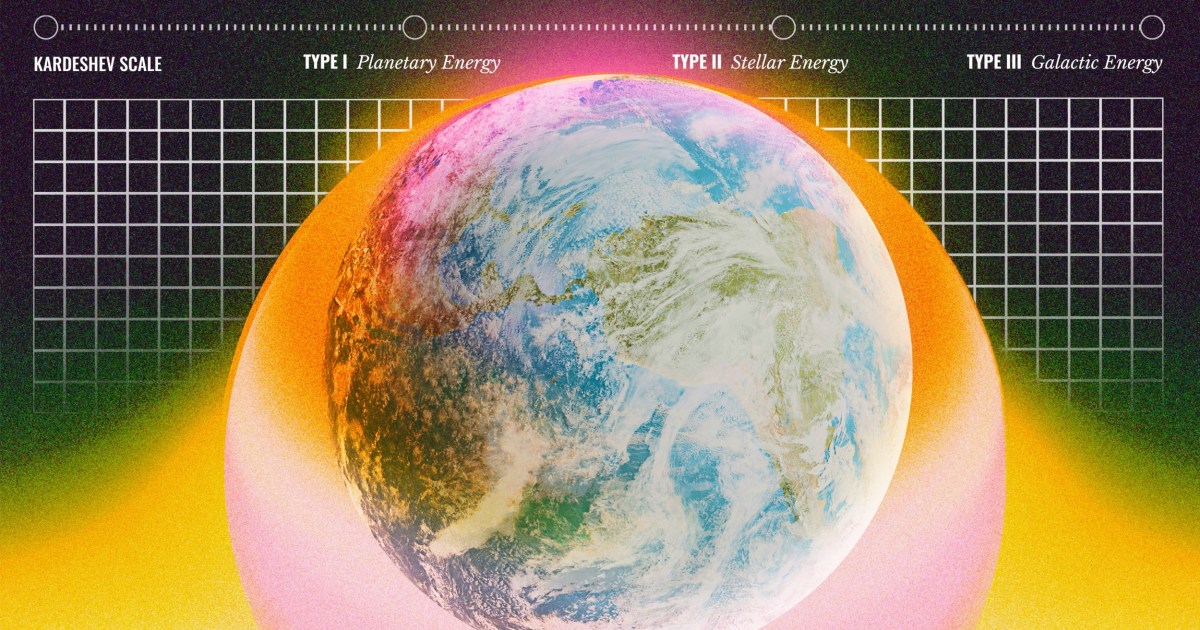
In the mid-20th century, while Carl Sagan pioneered the search for extraterrestrial intelligence (SETI) in the U.S., eminent Russian astrophysicist Nikolai Kardashev did the same in the Soviet Union, which was, at the time, the other great scientific superpower.
From that vantage point, he proposed using the energy demands of an alien civilization as a way to categorize its place on the ladder of technological advancement. This framework became known as the Kardashev scale, and it is one of the oldest and most visionary ideas in SETI, as well as a fixture of science fiction.
It is also profoundly incomplete — and if we want to advance our own civilization, we need to take the whole picture into account.
The energy ladder
Kardashev’s thinking about advanced alien civilizations was grounded in fundamental physics: No matter how advanced a civilization might become, it would still need energy to power its technology.
The Kardashev scale not only gave scientists a new framework for thinking about extraterrestrials, but also a new way to think about humanity.
Kardashev’s proposal was to be explicit about what energy sources would become available to a civilization as it became more advanced. He focused his scale on starlight because no other energy source is so accessible and so prodigious. Every star is a massive thermonuclear reactor pumping enormous amounts of power into space. So, given the ubiquity of star power, the remaining question is: How much stellar energy can a civilization capture?
From that premise, he outlined three increasingly advanced levels, or “types,” of civilizations. This scale not only gave scientists a new framework for thinking about extraterrestrials, but also a new way to think about humanity. Where do we land on the scale? Are we close to any of its milestones? Are we on our way to becoming the kind of advanced civilization the Russian scientist dreamed about?
Type I
Kardashev defines a Type I civilization as one able to use all the solar energy falling onto the surface of its home planet. The Sun provides more energy to Earth in one hour than humanity currently uses in a year. If we were a Type I civilization, we’d have all that energy available to us for civilization-building.
Type II
A Type II civilization has far greater technological capacities: It can harness its home star’s entire energy output. That means that a Type II human civilization would be able to harness 2.2 billion times more energy than a Type I human civilization.
One way to harvest all this solar energy would be to enclose the star in some kind of giant energy collector. Physicist Freeman Dyson proposed this idea a few years before Kardashev wrote up his idea for ranking civilizations. His hypothetical structures became known as Dyson spheres, and like the Kardashev scale, they quickly became a foundational idea in both SETI and science fiction.
As many scientists, including Dyson, have pointed out, a civilization doesn’t need to build a full Dyson sphere to qualify as Type II on the Kardashev scale. A Dyson swarm — a dense constellation of energy collectors orbiting a star — would suffice. Building a Dyson sphere or a Dyson swarm, however, is no easy task since grinding up a significant fraction of the planets in your solar system for building materials is a prerequisite.
Type III
The top rung on Kardashev’s ladder takes us from the scale of solar systems to entire galaxies. The Sun is part of the Milky Way galaxy along with 400 billion other stars — if humanity were a Type III civilization, we’d be able to harvest the energy from every single one of them. At this level, we are talking about civilizations with near-godlike capacities.
Where we stand
While humanity won’t be building a Dyson sphere any time soon, our ability to harvest energy has rapidly increased over the past two centuries — thanks to the Industrial Revolution and the discovery of fossil fuels, our energy use is now on an exponential growth curve.
There was a factor Kardashev ignored when he forged his grand idea, and it alters all our thinking about energy, planets, and the fate of civilizations: a planet’s biosphere.
In 1976, Carl Sagan tallied up our energy consumption and determined that we were a Type 0.7 civilization. He then extrapolated our energy use into the future and predicted we’d reach Type I in just a few hundred years. More recently, a group of scientists led by Jonathan Hiang at NASA’s Jet Propulsion Laboratory looked carefully at the problem and estimated we’d hit the all-important Type I milestone in 2317 (proving once again that Carl Sagan was always ahead of his time).
So, we are just a few centuries away from crossing the first milestone on Kardashev’s vaunted scale. That should be a huge cause for celebration, right?
What Kardashev missed
Unfortunately, things aren’t that simple. There was a factor Kardashev ignored when he forged his grand idea, and it alters all our thinking about energy, planets, and the fate of civilizations: a planet’s biosphere, the sum total of living organisms on it and the ecosystems they inhabit.
Earth’s biosphere includes microbes, forests, savannas, animals, and more. Humans are a part of the biosphere, and every species on any planet that hosts an advanced technological civilization will be, too. Biospheres are a critical factor when thinking about civilizations and their trajectories because, simply put, they don’t like to be messed with. Biospheres are, on their own, a powerful force, as we humans only recently discovered.
Drawing vast amounts of energy from the planet dumps vast amounts of waste heat back into the biosphere. And the biosphere, with its deep coupling to the geospheres, will react when that happens.
There is a great irony in Kardashev not taking biospheres into account when thinking about civilizations: It was his countryman, the great Russian biogeophysicist Vladimir Vernadsky, who coined the term “biosphere” in 1926. Vernadsky was the first scientist to realize that life, expressed as the biosphere, had to be counted as a factor affecting the development of a planet.
If you want a potent example of a biosphere’s ability to hijack a planet, just take a deep breath. Earth’s 21% oxygen atmosphere is a consequence of microbes inventing a new form of photosynthesis more than 2.5 billion years ago. This “Great Oxygenation Event,” driven by the biosphere, was one of the most significant points in Earth’s geophysical history, completely altering all aspects of the planet’s evolution.
Life pushes back
Ignoring the power of the biosphere was Kardashev’s critical mistake. A civilization ascending the curve of energy-harvesting capacities can’t simply climb to the point where it pulls in all infalling solar photons. Before that happens, the biosphere would produce feedbacks that could potentially bring the technological civilization to its knees, its ascent up Kardashev’s scale halted perhaps permanently.
Realizing the biosphere’s power eventually led to Earth systems science (ESS), a modern scientific field in which a strong coupling between Earth’s biosphere (life) and the other geospheres — atmosphere, hydrosphere (water), cryosphere (ice), and lithosphere (ground) — is taken as fundamental. Because these geospheres are closely linked, changes in one can trigger a response in another. These responses are known as “feedbacks,” and they can be positive or negative.
Our simulations showed exactly what the Kardashev scale misses about civilizations ascending the ladder of energy use: The climb is neither simple nor straightforward.
ESS researchers have been warning about this for the last few decades. Our remarkable energy-harvesting capacities, in the form of fossil fuel use, have triggered a feedback in the form of climate change.
The important thing to realize is that energy harvesting always results in some form of feedback. The second law of thermodynamics (also a fundamental physics concept) says that the use of energy to do useful work is always accompanied by waste. Power a car with a gallon of gas, and some of that energy is squandered heating the engine block rather than spinning the wheels. Drawing vast amounts of energy from the planet dumps vast amounts of waste heat back into the biosphere. And the biosphere, with its deep coupling to the geospheres, will react when that happens.
Testing the limits
In 2018, my colleagues and I tried to model the interactions between energy-harvesting technological civilizations and their planets. Our models were simple, but we tried to capture the interlinked trajectories of the planetary state and the civilization as it used ever greater amounts of energy.
In a third of our simulations, the planet was environmentally changed but still “habitable” for a complex technological civilization — its population reached a stable state. In another third, the population spiked and then rapidly declined in ways that might make the continued operation of a complex technological civilization hard to maintain. In the final third, the civilization collapsed entirely, its population essentially plummeting to zero.
Any successful, long-term technological civilization must have developed the wisdom to bring its “technosphere” into balance with its biosphere.
Our simulations showed exactly what the Kardashev scale misses about civilizations ascending the ladder of energy use: The climb is neither simple nor straightforward. If you are not careful, the biosphere your civilization depends upon will blow you off the ladder with hurricane-force winds. The feedback from fossil fuels may be more dramatic, but the energy we harvest from renewables is subject to the same constraints imposed by the second law of thermodynamics. The more energy of any kind we use, the more feedback our biosphere will generate. There is no free lunch.
When Kardashev proposed his scale, most people were not aware yet of the biosphere’s awesome power. That’s why he could imagine an unimpeded climb to Type I status for young technological civilizations. But if there are successful, long-term technological civilizations out there, they know better. They must have developed the wisdom to bring their “technospheres” into balance with the biospheres on which they depend. The real question before us now is: Can we be so wise?