
In endurance sports, marginal gains can greatly impact outcomes. In cycling, those gains are increasingly not coming from lighter frames or deeper wheels. Instead, they are the result of a rider’s position on the bike, how the bike is set to the rider’s body and how the body can be adapted or treated to perform at its best.
Performance, biomechanics and long-term health all come together in the world of modern bike fitting, resulting in a highly data-driven and individualized process. What was once a one-time adjustment, often made by the rider themselves, has morphed into an ongoing progression shaped by flexibility, training goals and physical therapy.
For many riders, especially those who are making the leap from recreational cycling into competition, the fit of a bike becomes a limiting factor before fitness does. A more aerodynamic position can significantly improve efficiency over long distances, particularly in disciplines like gravel racing. Despite that fact, the ability to sustain that position depends heavily on the rider’s mobility, which is in turn supported by physical conditioning and therapy.
“If someone doesn’t have the flexibility, you can’t just force them into a more aggressive setup,” said Raymond “Ray” Degli, who owns Alchemy Body+Bike in Steamboat Springs.
Degli is also the lead physical therapist and bike fitter at Alchemy.
The process, he explains, has shifted in recent years beyond just looking at the bike itself. Riders may be encouraged to address limitations, such as tight hips or restricted movement, through targeted physical therapy before beginning or completing a fit.
“We’re trying to keep people riding longer,” Degli said. “That’s really what it comes down to.”
This integration between bike fitting and physical therapy is part of a broader shift in the industry. Rather than treating discomfort as a byproduct of cycling, fitters are focusing on identifying root causes and resolving them through movement and adaptation.
“The goal is to get you as dialed in on the bike as we can, with the understanding that if there are limitations with your body, we have to address those early,” Degli said.
That philosophy has become central to Alchemy’s growth.
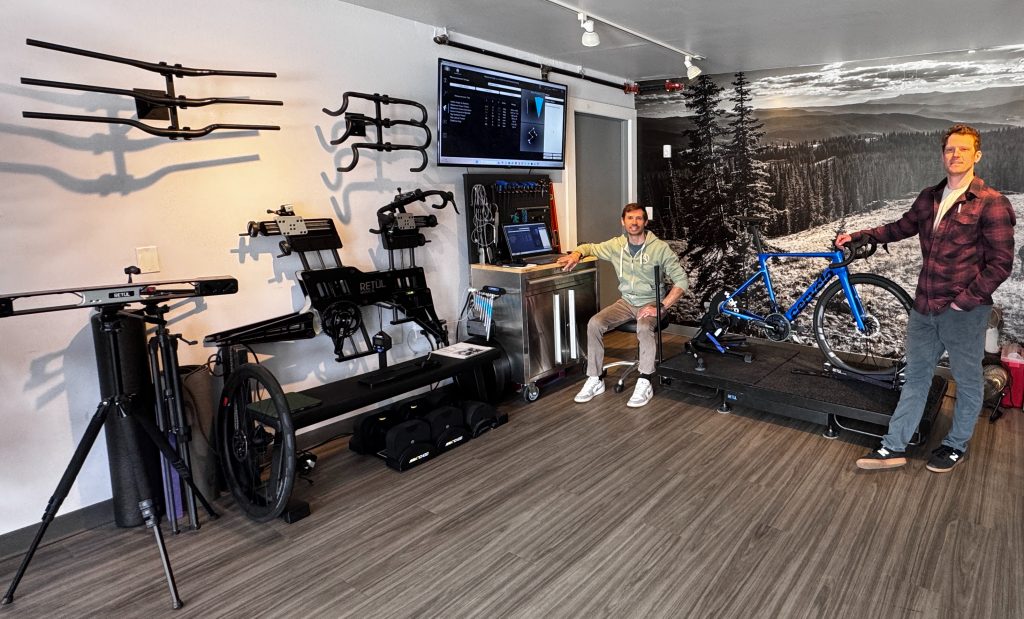
What began as a bike fitting service was, from the outset, structured to include both physical therapy and fitting. Since its founding five years ago, the practice has combined the two disciplines in a single setting, an approach reflected in its name. Degli and his team evaluate how a rider moves while making adjustments to equipment, using tools such as Retül 3D motion capture technology alongside clinical assessment.
In the years since, the business has expanded its services to include a Fit Bike and the retail of Cervélo and Scott bikes. The Fit Bike is used to help determine appropriate sizing and positioning before a purchase, including measurements such as saddle height and handlebar position. This process provides an alternative to relying only on general sizing charts.
“Those are the big changes,” Degli said. “We’ve added services that are huge, and that’s really what separates us.”
The result is what many refer to as a progressive fit. Rather than locking in a static position, riders return periodically as their bodies evolve through training, rehabilitation or growth.
“We’re not just setting it once and sending you out the door,” said Mitch Stypinski, who works alongside Degli and has spent the past year learning the craft. “We’re looking at how your body moves and how that changes over time.”
Small adjustments, sometimes measured in just a few millimeters of saddle height or subtle changes in reach, can have immediate and significant impacts.
“Even three degrees on a saddle can be a mess,” Degli said. “It doesn’t sound like much, but it makes a huge difference.”
That level of precision is driven by motion capture systems, which allow fitters to analyze a rider’s pedal stroke in real time while also measuring joint angles and movement patterns under load.
“We’re getting dynamic data while you’re pedaling,” Degli said. “That’s the difference. You’re seeing what’s actually happening, not just a static snapshot.”
That data often confirms what riders feel. A series of small adjustments, lowering the saddle, leveling it and shifting it slightly back, immediately reduced pressure on the rider’s hands.
“I can instantly feel the difference,” a rider who worked with Degli said. “I felt less pressure in my hands almost right away.”
For Degli, those moments reinforce the connection between fit and injury prevention. He noted that many of the issues riders experience are not caused by crashes, but by repetition in less-than-ideal positions that can be traced to a bike’s fit.
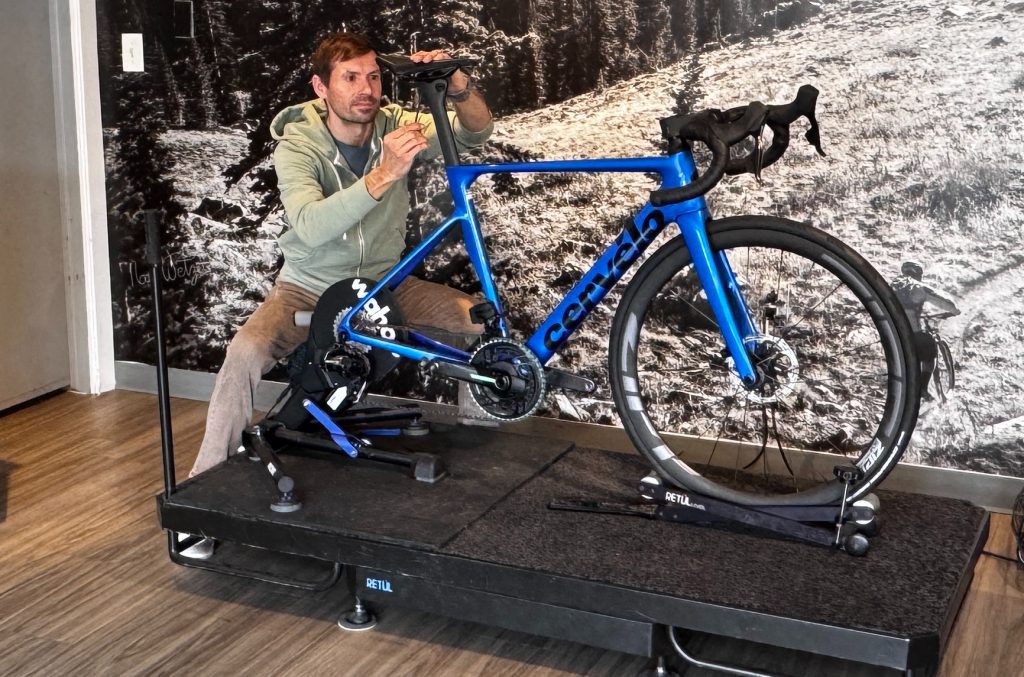 Degli adjusts a saddle on one of Alchemy’s bikes. His approach balances the dynamic state of the body in various cycling positions with physical therapy, aiming to improve efficiency and comfort for cyclists.John Camponeschi/Steamboat Pilot and Today
“About 90% of injuries on a bike are overuse,” he said. “A lot of it comes down to position.”
That focus on prevention has fueled growth, particularly in physical therapy. By addressing imbalances, such as hip tightness or asymmetry, Degli can improve both comfort and performance for riders of all disciplines.
“If you don’t address it, it can keep getting worse and start to cause more problems down the road,” Degli said.
The expansion into physical therapy has also changed how the business supports the broader cycling community. Riders are no longer coming in only after problems arise. Instead, many are seeking out fittings proactively, especially as awareness grows around the impact of proper positioning and what it can create in terms of positive results on the road or trail.
“There’s a lot of people riding bikes that aren’t set up properly,” Degli said. “More than you think.”
That awareness extends to younger riders as well. As youth cycling programs expand, proper fit is becoming part of the early stages of training and development.
Growth spurts and changing biomechanics mean younger riders may need frequent adjustments, especially if they are training consistently. Without those changes, improper positioning can lead to inefficiency or injury over time.
Differences in physiology also play a role, particularly for female riders. One of the most common issues is saddle width, which is often mismatched to the rider’s anatomy.
“Women generally have wider sit bones, so they need a wider saddle,” Degli said. “A lot of stock bikes don’t account for that.”
Addressing those differences early can significantly improve comfort and stability, reinforcing the idea that fit is not one-size-fits-all, as often suggested by many bike companies’ sizing charts.
The same applies to component choices across the bike. Industry trends, such as shorter cranks, have been widely embraced for their ability to reduce strain and improve efficiency.
“It’s one of the best things the industry has done,” Degli said.
Other trends, however, require more nuance. Extremely short stems and wide handlebars, common in some mountain biking disciplines, may not benefit every rider.
“Sometimes it’s too much,” Degli said. “It can drive your shoulders up and create more tension.”
Ultimately, the process comes back to the individual. Stock builds are starting points, not final answers.
“Everything we do is about what works for that rider,” Stypinski said. “The numbers help, but it has to feel right, too.”
For more information visit AlchemyBodyAndBike.com.