
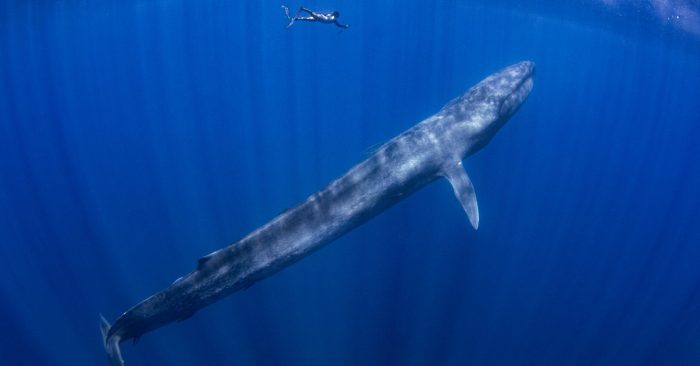
A UNSW-led study demonstrates how a new tool can detect blue whale calls with almost 100% accuracy, despite only being trained on one sample song. The tool has the potential to transform how scientists analyse rare and elusive species.
Trying to find a whale song in the ocean is like trying to find a needle in a haystack. But now, UNSW Sydney researchers say they’ve trained a model, with just a single case study, to find blue whale songs in recordings that span across decades and entire ocean basins.
In a new study, lead author UNSW PhD candidate Ben Jancovich showed how a neural network – a deep learning model that can recognise patterns in data through interconnected layers of artificial neurons – could detect blue whale songs with remarkable accuracy.
The researchers’ findings have implications for the field of ecology, paving a new way to analyse rare species across decades.
“Machine learning models traditionally need to be trained on thousands of recordings of the very whale song that they’re trying to find,” Jancovich says.
“However, this new model was trained on only one recording of a blue whale call.”
Because studies in ecology often require monitoring change across many years, he says, the tool could help scientists unlock decades of recordings.
“When we’re studying marine mammals, that data is often acoustic recordings – and when you’ve got really long recordings, finding all the individual animal calls is incredibly labour-intensive, slow and expensive,” he says.
Manually analysing datasets that span decades, he says, “is just not possible for humans. And even with automation, it still might not be possible if we lack training data for the target species.”
Jancovich says these limitations have prevented a “full exploitation of these long-term datasets”.
He says to mine the wealth of information they contain, high-performance, cheap, accessible tools like the one he developed need to be made available and open-source.