
The hypothesized mean differences in effort perceptions, moral judgment, cooperation satisfaction, outcome deservingness, competence, and warmth between dieting strategies replicated in all four Studies. The meta-analyzed results can be found in the section for “Evidence Synthesis,” and the detailed results from Studies 2–4 (Hypotheses 1, 2, and 4–7) on these measures are presented in the SOM, as well as correlation tables of all measures of interest.
Study 1Confirmatory results
As hypothesized, there was a large difference in effort perception between dieting strategies (Maom = 4.51 (1.51), Mtraditional = 6.63 (0.66), t(317) = 23.37, p <.001, d = 1.31, 95% CI [1.16, 1.46], BF10 > 1,000). Further, a large difference in moral judgment was observed (Maom = 4.08 (1.05), Mtraditional = 5.66 (0.89), t(317) = 22.27, p <.001, d = 1.25, 95% CI [1.10, 1.39], BF10 > 1,000). There was no significant interaction between group (AOM use or non-use) and perceived effort on moral character judgment (p =.656, β = − 0.04 [−0.23, 0.14]), but significant main effects of group (p <.001, β = − 0.56 [−0.72, − 0.40]) and effort perception (p <.001, β = 0.54 [0.37, 0.72]). The model accounted for large shares of the variance in differences of moral judgment (R2marginal = 0.534, R2conditional = 0.652).
Exploratory results
We tested whether the AOM use further influenced assessments of cooperation satisfaction (Maom = 4.39 (1.49), Mtraditional = 6.01 (1.18), t(317) = 16.99, p <.001, d = 0.95, 95% CI [0.82, 1.09], BF10 > 1,000), competence (Maom = 4.09 (1.35), Mtraditional = 5.57 (1.21), t(317) = 15.80, p <.001, d = 0.89, 95% CI [0.76, 1.01], BF10 > 1,000), warmth (Maom = 4.23 (1.13), Mtraditional = 4.88 (1.20), t(317) = 9.99, p <.001, d = 0.56, 95% CI [0.44, 0.68], BF10 > 1,000) and outcome deservingness (Maom = 5.41 (1.53), Mtraditional = 6.88 (0.38), t(317) = 17.18, p <.001, d = 0.96, 95% CI [0.83, 1.10], BF10 > 1,000). All tests were significant and more positive towards the dieter not using AOM. Apart from warmth (medium effect), all effects were large.
Study 2Confirmatory results
Differences in effort perceptions were associated with differences in moral judgment (H3) in the expected direction (larger effort difference corresponded with larger differences in moral judgment): t(343) = 13.61, p <.001, r =.59, 95% CI [0.52, 0.66]. Hypothesis 8 was not tested, given the low share of personal experience with AOM (2.89%) or within the close environment (16.23%). There was no significant interaction between AOM attitudes (H9) and differences in effort perceptions on differences in moral judgment (p =.670, β = − 0.02 [−0.10, 0.06]), but two significant main effects; for effort differences (p <.001, β = 0.52 [0.43, 0.60]) and AOM attitudes (p <.001, β = − 0.25 [−0.34, − 0.17]), explaining a large share of variance in the differences of moral judgment (R2adjusted = 0.405). While showing large differences in perceived laziness between AOM users and non-users (p <.001, d = −0.89, 95% CI [−1.01, −0.76], BF10 > 1,000), no interaction between effort differences and laziness differences on differences in moral judgment (p =.173, β = 0.05 [−0.02, 0.13]) were found (H10), but significant main effects of effort differences (p <.001, β = 0.47 [0.38, 0.56]) and laziness differences (p <.001, β = − 0.31 [−0.40, − 0.21]), explaining a large share of variance in moral judgment differences (R2adjusted = 0.416).
Exploratory results
We explored whether shortcut beliefs (i.e., AOM use represents a shortcut towards weight loss) moderated the relationship between differences in effort perception and differences in moral judgment. This received support with significant main effects for effort differences (p <.001, β = 0.47 [0.38, 0.57]) and shortcut beliefs (p <.001, β = 0.29 [0.19, 0.38]) as well as a significant interaction (p =.004, β = − 0.12 [−0.21, − 0.04]), explaining a large share of variance in moral judgment differences (R2adjusted = 0.429).
Study 3Confirmatory results
As in Study 2, the association between differences in effort perceptions and differences in moral character judgment was strong in the US sample: t(241) = 14.80, p <.001, r =.69, 95% CI [0.62, 0.75].
Originally, the pre-registration stated that Hypothesis 8 would only be tested if the share of individuals with personal or close familial experience with AOM would exceed 20% of the sample. Given that 19.34% of participants had personal experience with AOM, we report the test but highlight that it deviates from the pre-registered analysis plan: We observed a significant interaction between perceived effort differences and personal AOM experience (p =.038, β = − 0.09 [−0.18, − 0.00]), indicating a smaller effect of differences of effort perceptions on moral judgment in individuals with prior AOM experience. No such interaction was observed for individuals with AOM users in their close social environment (31.27%): Only perceived effort differences reached significance (p <.001, β = 0.68 [0.59, 0.78]), while AOM experience in the social environment (p =.058, β = 0.09 [−0.00, 0.18]) and the interaction of the terms did not reach significance (p =.635, β = 0.02 [−0.07, 0.11]). Hypothesis 9 was supported. Again, stronger differences in perceived effort predicted stronger differences in moral judgment (p <.001, β = 0.64 [0.54, 0.74]), and a more positive AOM attitude predicted a smaller difference (p =.029, β = − 0.11 [−0.21, − 0.01]), attenuating the effect of perceived effort differences (p =.025, β = − 0.11 [−0.20, − 0.01]). As such, we replicated the significant main effects of Study 2 and additionally observed a significant interaction other than in the prior study. Hypothesis 10 (correlation of moral judgment differences and effort enjoyment) was not supported. The effect was not significant and very small: t(241) = 0.46, p =.649, r =.03 [−0.10, 0.15]. Further, there was no significant association with conscientiousness (Hypothesis 11): t(241) = 1.28, p =.201, r =.08 [−0.04, 0.21].
Exploratory results
The pre-registered exploratory tests with the other BIG-5 dimensions yielded no significant effects apart from a small, and negative relationship with neuroticism (openness: t(241) = −0.56, p =.576, r = −.04 [−0.16, 0.09], extraversion: t(241) = −0.34, p =.736, r = −.02 [−0.15, 0.10], agreeableness: t(241) = 1.17, p =.245, r =.07 [−0.05, 0.20], neuroticism: t(241) = −2.02, p =.044, r = −.13 [−0.25, − 0.00]).
Further, we tested again whether the belief that AOM use was a shortcut moderated the relationship between differences in effort perceptions and differences in moral judgment. This received support, with significant main effects for effort differences (p <.001, β = 0.58 [0.48, 0.68]) and shortcut beliefs (p <.001, β = 0.22 [0.12, 0.31]) as well as a significant interaction (p =.004, β = 0.14 [0.05, 0.24]). Together, the model explained a large share of variance in differences in moral judgment (R2adjusted = 0.524).
Study 4
As previously, the association between differences in effort perceptions and differences in moral character judgment was strong: t(298) = 14.90, p <.001, r =.65, 95% CI [0.58, 0.71].
Hypothesis 8
remained untested due to the low prevalence of own experience with AOM (8.00%) or within the close personal environment (16.33%). Hypothesis 9 replicated the interaction effect of differences in effort perceptions (p <.001, β = 0.56 [0.47, 0.65]) and AOM attitudes (p <.001, β = − 0.21 [−0.30, − 0.12]), which attenuated the effect on moral judgment (p <.001, β = − 0.08 [−0.17, − 0.00]). Regarding Hypothesis 10, a strong correlation was observed between AOM shortcut beliefs and moral judgment differences, indicating that stronger AOM shortcut beliefs would be associated with stronger moral judgment differences between AOM-users and non-users.: t(298) = 10.41, p <.001, r =.52, 95% CI [0.43, 0.60]. Last, for Hypothesis 11, only significant main effects of differences in effort perception (p <.001, β = 0.52 [0.42, 0.61]) and shortcut beliefs (p <.001, β = 0.26 [0.17, 0.36]) were observed, but no significant interaction (p =.107, β = 0.06 [−0.01, 0.14]).
Evidence synthesis
To deliver a reader-friendly overview of the main results for dissemination, we applied fixed- and random-effects meta-analysis on the mean comparisons across studies (Fig. 1) and computed the respective prediction intervals. Apart from the summary effects for warmth, which were medium-sized, all effects were large30. These results can be used for future advances and replications.
Further, to highlight the influence of differences in effort perceptions on differences in moral character judgment, we used random-intercept multi-level modeling, nesting participants in their respective studies (Fig. 2). Mostly through the fixed terms of the model, the interaction of differences in effort and the study, a large share of variance in moral judgment differences was explained (R2marginal = 0.389, R2conditional = 0.397). Only the main effects for perceived effort differences (p <.001, β = 0.59 [0.50, 0.68]) and Study 3 (US) (p =.041, β =.−28 [−0.56, − 0.01]) reached significance. There was no interaction between differences in effort perception and study, indicating no altered relationship with moral judgment in a specific sample. The full set of model coefficients is available in the SOM.
Fig. 1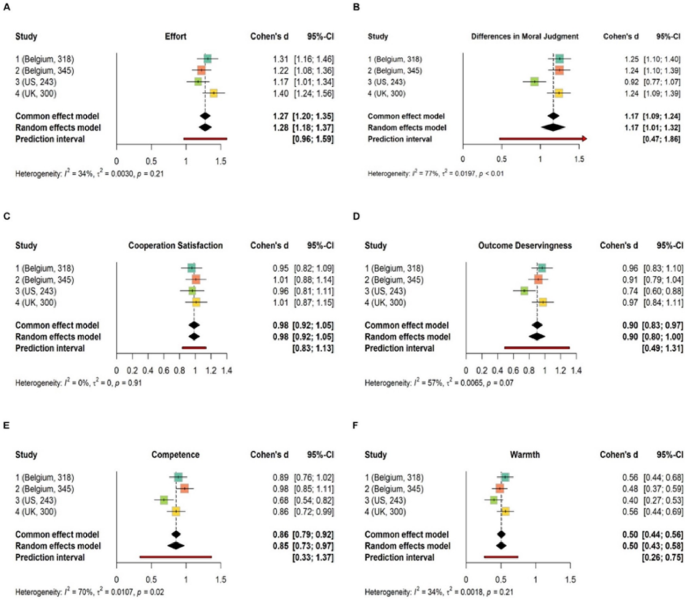 The alternative text for this image may have been generated using AI.
Meta-analyzed mean comparisons across studies.
Fig. 2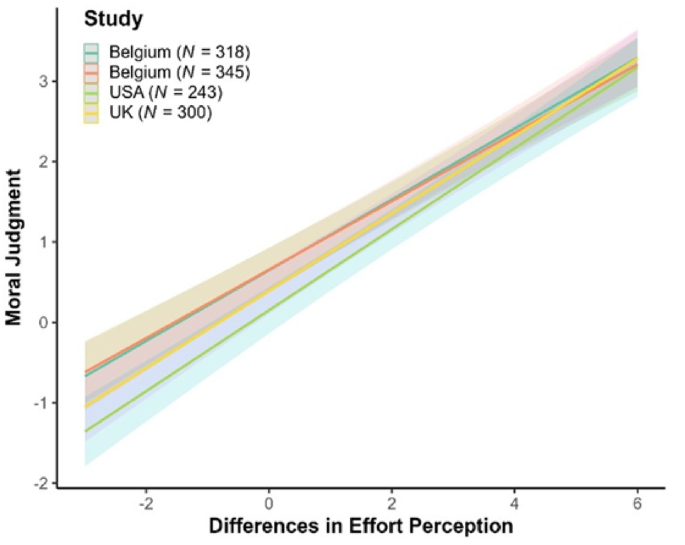 The alternative text for this image may have been generated using AI.
Association of effort and moral judgment differences by study.