
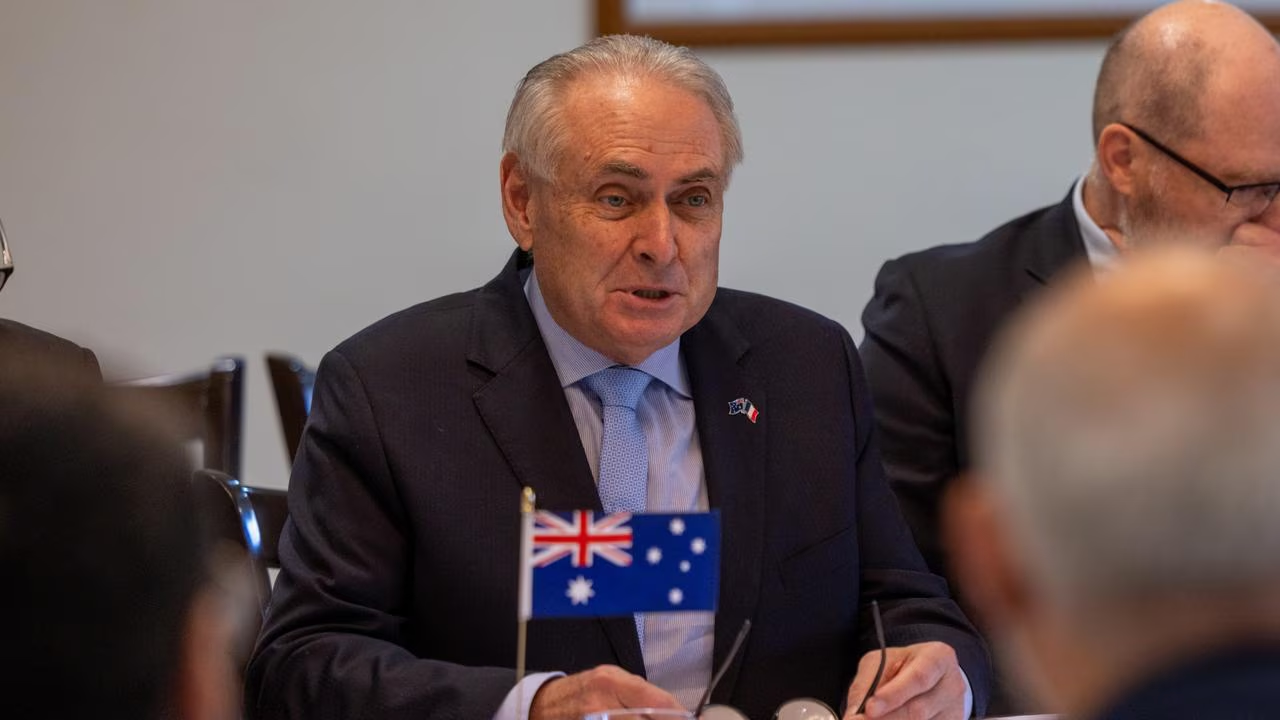
Australia will be left behind if it turns away from international trade as Iran war shocks spur worldwide debate over the need for sovereign capability, the country’s trade chief has told NewsWire in an exclusive interview.
The conflict in the Middle East has cut a fifth of global oil supply and about a third of fertiliser-grade urea, driving fuel prices to historic highs and threatening food security.
Governments and economists alike have warned the worst of the financial fallout is yet to come.
But even with supply chains battered by the Covid-19 pandemic, Russia’s invasion of Ukraine and US President Donald Trump’s global tariff assault, Trade Minister Don Farrell says Australia must not relinquish its role as “a great trading nation”.
“One in four jobs in Australia is based on trade, and if you’re a trading company then not only are your profits higher, but the wages of your staff are higher,” he said, sitting down with NewsWire at his vineyard in South Australia’s Clare Valley.
He lauded that Australia’s total trade hit a record $1.3 trillion last year but warned “we can’t rest on our laurels”.
“We can’t say, ‘Oh, look, jobs finished.’ We’ve actually got to keep looking for opportunities. Because if we don’t, other countries will,” he said.
At a time when middle powers and emerging economies are banding together and removing tariffs, he also warned against Coalition calls to impose import duties, saying the US has become an outlier.
“America is going down the track of protectionism. They’re not going to shy away from that anytime soon,” Senator Farrell said.
“We’ve got to look at that but they only represent 13 per cent of world trade.
“So we’ve got to talk to the other 87 per cent of countries in the world who believe in free and fair trade and get agreements with them to open up our country.
“It’s not always easy, but I think that’s … the way we’ve built our wealth in the past, and that’s the way that we’ll build our wealth in the future.”
Don’s art of the deal
Senator Farrell is an unapologetic champion of all things South Australia, especially the wines of his native Clare Valley.
He makes a point of bringing visiting foreign officials to his home in the riesling capital and giving them a taste of the region’s finest offerings.
If they are very lucky, they might even nab a bottle of his own Godfather Too cabernet – a nod to his deal-maker repute on Capital Hill.
But hosting fellow trade emissaries at his five-acre vineyard is about more than spruiking the Clare.
It is his way of building the relationships that underpin negotiations.
“If you’re not prepared to try and understand the position of the people that you’re negotiating with, then you’re never going to get an agreement,” Senator Farrell said.
“And how do you get that understanding? Well, you try and engage them at a personal level, and that’s what I try and do.”
Among those he has hosted are EU Trade Commissioner Maros Sefcovic and Chinese Commerce Minister Wang Wentao.
He said those experiences helped get both the EU free-trade deal over the line and $20bn in Chinese trade barriers removed.
A French delegation pulled in the drive way as dusk set in on the vineyard.
NewsWire was invited to see “The Don’s” diplomacy in action.
The French trade minister, Nicolas Forissier, was visiting to discuss deepening bilateral trade and investment beyond the EU free-trade deal.
Senator Farrell arranged for Mr Forissier and French ambassador Pierre-Andre Imbert to stay at his vineyard ahead of official talks the following day.
Greeting his guests, he invited them indoors for cheese and wine.
On the board were three Australian cheeses and three French, paired with two wines from each country.
Wine glasses in hand, the ministers agreed to discuss the challenges facing global trade further before their dinner reservation at the Watervale Hotel – a farm to plate restaurant that pairs local wines to its degustation menu.
Mr Forissier said Australia and France “have a very like minded position” on trade post-Iran war.
“Australia and France, we are in favour of multilateralism,” he said, adding that both countries are trying “diversify our relations”.
“We are trying to develop another way. Not force to force but de-escalation.”
Mr Forissier said the economic fallout from the conflict “is getting very bad” and that Canberra and Paris “have to reinforce, strengthen our relations on this basis”.
Senator Farrell agreed and said there is a bright future for trade despite global challenges.
“Those people that believe in free and fair trade in this world have to work together,” he said.