
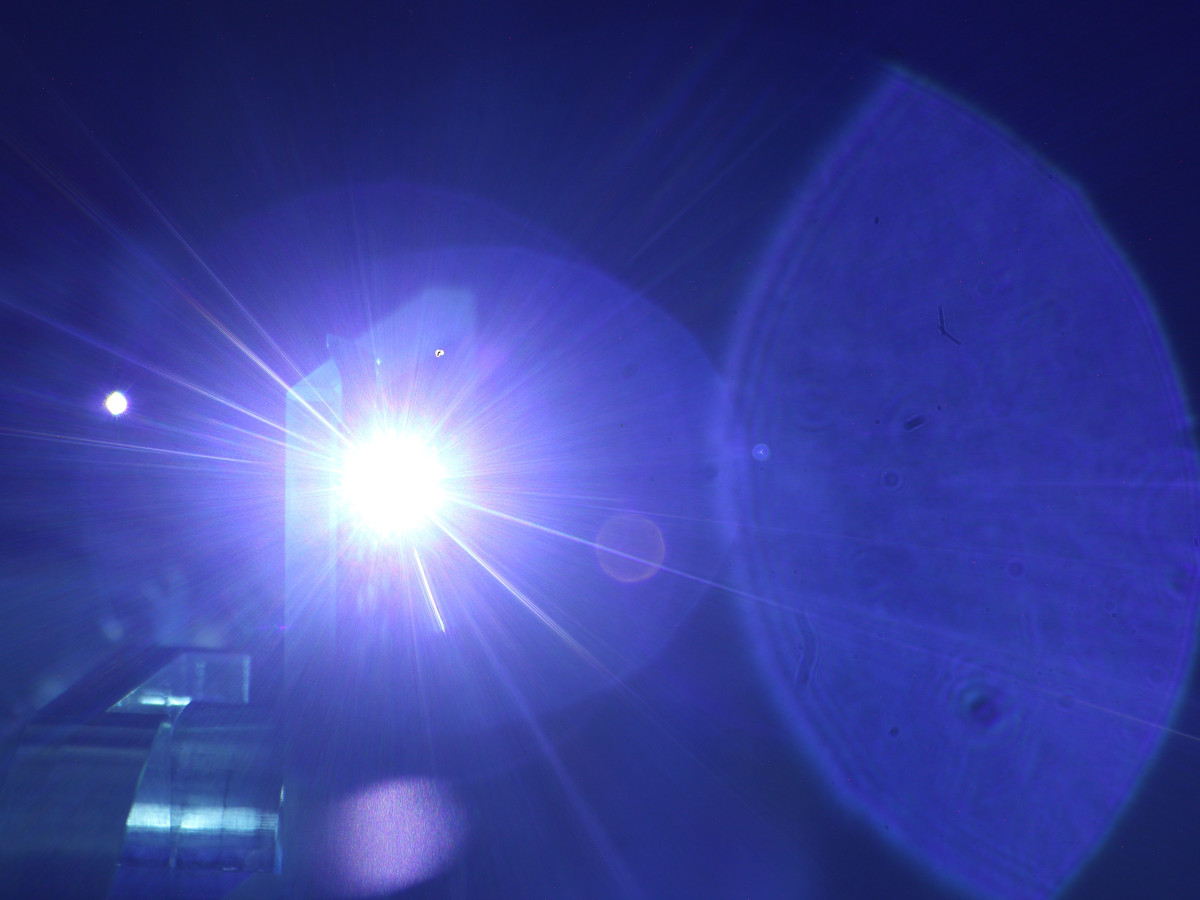
A team of physicists have demonstrated for the first time a new way to dramatically boost the intensity of high-power laser light. They do it by firing an already very powerful laser beam at a material surface. So much energy is dumped rapidly into the surface that it turns into a state of matter called a plasma: essentially a fluid of charged particles. These then begin to resonate in lockstep with the laser, spitting out new pulses at extremely high energies. It’s the photonic equivalent of a sonic boom. The team hope that the findings – published in Nature – will lead to the most powerful lasers ever created, orders of magnitude more energetic than what we can make at the moment. Among other things, these will enable us to begin to probe problems and ask questions about the quantum realm that are beyond the reach of current physics. Speaking with Chris Smith, Robin Timmis did the experiments at the University of Oxford…
Robin – What we’ve done here is we’ve taken a really bright laser source and interacted it to be able to kind of boost the intensity of that light even further by many many times the original intensity that it was.
Chris – So it turns a super laser into a mega laser?
Robin – Pretty much, yeah!
Chris – How are you doing that?
Robin – We study this interaction where you take one of these lasers and you focus it down onto a solid target and when you do that you create this relativistic interaction so all of your matter in that target starts moving at the speed of light and that allows you to then get these really cool effects in the reflected light off that surface.
Chris – So it’s a mirror that you’re bouncing it off?
Robin – Yeah, yeah, you essentially turn your target into a mirror but then that mirror starts moving.
Chris – And why does the movement matter?
Robin – This is the whole key thing, right. This is something that probably a lot of people are familiar with. When you have an ambulance go past you and the sound changes coming from it as that fast moving object is either coming towards you or away from you, you get this change in frequency from the sound there. So, essentially, we’re doing the exact same thing but now just with light where we get our mirror to move fast enough that it changes the frequency of the light that comes off it.
Chris – Is this sort of the light equivalent of a sonic boom then, in some respects, where all of the light sort of heaps up and you get a much more powerful effect?
Robin – Oh yeah, I like that idea, exactly! Yeah, starting with just something that was like a sine wave and then when you reflect it off you end up with these pulses of radiation. Each of them are very, very short in duration.
Chris – And how much more powerful does this make a laser then?
Robin – We are pretty optimistic about where this can go. People have suggested like if we can get this working properly 10,000 times intensity boost may be reasonable which is, you know, quite an exciting breakthrough considering at the moment we’re sort of operating with high power lasers on just getting like an order of magnitude increase.
Chris – Does it work with all colours, in other words frequencies or wavelengths of light, or are you focusing on one particular wavelength at the moment?
Robin – Yes, that’s something that’s quite cool about this field is that it should be kind of scalable. We can do this with all sorts of different frequencies and we’re looking at that in many different ways actually. But at the moment, yeah, we’re focusing on infrared light.
Chris – And do you need a special mirror, in other words a solid surface that does the vibrating effect?
Robin – There are definitely some materials that are better than others but the kind of cool thing as well is you could probably do this with pretty much anything if you had the right sort of laser because you start with this solid and you’re turning it into a plasma. The actual material doesn’t matter so much when you do that.
Chris – When you say turning into a plasma, so does the surface that’s being the mirror, does that effectively vaporise then in order to make this effect happen?
Robin – What you essentially do is you put enough energy in that all of the electrons that are in your atoms in that surface get ripped out. So you end up with this essentially a sort of liquid that’s composed of charged particles.
Chris – And then they’re seeing the laser light coming in and they’re then doing the movement or the vibration effect that has this amplifying effect?
Robin – Yeah, exactly. It’s the electrons, because they’re the really light particles. They’re the ones that actually start to accelerate to these very high speeds, almost to the speed of light, and can therefore all move around together coherently and create this mirror surface.
Chris – Why doesn’t the mirror surface just completely evaporate instantly then? The minute you start putting all this energy in and you turn it into a plasma, why does it not just all evaporate? How do you confine that plasma where the laser light is incident so that you can actually get this effect for long enough for it to be useful?
Robin – You’ve actually hit the nail on the head there with that question about what’s actually really interesting here and what we’ve managed to do. Essentially, you’re completely right. That does happen, which is why you’ve got to hit these things really hard and really fast. If you don’t hit your target hard enough and fast enough, then that’s what happens. You eventually destroy it and you don’t get this interaction at all, which is why you’ve got to operate with these very, very clean pulses that are very, very precisely tuned to enable this interaction to happen.
Chris – In the aftermath, does the surface stay intact? So in other words, could this be something that could be a sustainable process? If you can actually harness this, you wouldn’t end up having to replace your mirror every time you fire a laser pulse.
Robin – This is the big problem with my entire field actually. These are very much single use situations. There’s a lot of people working on ways of creating targets that will instead be regenerative in this way. But for now, yeah, you end up with a big damage mark on your pieces of glass.
Chris – What can we do with it though? Now you’ve discovered this, you’ve shown that hitting a surface really hard like this will produce these really interesting effects with this dramatic power increase. What can we do with it?
Robin – There’s many possible things that we’re looking into. For example, if you can get enough energy into a small enough volume of space, then you can start actually directly interacting that light with the vacuum and start to get all sorts of interesting quantum effects happening from that interaction. The thing is, you know, at the moment we are about a million times away in terms of light intensity from being able to do that. So at the moment it’s just completely unfeasible for us to reach those levels. But maybe, maybe we could actually, you know, via this sort of technique, start to approach the desired intensities.
Chris – If you are able to do that and you get these quantum effects, well what can we do with them? Why is that useful?
Robin – So this application is very much just about testing theories we have about the fabric of the universe and essentially testing things that at the moment we can only do theoretically. So hopefully we’ll reach a new sort of regime where we can do laboratory tests. That is the real physics, I think, once you can actually do the experiments.