
Although he once asked a film crew to manually haul a 320-tonne steamship over a mountain in the Peruvian Amazon for his film Fitzcarraldo (1982), director Werner Herzog is an intensely practical artist. In conversation with critic Jerry Saltz last year at Manhattan’s 92NY, he explained that film funding follows certain laws. You obey them and get your film made and seen, or you ignore them and waste both your talent and your life.
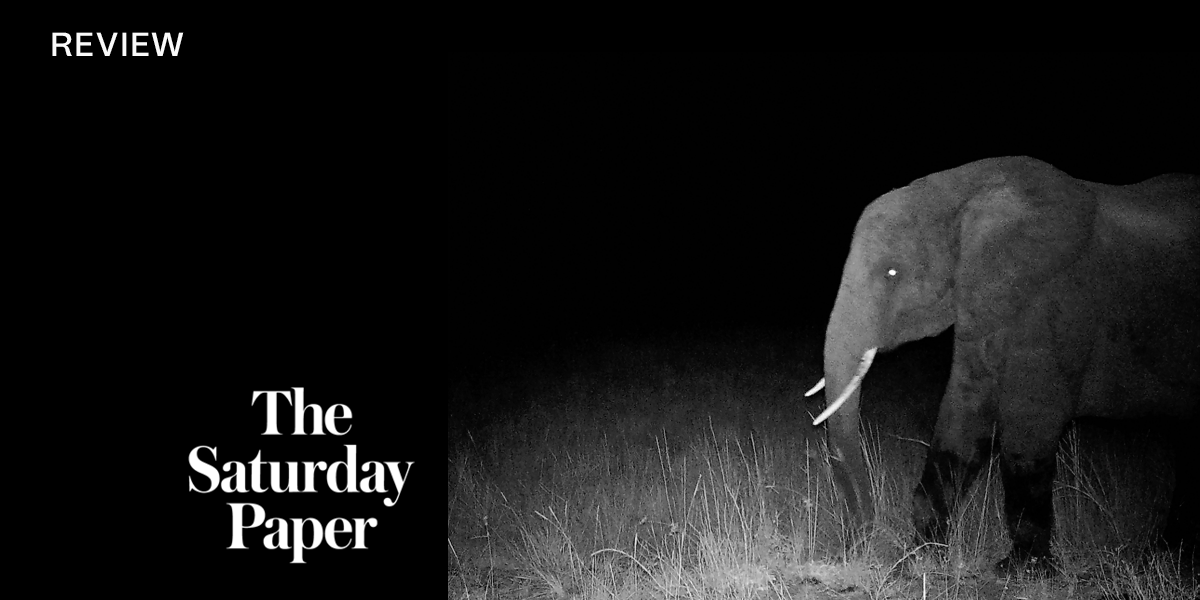
Through that lens, the otherwise surprising fact that the rarified director’s latest offering – the documentary Ghost Elephants – is streaming on Disney’s National Geographic makes perfect sense despite the fact that, by his own admission, “you barely see any elephants in the movie”. This lack is fundamental to both its premise and power.
South African conservation biologist Dr Steve Boyes has devoted his life to a search for an elusive – or possibly illusory – species of elephant in the Angolan highlands, an area known by the local Luchazi people as Lisima Iya Mwono, the Source of Life. “It’s the experience of going back in time and it’s perfect again,” Boyes has said of the almost inaccessibly remote wetlands and forests. “Places so uncreated by man, only created by elephants. It’s a dreamscape and I can’t get enough of it.”
Though Boyes and his team have documented nearly 300 new populations of cheetahs, leopards and lions there, efforts to encounter the elephant herd have been unsuccessful. “I’d find footprints and I’d run after them as far as I could and then… nothing.”
Aside from the geographical isolation of their habitat and the active minefields along its periphery, the other factor accounting for the mystery surrounding the herd is its exceptional ability to avoid humans. This is due to behavioural adaptations developed in response to massive losses inflicted during Angola’s civil war, which began in 1975 and lasted for nearly 30 years.
Ghost Elephants follows Boyes’ latest arduous expedition – with San Bushmen master trackers Xui, Kobus and Xui Dawid, as well as Angolan environmental anthropologist Kerllen Costa – deep into the highlands in another attempt to find the herd.
Herzog’s work reveals a steadfast fascination with the line between fact and fiction, dreams and delusion.
We meet Boyes under the rotunda of the Smithsonian National Museum of Natural History in Washington, DC, gazing up in wonder at the four-metre-tall African bush elephant that has been displayed there since 1959. Known as Henry or the Fénykövi elephant, after the Hungarian big game hunter who killed it in Angola in 1955, it remains the largest elephant specimen ever recorded. There is a photo of Fénykövi from that day, smiling in his khakis as he sits, tiny and triumphant, with his rifle atop the mountain of dead flesh.
Boyes believes that the unverified elephants of present-day Angola are descendants of the Fénykövi elephant, and therefore likely to be the largest land mammals. He aims to collect DNA in Angola that would establish that link. Awestruck in the museum, he says he cannot believe that he’s finally standing in front of the elephant he has dreamt about for so long.
But he isn’t. It’s just scaffolding and skin, a partial skeleton, as the actual tusks and skull are too enormous to prop up for display. From its architecture to its location to its name, the specimen reveals more about us than the living being towards which it can only limply gesture. Boyes’ obsessive striving to convert that mystery into certainty is what makes his quest uniquely Herzogovian.
Auteurship is less about the subjects an artist inexorably returns to, more about what they see in that material. Herzog’s work reveals a steadfast fascination with the line between fact and fiction, dreams and delusion, that any hero – or scientist or artist – must monomaniacally blur to create something from nothing. He eternally returns to those who fail magnificently, and occasionally to those who defy the laws of physics to miraculously turn their falls into flight. Also: our dangerous estrangements from ourselves, each other and the natural world as well as our infinitesimal smallness compared with the cosmos in which we are intractably embedded.
Ghost Elephants is a factual documentary, which – in Herzog’s realm – means it is spacious enough to see beyond “the truth of accountants”, as he once put it, in order to articulate elements of the “ecstatic truth” that also informs all human existence. The ecstatic figures in the camera’s attention to images that unite the mundane and the mystical: the wheeling of the stars above Boyes’ campsite, San religion and ritual, the buoyancy of an elephant in deep river water, its heavy legs churning the finest silt. The ecstatic is there too in the transcendent union of opposites – Boyes the scientist’s mythic questing and the ways in which the ghosts of the past haunt the present.
The counterpoint to the sublime underwater imagery is footage from the 1966 Italian film Africa Addio of a hunter gunning down elephants from a helicopter, and a corridor of discarded animal bones that stretches into the distance. “It’s not just Angola where you see humans fighting against creation … as if man is on a mission to destroy what he is a part of, which is life, biodiversity,” Costa says. “This is also represented by the Fénykövi elephant … he was shot because of his majestic-ness, because of his greatness, and it seems like this greatness is what causes not just this elephant but all other living beings to be destroyed by humans.”
By centring Boyes, the film is susceptible to criticism that it replicates the myths of the great white hunter or the white saviour. The perplexing and frustrating incompleteness of translation when Boyes is in conversation with the king of the Nkangala people, asking for permission to enter their highlands to search for the elephants, would perhaps support that view. Ultimately, however, the portrait drawn of Boyes is at once too simplistic and too complex to support that assessment. What we have in the end is a portrait of one person, at one moment of his life, chasing fanatically after a dream.
Instead of setting out to collect material that confirms his preconceptions, Herzog has explained that the structure and content of his documentaries, as well as his trademark voiceover narration, come from the footage itself. What emerges across the 98-minute span of this documentary is the leanest and ultimately most moving expression of an obsession that has spanned over six decades of his work: a multifaceted exploration of the highest and basest potentials of our quixotic capacity to dream impossible dreams. Or, as he articulated it in Fitzcarraldo, the idea that “our everyday life is only an illusion behind which lies the reality of dreams”.
“This quest,” Herzog asks Boyes before they set out on the road, “is it almost going after the white whale? The unknown, the mysterious…”
“It is a bit like Moby-Dick, where I don’t even know if these elephants exist the way I imagine them,” Boyes replies.
“Does it matter if they’re a dream?”
“It doesn’t matter for me if they are just a dream,” Boyes says. “That’s almost better. Then they will always exist because they could always be there.”
This idea of Schrödinger’s elephant, simultaneously there and not, is the ambivalent heart of the film. It is also at the heart of – to borrow the perfect phrasing of the writer Hanif Abdurraqib in a different context – the grand project of Werner Herzog, as I have always projected it onto myself: a continual rediscovery of the fact that the sublime is always waiting to be found in this broken world, and not some better one just around the corner.
I believe that’s what Herzog means when he rues how Boyes might have to live with success; how will the dreamer resign himself to the reality that all of our Edens and El Dorados are also war zones? That there are no doors to somewhere better, only the work of our own hands which, at best, will continue to create amid the destruction that we have always wrought?
Which is all to say that Herzog is no less of a Don Quixote than his subjects – doomed to glimpse the ecstatic truth only briefly, in pieces on the ground. Because he has battled with that duality all the days of his long working life, he has given us work that reaches the pinnacle of human endeavour, artistic or otherwise: stories that gesture at the great mystery, font of all grief and joy, of life’s fundamental, inescapable and ultimately unfathomable interrelatedness.
Ghost Elephants is streaming on Disney+.
ARTS DIARY
EXHIBITION 5th National Indigenous Arts Triennial: After the Rain
Sydney Opera House, Gadigal Country/Sydney, April 24 – May 13
LITERATURE Stratford Shakespeare Festival
Gunaikurnai Country/Stratford, Victoria, until May 10
CULTURE Vigil
Arts House, Naarm/Melbourne, until May 3
THEATRE SISTREN
Belvoir St Theatre, Gadigal Country/Sydney, until May 3
VISUAL ART Towards a Collapsing World: German Expressionism
Queensland Art Gallery, Meanjin/Brisbane, until February 12
Last Chance
MULTIMEDIA Still Presence
Lightbox Gallery, Nipaluna/Hobart, until April 27
This article was first published in the print edition of The Saturday Paper on
April 25, 2026 as “Schrödinger’s elephant”.
For almost a decade, The Saturday Paper has published Australia’s leading writers and thinkers.
We have pursued stories that are ignored elsewhere, covering them with sensitivity and depth.
We have done this on refugee policy, on government integrity, on robo-debt, on aged care,
on climate change, on the pandemic.
All our journalism is fiercely independent. It relies on the support of readers.
By subscribing to The Saturday Paper, you are ensuring that we can continue to produce essential,
issue-defining coverage, to dig out stories that take time, to doggedly hold to account
politicians and the political class.
There are very few titles that have the freedom and the space to produce journalism like this.
In a country with a concentration of media ownership unlike anything else in the world,
it is vitally important. Your subscription helps make it possible.
Send this article to a friend for free.
Share this subscriber exclusive article with a friend or family member using share credits.

Used 1 of … credits
use share credits to share this article with friend or family.
You’ve shared all of your credits for this month. They will refresh on May 1. If you would like to share more, you can buy a gift subscription for a friend.
SHARE WITH A FRIEND
? CREDITS REMAIN
SHARE WITH A SUBSCRIBER
UNLIMITED
Loading…