
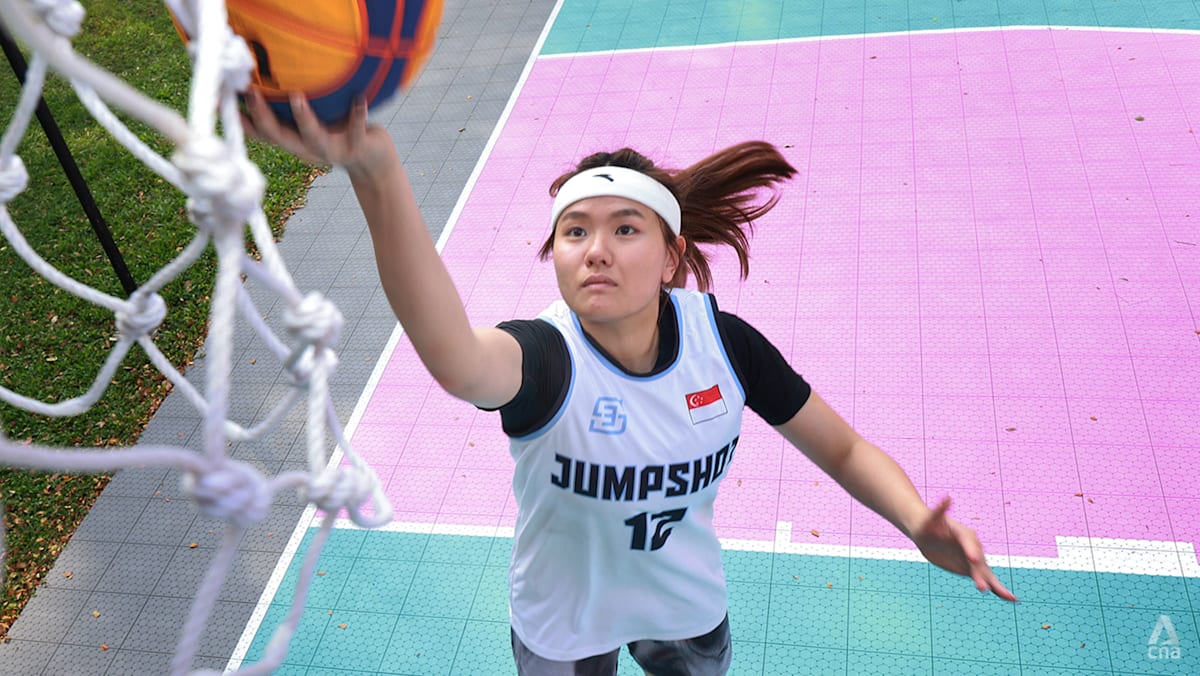
Upon graduating from junior college, she was keenly interested in Nanyang Technological University’s sport science programme. Her first application in 2020 failed, but after taking a gap year, her second try the next year was successful.
All the while, basketball continued to chart its own course for her.
While working part-time at a cafe during her gap year, she had a chance encounter with her former primary school basketball coach, Ms Esther Quek, the chief executive officer of basketball academy Jumpshot Singapore.
At the time, Ms Quek, a former Singapore national women’s basketball player, was in the process of restructuring her academy’s women’s team from the traditional 5v5 format to a 3×3 squad.
They arranged to meet for a proper catch-up – and this was where Ms Quek introduced Ms Tan to the new game format and planted the idea in her mind of going professional.
A CALLING TO 3X3 BASKETBALL THAT CHANGED HER GAME
Compared to regular basketball, the urbanised 3×3 version is faster-paced, with shorter games.
Originally known as streetball or street basketball, 3×3 games are played on a half-court with one loop and last only 10 minutes, compared to traditional basketball games, which comprise four 10-minute quarters.
Most importantly, 3×3 basketball was formally trialled by the International Basketball Federation (FIBA) at the 2007 Asian Indoor Games in Macau, and in 2021, made its Olympic debut at the delayed Tokyo Games.
The 3×3 format has been gaining more attention in Singapore lately, largely thanks to the men’s 3×3 team clinching a silver medal at the 33rd SEA Games in Bangkok last year – the country’s first notable 3×3 basketball victory.
Hearing Ms Quek’s vision for Singapore women’s 3×3 basketball, combined with the promise of international experience and exposure for promising players, Ms Tan was convinced.
“I was always interested in basketball, but it was only after meeting Coach (Quek) that I realised becoming a professional player was possible,” she said. Ms Quek is now not only her coach, but also her mentor and manager.
“Without her, I would not have known how to get there,” Ms Tan said. “She opened up a lot of doors, a lot of opportunities for me.”