
SAN FRANCISCO — During his decorated catching and hitting career with the San Francisco Giants, Buster Posey made thousands of decisions at or behind home plate. Swing or take? Signal for a fastball or something off-speed? Go after a hitter or pitch around him? Make a mound visit or keep a pitcher in rhythm?
Pile up all of those granular decisions and the result was the ultimate day at the beach. The Giants won three World Series championships from 2010-14. But only so much can ride on an individual pitch selection or swing decision. At no point did a franchise’s fortunes or multiyear financial flexibility hang in the balance.
Now that Posey is the Giants’ president of baseball operations, his individual decisions have the potential to be far more consequential. And none of them have been bigger or bolder than the bet he made last June when he acquired Rafael Devers and took on the remainder of the 10-year, $313.5 million contract that the left-handed slugger had signed just 17 months earlier.
The Giants also sent four players to the Red Sox in the stunning trade, but it almost doesn’t matter if outfielder James Tibbs III (since dealt to the Dodgers) becomes an All-Star or left-hander Kyle Harrison (now with Milwaukee) becomes a rotation stalwart. It’s the weight of Devers’ contract, and whether he’s producing enough to justify it, that will most impact the Giants’ success and their financial wherewithal over the remainder of the decade and beyond.
The early returns in Devers’ first full season in San Francisco have been, to put it mildly, bleak.
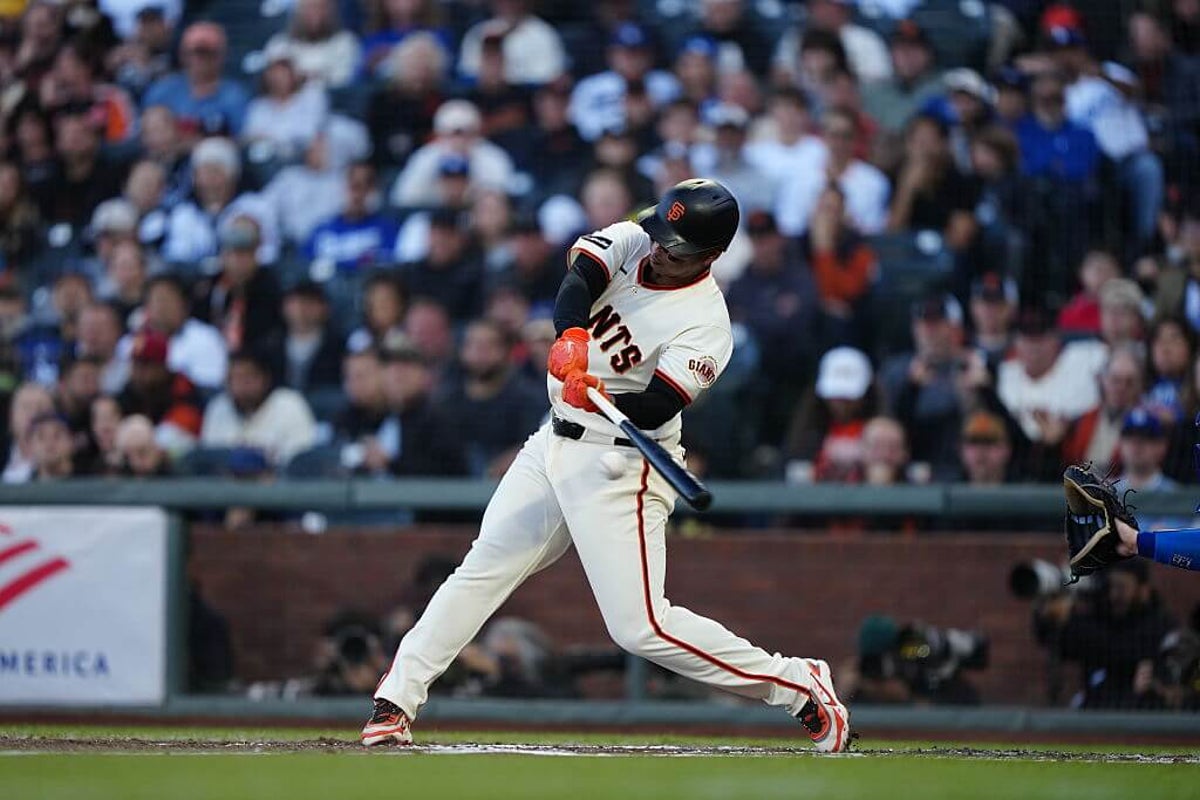
He struck out three times Thursday while the Giants managed just one hit in a 3-0 loss to the Los Angeles Dodgers. His OPS is down to .577. He’s hit just two home runs. Last year, Devers drew a career-high 112 walks. This year, he’s on a pace for 32. You don’t need a sneak peek at the scouting reports to know what opposing teams are thinking. They’re straight-up challenging him with fastballs and he continues to swing through them.
And although the Giants (11-14) have won consecutive series for the first time this season, with their primary run producer in a fog, the team isn’t generating enough offense to climb up the NL West standings. Entering Thursday, their 3.38 runs per game ranked 29th among the 30 major league teams.
Do Giants officials believe that Devers will have his typical numbers at the end of the season? Yes. Are they worried anyway? Also yes.
But Posey made it clear in a recent conversation with The Athletic that he feels just as confident about the biggest and what likely will rank as the most defining bet of his executive tenure.
“It’s hard not to feel that way just based on what he’s done in the past,” Posey said. “I mean, this guy’s been doing it what, eight or nine years now? He’s been one of the best hitters in the game. So he’ll get there. All those years, it’s not like we’re dealing with a small sample size. So yeah, I do feel good about it.”
Even if Posey believed differently, of course, he couldn’t come out and say it. So put it this way: A whole lot of folks at 24 Willie Mays Plaza will feel a lot better if Devers starts sending fastballs over the fence in the near future.
His bat speed hasn’t gone off a cliff, even if it’s declined a bit in each of the past four seasons — from 73.4 mph in 2023 to 72.5 mph in ’24 to 71.6 mph last season to 71.2 mph in a 25-game sample this year. But his fast-swing percentage, which measures how often he swings the bat above 75 mph, has taken a precipitous drop. It was 34.5 percent three seasons ago. It’s down to 15.2 percent this season.
There are several potential explanations for that drop that could have little to do with deteriorating skills. Perhaps Devers is taking more defensive swings than he has in the past. Perhaps he’s not seeing the ball as well. Perhaps something is off in his swing mechanics that’s making him a bit more tentative.
Posey doesn’t see a hitter with eroding skills. He merely sees a hitter who isn’t in a groove.
“I think he’s just a little in between right now,” Posey said. “Maybe a tick late on some heaters, and then a little bit out in front on off-speed. But there’s such a track record that you’re just waiting each day to be like, `Ooh, there it is.’ Put together three or four or five at-bats in a game that looks more like what you’re used to seeing.”
Devers had one of those “ooh” swings Wednesday night when he redirected a 99-mph fastball from Shohei Ohtani for a line drive single to left field. It was one of the few times this season he’s made hard contact on the firmest of fastballs. Devers entered Thursday with a .136 slugging percentage on pitches 95 mph or harder, down from .362 last year and .722 in 2024. Last year, he generated a run value of plus-12 while slugging .512 on four-seam fastballs. This year, it’s minus-2 with a .393 slugging percentage.
In Devers’ last at-bat Tuesday night, Dodgers left-hander Tanner Scott threw him three consecutive 95 mph fastballs down the middle. Devers swung through all three of them.
It’s at-bats like those that might also explain the most significant year-over-year drop in Devers’ production. Last season, he posted a career-best walk rate of 15.4 percent. This year, his 5.3 percent walk rate would be a career worst.
You can’t draw walks when pitchers feel like they can go right after you.
The optimistic view of that dim reality? When Devers is timing up fastballs again, assuming he does, there should be a fat period when he’ll see plenty of them before the league adjusts. Perhaps that’s how some home run hitters develop a reputation for hitting them in bunches.
“Right now, if you’re gonna attack and be more aggressive, the last couple weeks is the time to do it,” Giants manager Tony Vitello said. “When he’s cooking the way he can, that’s when fear is on the mound and guys are more careful and he’s drawing more walks.”
“Sometimes walks and a dangerous hitter go hand in hand, right?” Posey said.
Swinging and missing is a part of Devers’ game even when he’s at his most productive. Last year, he whiffed 456 times. Only Seattle’s Cal Raleigh, who had one of the best offensive seasons by a catcher in major league history, swung and missed at more pitches. What mattered for both hitters was that many of those whiffs came early in counts. They kept taking damage-inflicting swings and often found the barrel.
But so far this season, Devers isn’t inflicting that damage in any count. He’s on pace for 213 strikeouts, which would easily break Bobby Bonds’ franchise record of 189 that has stood since 1970.
For now, Devers is in nothing more than a slump. Not a lost season. And even a lifetime .302 hitter like Posey is familiar with the process of digging out of a downturn to reestablish confidence and timing at the plate. So Posey doesn’t look too deeply into the numbers behind Devers’ current malaise. There’s nothing complicated about the advice he’d give to him, either.
“Less is more,” Posey said. “That’s the first thing that comes to mind for me. I don’t know how Rafi would answer it, but when you’re not going good, it’s not always the same stuff to get back on track. Maybe your front side is coming out. Maybe your back side is collapsing. Maybe you’re starting too late. Maybe it has something to do with your load or your head’s moving too much. That’s why I go to ‘less is more.’ You simplify and a lot of things get cleaned up through that simplification.”
Vitello acknowledged that Devers recently expressed more openness to suggestions from hitting coaches Hunter Mense and Oscar Bernard.
“It starts with him taking some initiative,” Vitello said. “I know Hunter and OB mapped out some things for him and he’s been putting in extra work in the cage. You don’t always get the outcome right away. It’s tough to translate your habits that quickly into the game. But if you just watched that swing to left field (against Ohtani), and don’t even worry about the exit (velocity), it was a it was a pretty swing for any type of hitter. So I’m encouraged by the work and glad it’s kind of showing up in the game as well.”
On the Giants’ three-city road trip that ended over the weekend, Vitello said he saw a hitter who had “a little too much body in the swing sometimes. I know he’s capable of hitting better than he did (on the road trip) but he hit well enough to put something in his basket every day and also had some key moments.”
Devers started the year a little bit behind. He missed time in the spring with a sore hamstring and was limited to designated hitter for the first week of the season out of an abundance of caution. His defense at first base was rough in the first few games but he’s shown improvement in the past two series, just as he did last year while learning the position for the first time. He also is separated from his family, including a newborn son, who is back in the Dominican Republic.
Devers, who turns 30 in October, could be charitably described as stocky but he’s been as durable as anyone in the big leagues over his career. Last year, because of the way the schedule fell when he was traded, Devers became the first major leaguer since Minnesota’s Justin Morneau in 2008 to play 163 games in a season. It’s that durability that allows Posey to feel satisfied with Devers’ conditioning and readiness to begin the season.
“I’m happy with it,” Posey said. “He’s a guy who wants to be out there and play every day. Those are the types of guys we want. He’s getting more and more comfortable at first base. And we can all see him cut it loose at times when he’s running.”
Especially when a reporter approaches his locker. Devers declined to be interviewed for this story. He consistently avoided beat reporters who requested him on the past road trip. He hasn’t given an interview since April 8, when he hit a home run in a home victory over the Philadelphia Phillies. During batting practice Wednesday afternoon, he raced down the dugout stairs past this reporter without stopping, saying he had to go hit in an indoor cage. Less than two minutes later, Devers exited the cage and disappeared back to the clubhouse.
The Giants did not acquire Devers to be a club spokesperson. They have other players like Matt Chapman and Willy Adames to fulfill that obligation. But some accountability should be expected, given the club’s commitment to Devers, his importance to the organization and the fact that he’s under contract through 2033.
For now, Devers isn’t making himself available to answer even softball questions.
In the batter’s box, until something changes, he’ll continue to see harder stuff than that.