
BROAD-BASED GROWTH:
The institute’s president said the upgrade was mainly due to AI-related technologies, which have boosted export and investment prospects
By Crystal Hsu / Staff reporter
Taiwan’s economic outlook has brightened, despite mounting geopolitical risks, as robust demand for artificial intelligence (AI) drives exports and investment, the Taiwan Institute of Economic Research (TIER, 台經院) said yesterday.
The Taipei-based think tank raised its forecast for Taiwan’s GDP growth to 7.56 percent this year, up from the 4.05 percent projected in January, after first-quarter exports and corporate earnings were better than expected.
The upward revision comes even as the IMF and other global institutions have downgraded global growth forecasts amid escalating tensions in the Middle East.
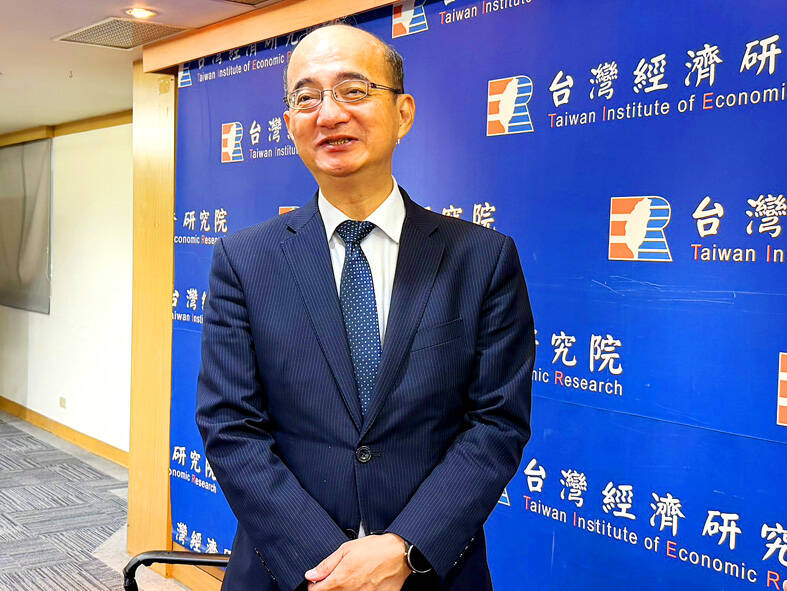
Photo: Lin Chin-hua, Taipei Times
“The upgrade is largely driven by AI-related technologies, which have boosted Taiwan’s export and investment prospects,” TIER president Chang Chien-yi (張建一) told a news conference.
TIER said it expects exports to expand 15.74 percent this year, a significant increase from its previous estimate.
Private investment and consumption are also projected to edge higher, supported in part by stock market gains, it said.
The more upbeat outlook is reinforced by momentum in the semiconductor sector.
Taiwan Semiconductor Manufacturing Co (台積電), the world’s largest contract chipmaker, on Thursday last week raised its revenue forecast for this year and signaled solid order visibility ahead.
The positive guidance points to continued expansion across AI-related supply chains, including servers, memory and other components. That prompted TIER to sharply raise its export projections, particularly for the second half of the year, Chang said.
Taiwan’s growth is also becoming more broad-based. In addition to advanced semiconductors, demand for memory chips and related equipment is increasing, benefiting a wider range of suppliers rather than a single company.
Still, risks remain.
A prolonged conflict in the Middle East could fuel inflation and weigh on global growth, TIER said.
TIER economist Gordon Sun (孫明德) said that a short-lived conflict would have limited impact, but one lasting several months could raise the risk of “stagflation” in the US — a combination of rising prices and slowing growth.
Such a scenario could weaken US consumer spending and prompt major technology firms to scale back investment, slowing the pace of AI development and adoption, Sun said.
Business sentiment was mixed last month, TIER said.
Manufacturers grew more cautious about the next six months, with the business climate index slipping 0.89 points to 95.95, as Middle East tensions weighed on sentiment, it said.
However, most firms expect conditions to remain broadly stable, with concerns centered on geopolitical risks and potential oil price volatility rather than a fundamental demand slowdown, it said.
In contrast, sentiment in the service sector improved, with the index rising to 97.5, supported mainly by gains in the financial and insurance industries, it said.
However, the construction sector remained under pressure.
Its business climate index fell 5.26 points to 91.19, marking a third consecutive monthly decline, as rising energy costs weighed on the industry, TIER said.
Prospective home buyers have largely stayed on the sidelines, anticipating a possible easing of property market curbs, it added.