
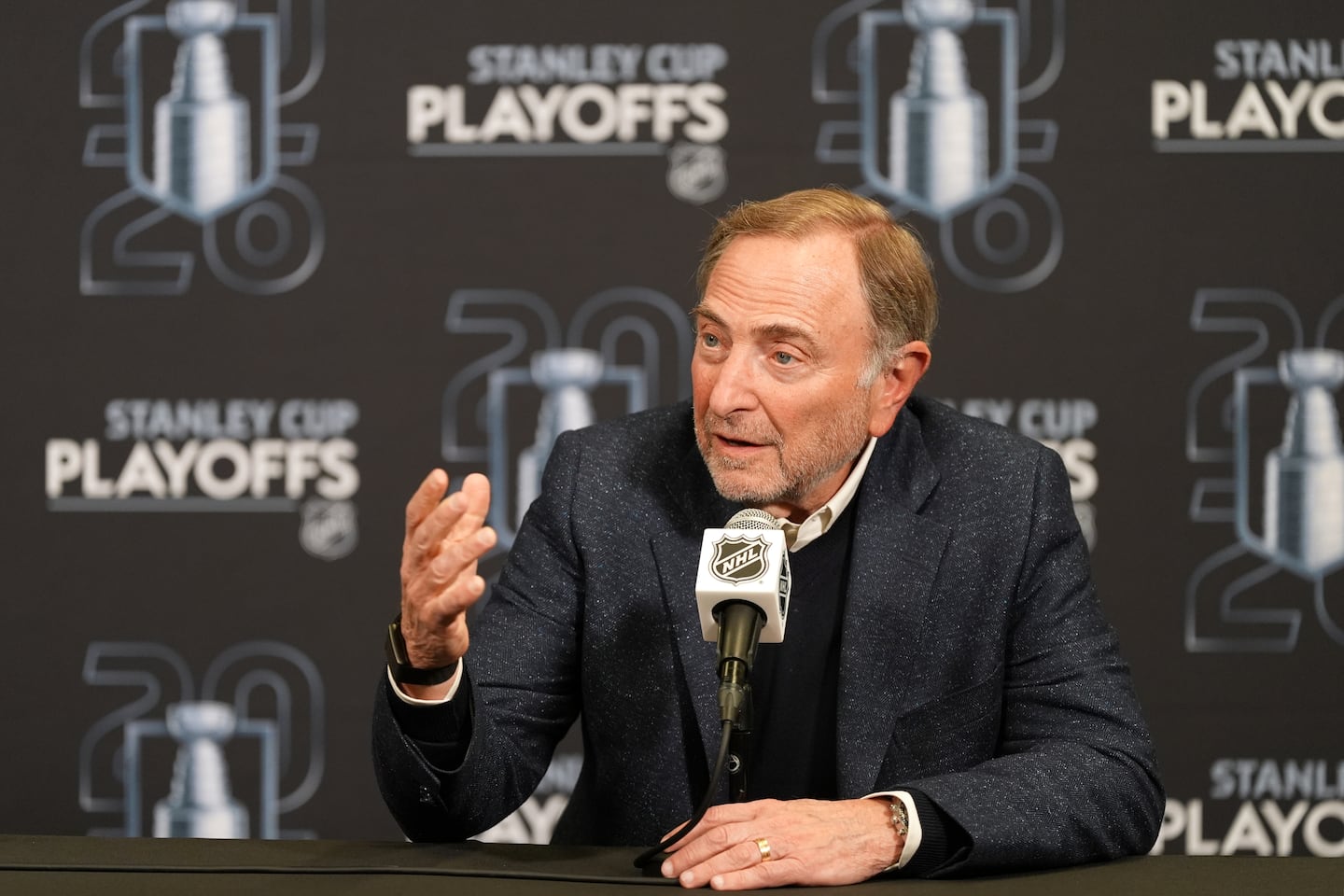
Bettman was referring to betting lines, as opposed to skating trios of a center flanked by two wings. In today’s gambling world, particularly when watching ESPN and TNT broadcasts, it’s often difficult to tell one from the other.
Get Starting Point
A guide through the most important stories of the morning, delivered Monday through Friday.
“We have outside organizations, service providers, that do that for us,” added Bettman, who took over the corner office in February 1993 and will turn 74 on June 2. “I will say I have the utmost confidence in NHL personnel, whether it’s players or supporting staff. But this is something we take very seriously. Players and personnel are briefed and given educational lectures on what is and isn’t appropriate conduct.”
Bettman, speaking in a pregame presser ahead of Game 2 of the Bruins-Sabres series, was accompanied to KeyBank Center by Jared Maples, a league senior executive vice president and its chief security officer. Offered the chance by Bettman to add anything to the commish’s comments, Maples polite declined.
“Thanks, good answer,” Bettman said kiddingly, before adding, “This is of the utmost priority, tracking and making sure there’s no concerns about the integrity of what’s taking place in our game. And when you look at our game, and the way it plays, it’s not like some of the other games — it’s not so easy for people to be tampering with it. But that aside, we don’t take it for granted.
“We monitor proactively, constantly.”
All sports, of course, are vulnerable to fixers and cheats. (See above: greed, avarice.)
Hockey may be a slightly different animal, simply due to the fact it’s an industry built around a frozen six-ounce chunk of bouncing vulcanized rubber, and therefore a difficult bet. But only a fool would believe it’s impervious to someone looking to tilt the ice surface and make off with a load of dough stuffed in the big box of the Zamboni. Start the car!
As notorious gamblers Adam and Eve are believed to have said, “I mean, it’s hockey, who’s gonna notice if we cheat just … this … once?”
Meanwhile, on the ever-ongoing question of expansion, Bettman offered nothing — in terms of timeline or landing spots — for possibly adding to the Original 32.
Rumors persist that the next two cities will be Houston and yet another foray to Atlanta, where the Flames and Thrashers both failed, ultimately picking up stakes for moves to Canada.
“I am not under any mandate from owners to pursue expansion,” Bettman said when the question was raised by the Globe, later adding, “We are not pushing for it.”
Vegas, the 31st team, paid a $500 million expansion fee in 2017, followed by Seattle in ′21, which ponied up $650 million.
Bettman said a fee “substantially more than one billion” would be charged in the next round, if it happens. He said in November that the buy-in fee would be north of $2 billion.
Anaheim and Florida paid $50 million each to come aboard in 1993, the year of Bettman’s arrival, a time when the league was operated and marketed much like it was in Original Six Days. An expansion fee of $2 billion would represent a 40-fold jump in price in 30-plus years.
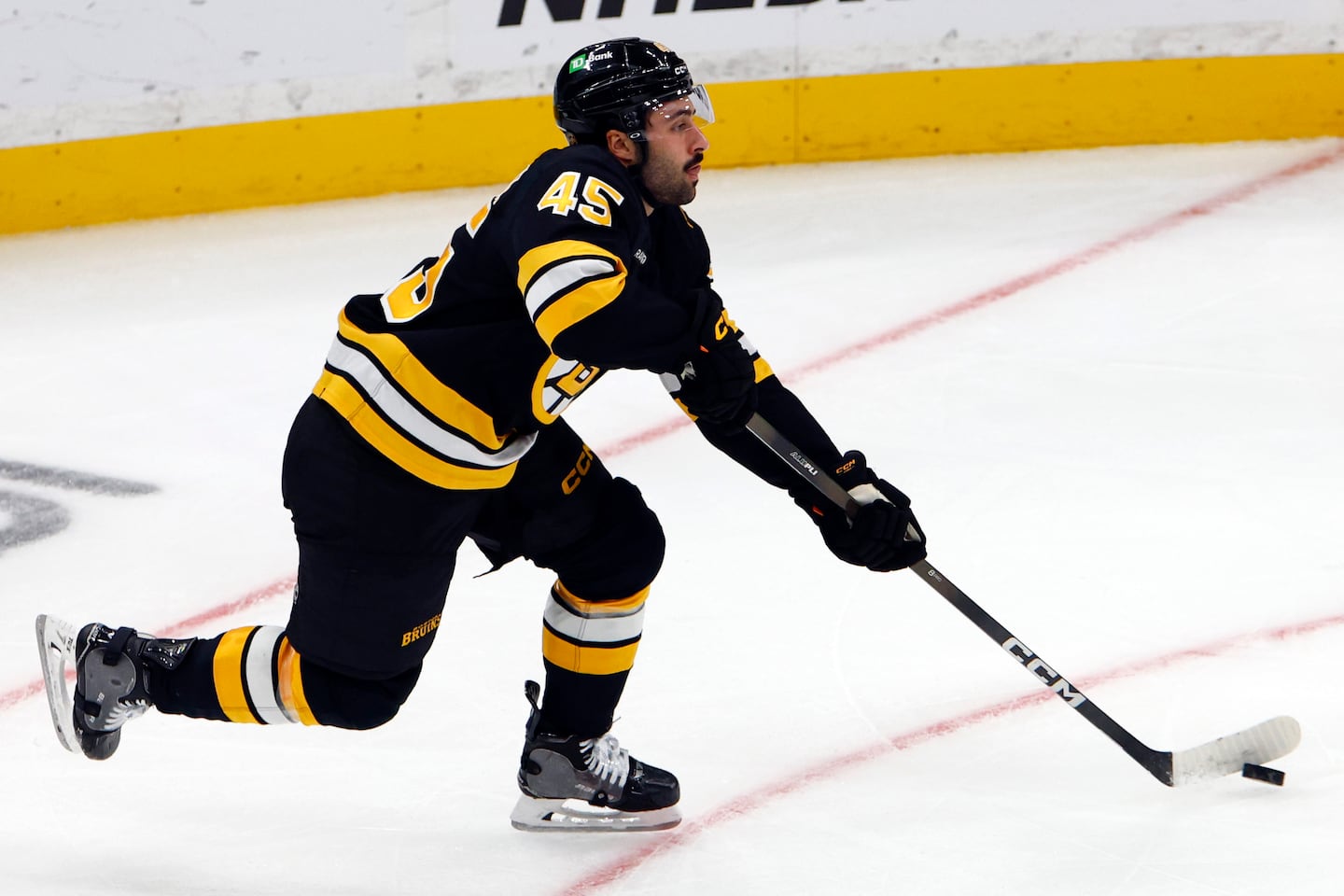 After six seasons stuck in the AHL, Jonathan Aspirot has become not just a regular on the Bruins blueline, but the perfect pair to top defenseman Charlie McAvoy. Danielle Parhizkaran/Globe Staff
WHAT A STORY
Aspirot makes most of journey, man
The steady, dependable, efficient Jonathan Aspirot played six years in the American Hockey League, wondering if there’d ever be days like this. A career journeyman offered a chance here last summer, he has become a solid fit on the Boston backline, most nights on the No. 1 pairing aside Charlie McAvoy.
Per coach Marco Sturm, the 26-year-old Aspirot is a prime example of a player whose game is a better fit in the NHL than in the minor pros. The reason?
“Very simple,” said the Bruins coach, who spent three years coaching the AHL Ontario Reign before taking over the Boston bench. “There’s guys — and Aspi’s one of ’em, and another was [Jacob] Moverare in LA — for example … when they have time, and they have time in the AHL, that’s where they get in trouble, actually.”
The slightly slower place of play in the AHL, explained Sturm, has a way of steering players off their career path. Rather than stick to the basics, they view the extra time with the puck as a way to expand their on-ice duties — and, in turn, their effectiveness diminishes, and their path to the NHL gets lost.
“They want to make plays because they have time,” mused Sturm. “They want to skate with the puck. They want to to do a lot of things. They want to get points. They want to be involved in the offensive zone. They want to do it all. Because they feel like they have more in them. Well, it’s normal … they feel like, ‘OK, I know I have more to show, so now I’ve just got to show them by doing all this on the ice.’
“The problem is, that’s where a lot of players get in trouble. And Aspi was one of ’em. I [coached] against him, and the more time he had, the more he struggled.”
The faster, tighter NHL doesn’t allow such mental meanderings. Its increased tempo demands players to narrow expectations, and be in read-and-react mode.
“That’s not [true] of everyone, but [Aspirot] is one of them,” noted Sturm. “We always talk about closing and playing D-zone and being smart about it, but also keep things simple. Play fast and don’t play with the puck. It actually goes to his favor. That’s why he and some other guys have more success here than the AHL.”
The Bruins signed Aspirot to a two-way deal in last July’s free agent market. Impressed by his early performance, they secured him in January with a two-year, one-way extension that carries an average-annual value of $887,500.
“It’s just been really fun playing with him,” said McAvoy, “and really, I think we’ve played great hockey together all year long. Just so many amazing things for him. I’m really happy for him.
“Now he’s getting to experience playoff hockey and he’s really amazing. You see him finally get a chance to play in the NHL and he does great. It’s a very feel-good story for a guy to continue to believe in himself, to get an opportunity and prove everybody wrong.”
A Quebec kid, Aspirot was drafted in the Quebec Maritimes Junior Hockey League as a defenseman but also played as a forward for a portion of his three seasons with Moncton before turning pro with AHL Belleville in 2019. He signed as a free agent with the Flames in 2024, and spent two seasons with the AHL Wranglers, where coach Trent Cull sometimes used him as a winger.
“It’s different, a different game, and I didn’t mind it,” said Aspirot, reflecting on his time playing along the wall. “It’s a nice experience to kind of see the game the way they do. It wasn’t my game, so to say, but I just tried to keep it simple, go in on the forecheck, and create room for the guys.”
His life in Black and Gold has been exclusively on the blue line. He is rarely, if ever, out of position, reads well off McAvoy on his right side and, to Sturm’s point, remains steadfastly on task.
“I’m just super happy to have the role that I have,” said Aspirot, “and it’s great.”
 Coming off his first 30-goal regular season, and then potting a power-play hat trick to open the playoffs, Juraj Slafkovsky sure looks like a fabulous pick by the Canadians atop the 2022 NHL draft.Derik Hamilton/Associated Press
ETC.
That pick sure was right one
It became clear well before this year’s playoffs that the Canadiens made the correct move, though a difficult one, eschewing conventional wisdom and opting not to take highly touted Shane Wright with the No. 1 pick in the 2022 draft and instead selecting Slovak winger Juraj Slafkovsky.
The 22-year-old Slafkovsky drove home that point yet again, and emphatically, in the Game 1 opener against Tampa Bay, when he collected three power-play goals, the final one in overtime for a 4-3 victory. He became only the 12th player in NHL history to score three times on the advantage in a playoff game.
The 6-foot-3-inch, 225-pounder completed the trick Sunday when he snapped the winner by Lighting goaltender Andrei Vasilevskiy 1:22 into the extra session. He was the first to hit for the all-PPG trick since Chicago’s Jonathan Toews in 2010 against Vancouver on the Blackhawks’ road to the Stanley Cup.
Bruins Phil Esposito (1969 vs. Toronto) and John Bucyk (’74 vs. Chicago) were the third and fourth to make the list, following Detroit’s Syd Howe (’39) and Toronto’s Sid Smith (’49).
Following Bucyk, Islanders Hall of Famer Denis Potvin did it in 1981 against Edmonton. Potvin remains the lone defenseman to do it. Rounding out the list: Flyers beast Tim Kerr, Oilers legend Jari Kurri, former US Olympian Mark Johnson for the Devils, Dino Ciccarelli twice for Detroit, and Colorado’s Valeri Kamensky.
Esposito recorded his as part of a four-goal bounty the night of the historic 10-0 shellacking of the Maple Leafs at the Garden on April 2, 1969 — the same series ex-Bruin Forbes Kennedy fought everyone but the Zamboni driver in what turned out to be the final game of his career. Espo scored two on Johnny Bower and one on Bruce Gamble.
Bucyk scored his three on Tony Esposito and the Black Hawks in an 8-6 win at the Garden, April 21, 1974. The Bruins rubbed out the Black Hawks in six games in the Cup semis prior to falling to Bobby Clarke and Philadelphia’s Broad Street Bullies in the Final in six games.
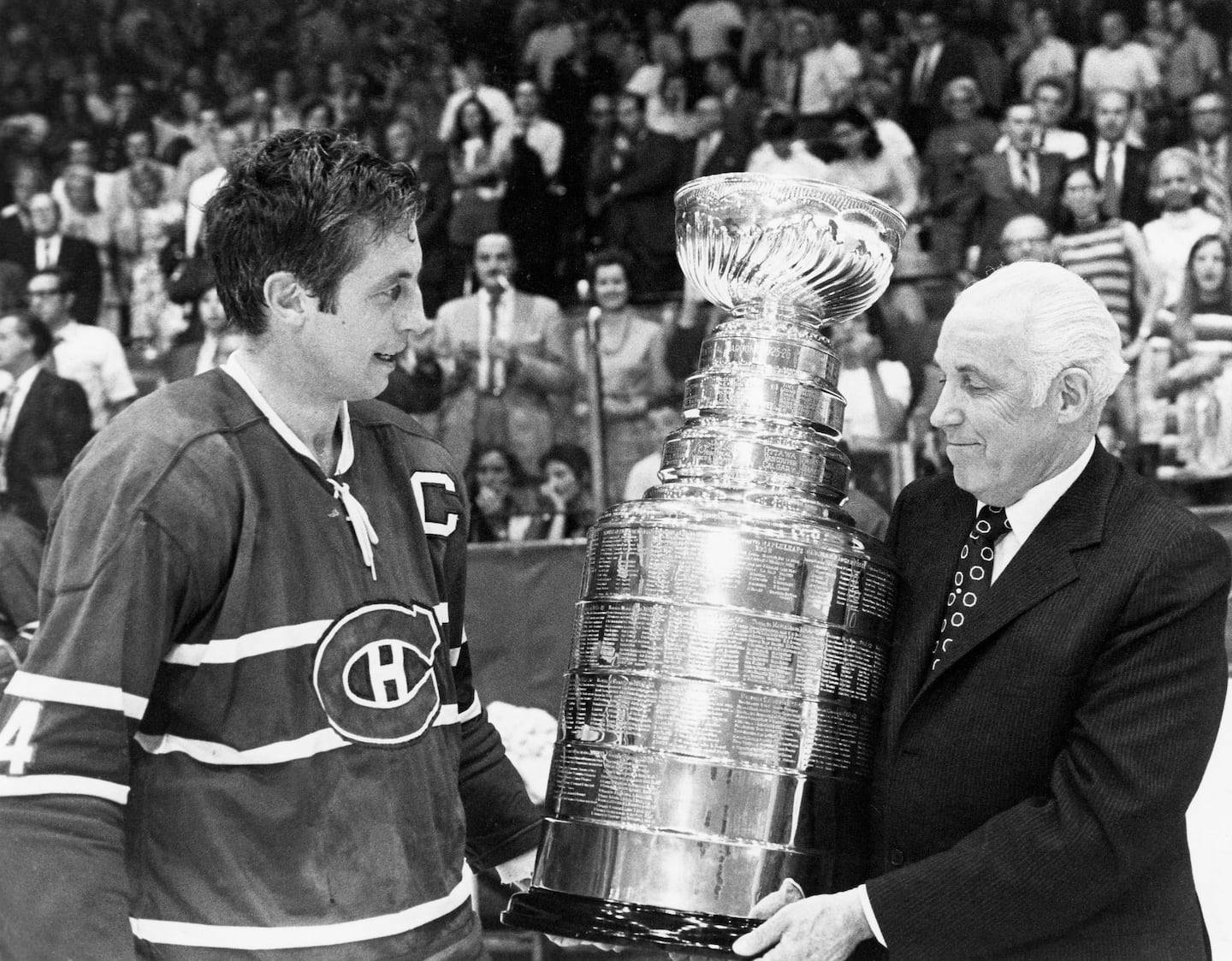 The Gentleman of the Forum, legendary Canadiens captain Jean Beliveau, accepts his 10th and final Stanley Cup from NHL commissioner Clarence Campbell after beating Chicago in seven games in 1971. AP
Montreal legend Jean Beliveau, though he never scored three power-play goals in a playoff game, forced the NHL rule book to be rewritten when he scored three times against the Bruins in a span of 44 seconds, all on the same power play, in a regular-season game on Nov. 5, 1955.
The great “Le Gros Bill,” age 24 at the time, knocked all three by Terry Sawchuk, who then was at the start of a brief, two-year tour with the Bruins. Upon the completion of the season, the Original Six franchises acted quickly to amend the rule around power plays to what it is today — play resumes at full strength or, if it’s a two-man advantage, one player is released from the penalty box.
On that night at the Forum, Bruins defenseman Hal Laycoe, a former Canadien, was whistled for hooking just 17 seconds into the second period. Beliveau then put on his show, with all three of his tallies assisted by Bert Olmstead, at 0:42, 1:08, and 1:26. Laycoe popped out of the box (canine cone of shame around his neck) at 2:17 with the Canadiens holding a 3-2 lead. The Canadiens won, 4-2, with Beliveau scoring once more at even strength.
Upon season’s end, the teams voted, 5-1, in favor of the rule change. The dissenting franchise? Hint: the one that kept Beliveau on the payroll through the spring of ’71, after he scored another 136 man-up tallies under the new rule and captured his 10th and final Stanley Cup.
On June 10, 1957, the Bruins dealt Sawchuk back to Detroit for cash and a 22-year-old left winger named John Bucyk, who at that time had but 11 goals and 104 games on his NHL resume. To date, it remains the only one-for-one deal in NHL history to include two Hall of Famers.
Bucyk wore Black and Gold for nearly a quarter century and finished with 556 goals and 1,369 points. Sawchuk, plagued by depression and alcoholism, wrapped up his storied career (445 wins, four Cup titles) with the Rangers in the spring of 1970. He died on May 31, 1970, three weeks after Bucyk and the Bruins won the Cup, from injuries he sustained in a drunken scuffle with Rangers teammate Ron Stewart.
Per reports at the time, Sawchuk and Stewart belted it out at season’s end, arguing over how to divvy up expenses at the Long Island rental they lived in during the season. Sawchuk died, age 40, following surgeries to repair gallbladder and liver damage sustained the fight.
Stewart, a former Bruins center, was exonerated by a grand jury and played three more seasons. He finished with 1,353 career games over 21 seasons with six teams and died, age 79, in 2012.
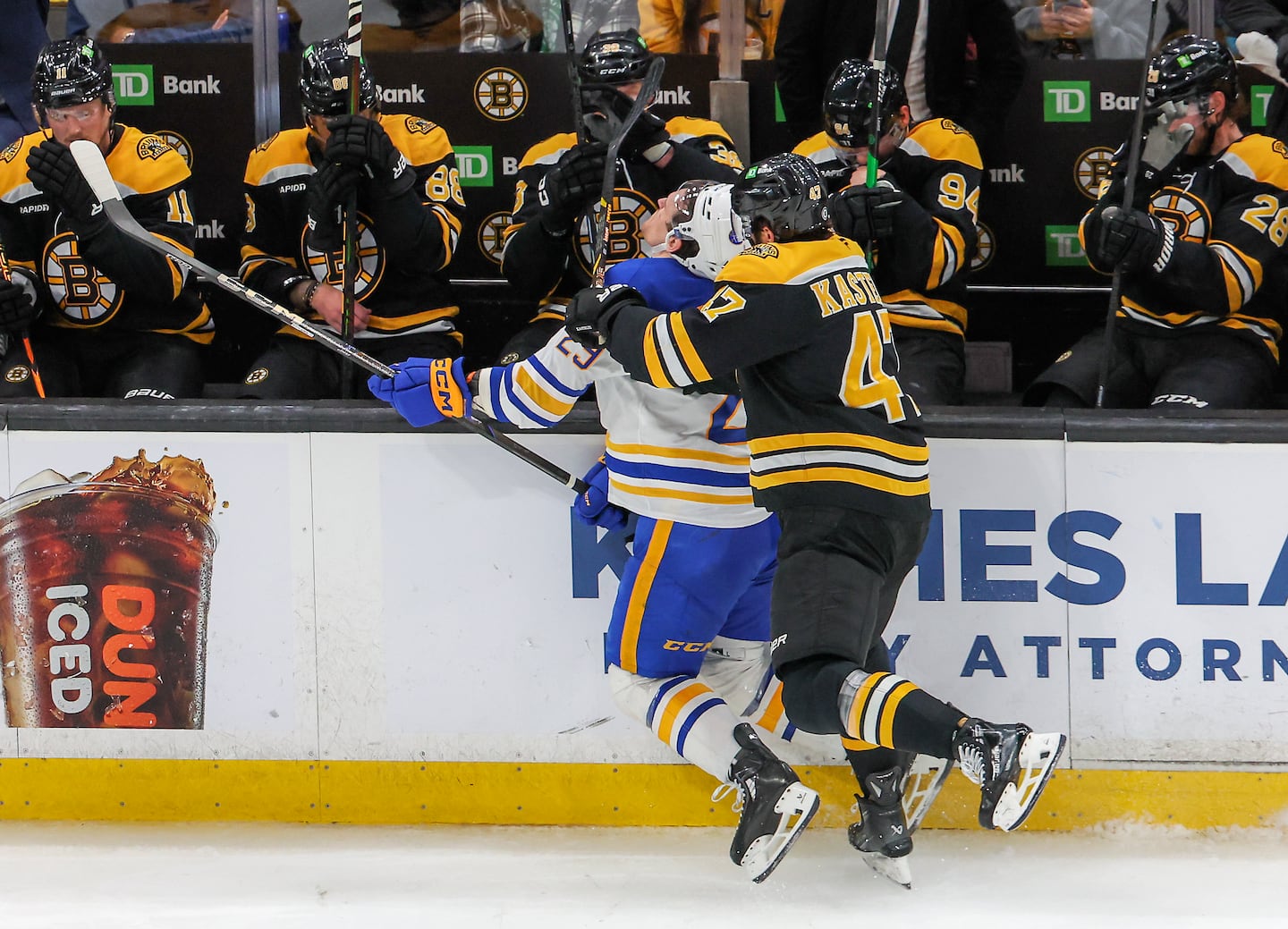 Bruins big-hitter Mark Kastelic (right) and Sabres tough-guy Beck Malenstyn were junior teammates as teenagers, but now they’re battling head-to-head in the playoffs. Matthew J. Lee/Globe Staff
Bruins fourth-line stalwart Mark Kastelic grew up in Arizona and was 16 years old, away from home for the first time, upon beginning his junior career with the Western Hockey League’s Calgary Hitmen in the fall of 2015.
One of the Hitmen vets at the time was Beck Malenstyn, who was yet to turn 18 upon Kastelic’s arrival in southern Alberta. A western Canadian kid from British Columbia, Malenstyn was in his second WHL season, knew the ropes a little bit and, unlike Kastelic, had a driver’s license and access to a car.
“Been a while … good memories,” mused Kastelic, who is facing Malenstyn, the Sabres’ leading hitter this season, in their first-round playoff matchup that will bring them together on Garden ice Sunday for Game 4.
“He was a great mentor to me. You could tell, he was a really good leader. He was only a year older than me, but I felt he took me under his wing a little bit, drove me around sometimes, all that stuff.”
A decade-plus later, they now have faced each other three times in this year’s postseason, focused on trying to win a Cup title for their respective clubs.
Though spending any mental energy on that long-ago connection “is pretty much out the window now,” said Kastelic, it’s satisfying to think they both succeed in fulfilling their dreams to reach the NHL.
“Pretty crazy,” said Kastelic, reflecting on their path to the show. “I’d like to think you could always see the potential for it. I always had belief in myself. You could tell, too, he was a great player when we were there, highly touted, so it doesn’t surprise me he got to where he is now. Because he’s such a hard worker, too. And for myself, I’ve worked hard similarly, so maybe it doesn’t surprise me … but it’s cool to think we are where we are now.”
Malenstyn was acquired from the Capitals by then Sabres GM Kevyn Adams in June 2024 to bring some weight and physical presence to a fairly young, inexperienced forward corps. He led the Sabres this season with 282 hits, fifth in the league, and second only to the Wild’s Yakov Trenin (413) among players who qualified for the playoffs.
Kevin Paul Dupont can be reached at kevin.dupont@globe.com.