

In the strange world of quantum physics, some effects are not just hard to control—they are completely hidden. These so-called dark modes quietly sit inside quantum systems, refusing to interact with external signals and, worse, shutting down the very behaviors scientists want to harness.
Now, a new study from researchers at Japan’s RIKEN Center for Quantum Computing presents a clever way to overcome this problem. By briefly turning these invisible modes visible, they have unlocked a path to control elusive quantum effects that were previously out of reach.
Our “study maps a general path towards generating a profoundly different topological quantum resource with immunity against both dark modes and dark states,” the study authors note.
This development could transform how future quantum devices store and transmit information, especially in systems that deal with light and sound at the smallest scales.
The dilemma due to dark modes
To understand the breakthrough, it is important to know the setting. The researchers were working with non-Hermitian systems—a class of quantum systems that can exchange energy with their surroundings.
These systems have become a hot topic because they can host unusual topological effects. In simple terms, topology here refers to properties that remain stable even when a system is slightly disturbed, making them attractive for robust quantum technologies.
In such systems, particles like photons (light) or phonons (vibrations of sound) can be guided in controlled ways—for example, forced to move only in one direction.
“Topological operations allow for various weird and fascinating phenomena, such as the buildup of chiral phases and the movement of phonons in one direction,” Franco Nori, one of the study authors and a scientist at RIKEN, explained.
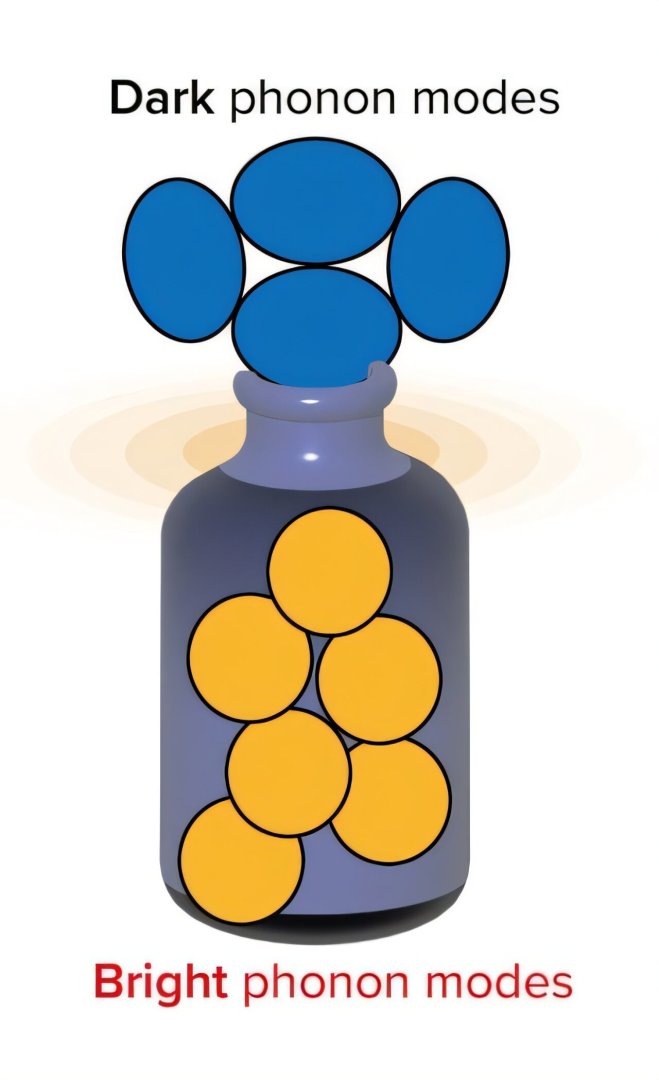 An illustration of a quantum system with the two phonon modes. Source: RIKEN Center for Quantum Computing
However, there’s a catch. Quantum systems don’t just have one mode of motion or excitation—they have many. Some of these are bright modes, which interact with external signals and can be controlled.
Others are dark modes, which are completely decoupled. They don’t respond to the driving field at all—almost like hidden gears in a machine that you cannot touch.
These dark modes create a serious problem. When they are present, “both conversion between different modes and the topological transfer of phonons break down, and these effects can’t be restored by the usual measures,” Nori explained.
This means no controlled transfer of energy, no directional motion, and no useful quantum operations. Traditional fixes—like tweaking the system’s parameters—don’t work because the dark modes remain fundamentally disconnected.
The way to outsmart dark modes
The RIKEN team took a different approach. Instead of trying to eliminate dark modes, they decided to reprogram them. They introduced carefully designed artificial quantum information into the system.
While the term sounds abstract, the idea is straightforward. They added specific quantum inputs that change how different modes interact. This engineering effectively forces dark modes to temporarily couple with the system—turning them into bright modes.
Once this happens, the previously blocked topological effects come back to life. Phonons can once again move in controlled ways, and different modes can exchange energy as intended. Crucially, this transformation is not random—it is precise and controllable.
“We were thrilled. Such engineered transitions make topological operations possible–something which was previously inaccessible due to dark modes,” Deng-Gao Lai, one of the study authors and a postdoc researcher at RIKEN, said
What surprised the researchers most was how robust the method turned out to be. Even under conditions where they expected the system to fail, the engineered transitions held strong. This suggests the approach is not just a theory but something that could work in real devices.
“Our work paves the way for constructing scalable quantum devices and discovering novel topological phenomena,” Lai said.
The study is published in the journal Nature Communications.
Rupendra Brahambhatt is an experienced writer, researcher, journalist, and filmmaker. With a B.Sc (Hons.) in Science and PGJMC in Mass Communications, he has been actively working with some of the most innovative brands, news agencies, digital magazines, documentary filmmakers, and nonprofits from different parts of the globe. As an author, he works with a vision to bring forward the right information and encourage a constructive mindset among the masses.